
About us
Last updated: August 4, 2026.
Since 2001, the UK Rivers Network (UKRN) has been helping to protect rivers and inland waters across England, Ireland, Northern Ireland, Scotland, and Wales by promoting community-based environmental projects and campaigns.
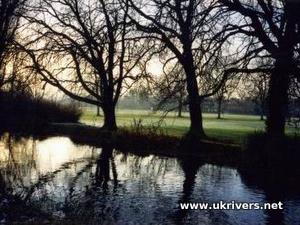
Photo: River Itchen watermeadows, Winchester, Hampshire.
What's it all about?
The UK Rivers Network is based on a really simple idea: We encourage people to get actively involved with projects and campaigns that help to protect their local rivers and inland waters. We think ordinary members of the local community—and not faceless bureaucrats sitting in offices miles away—have to be at the heart of protecting the local environment. Why do we want to protect rivers? Because everyone loves them and they're important. We don't champion rivers on behalf of any special interest group or activity; we don't want to protect rivers so we can fish them or paddle canoes along them (both of which are fine, incidentally), but because the river environment and its biodiversity is worth protecting for its own sake.
The UK Rivers Network is a simple, very informal network of people who believe in this ideal. And that's it! We don't have a formal membership; you don't have to sign anything or pay anything to belong. If you like what we stand for and follow what we do, you're part of the network. Simple as that. Think of us as a free club you can go to when you feel like it—or a magazine you can dip into when you want. Or not. It's as relaxed as that.
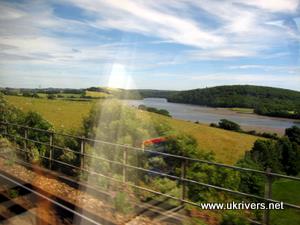
Photo: This is how many of us see rivers: in a magical glimpse—fleetingly, tantalisingly, from a distance, in a train or a car. Why not get up close and help rivers like this to thrive? This is the River Tamar seen from the Cornish mainline railway.
Although we're a fully constituted organization, we don't believe in offices and committees, "CEOs", "executive directors", or any of the bureaucratic baggage that seems to go with running a modern eco-group. We just get on with it, quietly. We work informally; like a river, we're guided along a fairly well-defined course by our objectives, but we flow and change all the time so we (hopefully) never stagnate. Sometimes we run active campaigns; sometimes we don't. For those who find this kind of thing too vague and relaxed, there are gazillions of other groups you can join with much more order and structure.
Obviously there are drawbacks to working in this way, but the big advantage is that it allows us to maintain complete independence and integrity: we don't have to compromise. We work on a shoestring budget that's small enough for us to fund ourselves. We don't (and don't need to) compete for funding with other NGOs; nor do we need to go cap in hand to dubious companies for financial support. Since we don't solicit or accept money from government sources, we can be freely critical of government policy with no risk of hypocrisy. Because we're not a charity, we're free to campaign politically and, when necessary, to support the kind of peaceful but effective direct-action protests that make mainstream green groups distinctly uncomfortable.
Our objectives

UKRN's objectives fall under four broad headings: campaigning, networking and community work, education, and (to a lesser extent) policy. We've been active in every one of these areas, on and off, for over two decades.
Campaigning
- Defend, protect, and conserve UK rivers from various kinds of threats (e.g. major developments of various kinds, pollution, etc.).
- Adopt a variety of campaigning techniques from attending public inquiries to supporting peaceful protests.
- Help local groups by putting campaigners in touch with experts or others who have fought and won similar campaigns elsewhere.
Networking and community work
- Promote grassroots, community-centred projects for river restoration and regeneration. For example, helping local communities to "Adopt-a-river".
- Promote a "positive river culture": Help to shift the mindset of river activism from "defending against the negative" to "protecting the positive". For example, using rivers as the focus of environmental education activities in a local community, or using a river that has fought off a development threat (or been restored by a local community group) as an educational, recreational, or sustainable tourism resource.
- Get together with other groups and individuals to share experiences, expertise, and support, and cooperate on joint projects.
- Act as an informal information interchange for the UK rivers community.
- Act as a UK contact for international campaigns that concern the UK people or its government.
Education
- Maintain our popular website and continue to provide regularly updated UK river news.
- Extend our educational coverage to make connections between a range of environmental problems and solutions (for example, between cleaner rivers and organic farming).
- Help to communicate information of mutual interest between local community groups and the wider community.
Policy
- Help to communicate policy issues to the wider river community through our website.
Despite our name, the UK Rivers Network is not just interested in rivers. We get involved in all aspects of the freshwater environment, including canals, lakes, estuaries, ponds, and wetlands. We're interested in ecological protection, recreational uses of water (fishing, bathing, paddling, river and lake swimming, and other watersports involving inland waterways), water quality issues, flood defence, impacts of climate change, implications of new national and European legislation/policy, river regeneration projects, developments that adversely affect rivers or groundwater, water pollution, and so on.
Our approach
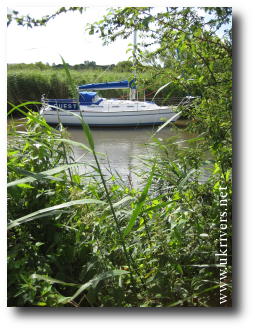
Photo: A yacht moored on the banks of the River Frome, Wareham, Dorset.
Think positive!
"Campaigning against the negative" is only one part of saving the environment and only one part of what we want to achieve through the UKRN. An equally important part is promoting positive action for river protection, restoration, and regeneration, particularly through community initiatives.
In the United States, there is a notable culture of community involvement in river protection. Throughout the country, community groups, councils, and voluntary bodies work together on river improvement projects. One of the UKRN's major objectives will be to try to promote similar schemes in the UK—to get ordinary people involved in protecting rivers as a community resource rather than leaving that responsibility to government agencies, local councils, or other "official" bodies.
Adopt-a-river
Some parts of the US operate "adopt-a-river" and "adopt-a-stream" campaigns —some adopt whole river basins—and we'd like to work with local communities to set up similar initiatives here in the UK. We would like to be in the position where we can stop inappropriate river developments and long-term deterioration of rivers not through hastily organized campaigns or protests, but because of a well-established, positive culture of community river protection in the UK. And if you have any ideas or you'd like to adopt your own river or stream, take a look at our (slighty dated) guide Adopting a river: How to get out, get dirty, and make a difference! or, better still, River Action's much more up-to-date River Rescue Kit.
With all due respect
We know many groups and individuals have been working on river protection, conservation, and restoration in the UK for many years and we are very keen to learn from and share that wealth of experience. We're not interested in empire-building or reinventing wheels. Our mission is simply to help improve UK and Irish rivers by encouraging more ordinary, local people to get involved with groups, projects, campaigns, and events in their local areas (or, indeed, to set up their own). We believe ordinary people and local communities must ultimately be at the center of any successful effort to protect the environment.
Our history
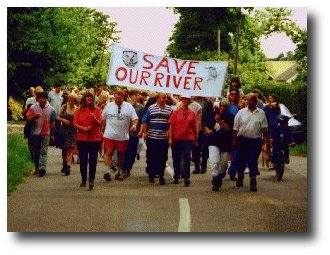
Photo: Teigngrace river campaign, Devon, 1997.
The UK Rivers Network originally grew out of a successful 1997 campaign and 1998 public inquiry to prevent the diversion of the rivers Teign and Bovey to make way for an expanded clay quarry in the village of Teigngrace, Devon. The notable thing about that campaign was that every official body and process had failed the rivers and the local community who loved them. Devon County Council had vigorously supported the plan and the Environment Agency had casually rubber-stamped it (failing to notice a massive potential flood risk that our own hydrological experts uncovered very late in the day), even though the overwhelming majority of local people bitterly opposed it. What stopped the plan was a physical occupation of the site, followed by a determined local campaign, energetic government lobbying, and a well-fought public inquiry with environmental activists, local people, and expert lawyers working as a superb team.
One of the things we noticed during this campaign was the difficulty in building a strong alliance of campaign groups to prevent damage to threatened rivers: lots of groups will rally around a threatened SSSI, AONB, rare species, or archaeological site, but no-one really looks out for rivers in quite the same way. People simply assume rivers can look after themselves. We'd found similar problems working on the Newbury bypass campaign, where two internationally important rivers were largely forgotten in the battle to defend other, no less important parts of the environment.
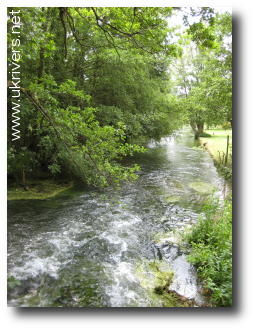
Photo: Rivers just the way we like them: the River Test, Mottisfont, Hampshire.
After we won the public inquiry at Teigngrace in 1998, the idea of setting up a wider rivers network was suggested to us by Phil Williams, founder and former President of the International Rivers Network (IRN) and we remain very grateful to Phil for his support and encouragement over the last few years. After a certain amount of debate and consultation, UKRN was finally born in summer 1999 (our website followed soon after) and formally constituted in spring 2001. We held our first (somewhat shambolic) national conference in Salisbury in September 2001.
After working intensively on a number of campaigns between 2001 and 2004, including the A303 Stonehenge tunnel campaign (as founder members of the Stonehenge Alliance), we ran out of steam and temporarily ceased our operations during 2005. We returned in 2006, with a new injection of funding and enthusiasm.
In 2009, we started the process of decentralizing the network and turning it over to anyone who wants to contribute. Our current focus is to improve the way the website works as a loose information interchange for the UK rivers community.
In 2013, we put the project aside for a decade-long hiatus while we worked on other other things.
In 2024, with renewed public interest in river issues, we dusted off and fully updated the website... and the network became active once again!
Copyright etc.
Our copyright

Any words or images created by the UK Rivers Network are published on this site under a Creative Commons License and you're very welcome to reuse them elsewhere under the terms of the licence. Please note that this applies only to photos and text created by the UK Rivers Network and not to material from other sources, or kindly created for us by other people, which may be subject to copyright.
Contact us?
You'll find current contact details for us here.
If you need to report a pollution emergency, we're not the people to call; instead, please contact one of the following organizations immediately:
England
Contact the Environment Agency.
Wales
Contact Cyfoeth Naturiol Cymru/Natural Resources Wales.
Scotland
Contact the Scottish Environmental Protection Agency.
Ireland
Contact your local authority or the Environmental Protection Agency for Ireland.
Northern Ireland
Contact your local authority or the Northern Ireland Environment Agency.
Website privacy policy
Please see our privacy policy page.