
News stories from 2026
Last updated: 18 October 2026.
Since newspapers are constantly rearranging their archives, some of the links on this page may now be broken. If you're interested in a particular story and you can't reach it from the link here, try copying the title of the story and pasting it into your favourite search engine.
Please note that the newest news stories are on our home page.
- 10 October 2026: Celebrating World Migratory Bird Day this October!: World Migratory Bird Day is celebrated worldwide, twice a year, in May and October. These mark the twice-yearly movements of millions of birds, as they move between their breeding and wintering grounds in spring and autumn. RSPB explains why this is such a milestone in the UK, where about half of all our bird species migrate.
- 10 October 2026: Free festival invites Norwich to discover the city's rivers this October half term: A brand-new festival, "Where the River Meets Us", will bring six days of activities to riverside and neighbourhood locations across Norwich from Monday 26 to Saturday 31 October. The programme invites residents to experience the city's rivers in new ways, from wildlife walks, following live music along the riverbank and discovering archive films beside the Wensum, to looking for bats, joining family storytelling and contributing to a community poem.
- 10 October 2026: River Severn sewage spills will take years to tackle: Reducing the number of sewage discharges into the River Severn will take time, say water company bosses. Meanwhile, local councillors are demanding action on a problem that's happening far too often.
- 9 October 2026: Government's "reckless" Environmental Delivery Plan risks more sewage in rivers, warns WildFish: Environmental Delivery Plans (EDPs) are a new proposed scheme by the government to help developers "tackle" pollution when building new homes. Under the EDPs, developers effectively pay money into a Natural England kitty, which can then fund environmental protection projects. The government calls the plans, drafted by Natural England under the Nature Restoration Fund, a "win-win approach to housebuilding and nature restoration", which can deliver healthier wetlands and waterways alongside new housing developments. But WildFish is concerned that the EDP scheme sets up a worrying pay-to-pollute system, one where developers can simply pay a fee to push through or speed up their development plans. The scheme will result in current environmental protections being lifted, such as developments around rivers where nutrients are a problem, after cash is paid by developers.
- 9 October 2026: Wildlife Trusts also take aim at EDP: Matthew Browne, head of public affairs at The Wildlife Trusts, said: "In a time of stark nature loss, The Planning and Infrastructure Act's approach to environmental protection - substitution rather than an avoidance of harm – could set us on a dangerous path towards further environmental decline. With developers now required to show weaker, more generalised 'overall improvements', the Act has opened the door to environmental harm being allegedly cancelled out by wider benefits. As a result, this first Starmer-legacy Environmental Delivery Plan (EDP) risks being just as we and others warned: specific and significant harms being traded for general, speculative benefits.
- 9 October 2026: Three new faces for the Great Yorkshire Rivers project: Great Yorkshire Rivers (GYR) has made three full-time appointments to help the organisation in the delivery of its mission to to remove artificial barriers that prevent fish moving freely through Yorkshire's rivers and reaching important breeding habitats.
- 9 October 2026: Two-year project to install eel screens begins: An £11.8m project to install screens to help eels safely navigate a river has begun. The screens will be placed at Barrasford raw pumping station on the River North Tyne in Northumberland over the next two years and are designed to prevent European eels from entering the station workings.
- 9 October 2026: [£££] Feargal Sharkey, patron saint of rivers: Patrick Galbraith celebrates the one-man clean-river campaign in this month's Critic (requires subscription).
- 9 October 2026: Water companies take at least £1.4 billion from industrial waste in six years: Companies reported nearly £340 million in the latest year alone for accepting industrial wastewater, but the true figure is likely to be higher because one water company (South West Water) refused to disclose their trade-effluent revenues on commercial-sensitivity grounds. Water companies have reported at least £1.4 billion in trade-effluent revenue over the past six years, including £336 million in 2025/26, according to a major investigation by Watershed Investigations and River Action, first reported in The Guardian.
- 8 October 2026: SAS: Sewage spills not recorded on time, report claims: Campaigners claim South West Water failed to report more than 3,000 sewage discharges within the legally required time of an hour, in the first half of this year. In its annual report into water quality Surfers Against Sewage said the water firm's sewage spills during dry weather last more than 12,000 hours.
- 8 October 2026: Mercury has long sickened and killed. Could the tide finally be turning?: Toxic mercury continues to pop up in everything from cosmetics to fluorescent lights and is widely used in small-scale gold mining. But that is changing thanks to a landmark international agreement: the Minamata Convention on Mercury. The pact, which celebrates its 13th year on October 10, has placed controls on the supply, trade and use of mercury, helping to protect people and the planet from its harmful effects. More than 153 nations are now party to the agreement, which its backers say represents an important example of international cooperation amid rising international tensions.
- 8 October 2026: PaddleUK announce new 2026 strategy: Places and blue spaces matter, paddling should be easier to access and navigate, strong communities make paddling happen, and coaching and leading should work better for people: these are just some of the areas PaddleUK will be focusing on following feedback from members of the paddling community.
- 8 October 2026: Wildlife populations have declined - but many animals still aren't being counted: Edinburgh University and CEH ecologists explain the difficulty in figuring out what's happening to the world's biodiversity.
- 8 October 2026: Words with Andrew McDermid: River Water Quality Champion at Forest of Dean District Council: A campaigning councillor explains his work fighting for water: "Our rivers, streams and wetlands are among the Forest's most precious habitats; protecting them is an investment in the future health, prosperity and resilience of our communities".
- 7 October 2026: High pollution levels found in Bristol rivers and streams: Drought conditions led to higher than usual levels of pollution in rivers and streams in the Fishponds area during tests carried out this summer. A survey by "citizen scientists" for the Bristol Avon Rivers Trust found high levels of phosphates and nitrates in the River Frome and other waterways in the area.
- 7 October 2026: Friends of the River Dart launch Household River Care Manual: Brand new this week, a simple guide that helps households reduce their impact on rivers: "The manual goes room by room, from the kitchen and bathroom to drains, the garden and the dog, with the evidence behind every action. There is a page for homes that aren't on mains drainage, with advice on septic tanks. If you only have a few minutes, start with ten things you can do this weekend: a fat jar by the cooker, a bin in the bathroom, old medicines back to the pharmacy. You can print a one-page fridge sheet or download the whole manual as a PDF". It's a great idea we hope other groups will copy.
- 7 October 2026: Toxic 'forever chemical' linked to reproductive harm found in almost all rivers and groundwater tested in England: A highly persistent 'forever chemical' linked to reproductive harm has been found in virtually all rivers and groundwater tested in England, according to Environment Agency data obtained through Freedom of Information by investigative journalists from Unearthed and Watershed.
- 6 October 2026: New report finds UK off track to halt and reverse nature loss by 2030: Ahead of the UN Convention on Biological Diversity's COP17, The Wildlife Trusts warn urgent action is needed to get the UK's nature commitments back on track. The UK is off track to meet its global commitments to halt and reverse nature loss by 2030, according to a new report from The Wildlife Trusts published today. The report, Route Map to Recovery— Fixing Nature in the UK, warns that continued delay risks both environmental recovery and national security and that urgent action is needed to close the gap between ambition and delivery on the ground..
- 6 October 2026: UK oil refinery broke toxic pollution limits dozens of times, documents reveal: One of the UK's biggest oil refineries spilled pollution into local rivers and the Mersey Estuary on dozens of occasions in 2023 and 2024, BBC News reported this week.
- 5 October 2026: New projects to save threatened freshwater species: Some of England's rarest freshwater plants and invertebrates will benefit from major new research and conservation projects funded through the Species Recovery Programme by Freshwater Habitats Trust.
- 5 October 2026: Cambridge: 100 years of the Fen Causeway: A fascinating history of one of Cambridge's major river crosssings was published by Bruce Huett of the Cam Valley Forum this week.
- 5 October 2026: Worldview: New map exposes dire state of American rivers as only six percent are healthy amid climate emergency: A new four-year analysis mapping 5.2 million miles of U.S. rivers shows only six percent are healthy, while three‑quarters could lose biodiversity due to climate change, prompting efforts to protect and restore vulnerable waterways.
- 3 October 2026: Photographer seeks... river collaborations: We had a message this week from documentary photography student Natalie Scurlock who's working on a project to document the effects of pollution on rivers and seas, and the groups working to tackle the problem. Natalie is interested in documenting upcoming campaigning events, including pollution testing and reporting sessions. If you might be interested in collaborating, you'll find more details on the Instagram page @natcapturess - or drop us an email and we'll pass it on.
- 1 October 2026: Exploring the Black history of the Thames: From Thames21: "To understand our present, it is important to look to the past. With this in mind, we want to use the opportunity to highlight the often unexplored relationship between Black people and the River Thames. There is evidence that people of African ancestry lived and worked in Britain as far back as Roman times. In AD 43, the Romans invaded Britain, and around AD 47 they established Londinium, present day London, on the banks of the River Thames".
- 1 October 2026: Sussex community quiz raises £414 for local rivers: Water-testing citizen scientists from Western Sussex Rivers Trust held a successful fundraiser last month.
- 1 October 2026: Natural flood management success at Gatwick: NFM is often quite modest, but here's news of a much bigger project being coordinated by South East Rivers Trust (SERT) as part of the Gatwick Airport Natural Flood Management project.
- 1 October 2026: New Project White Hart website brings chalk streams to life: Project White Hart is a multi-river restoration project led by the Test and Itchen Catchment Partnership, hosted by the Wessex Rivers Trust and the Hampshire and Isle of Wight Wildlife Trust, in partnership with the Atlantic Salmon Trust. It's just published a brand new, interactive website bringing the story of England's chalk stream salmon to life.
- 2 October 2026: Carlsberg Britvic and The Rivers Trust launch 10-year water replenishment partnership: The partnership will support the delivery of multiple projects across the Warwickshire Avon catchment, just 15 miles from Carlsberg Britvic's Rugby site, including on local rivers such as the Leam, helping to reconnect and enhance floodplains, create new wetland habitats and improve the landscape's ability to store and slow water.
- 2 October 2026: Law: "Dammed if you don't": the impact of dam extensions explored: Many European dams are operating well beyond their original planned life expectancy in an entirely different cimate. That's the problem examined in ClientEarth's new report "Past the Expiration Date", which looks at dam lifetime extensions and EU environmental law through case studies in Poland, Italy, Bulgaria, and Romania.
- 2 October 2026: River rights: More councils adopt River Avon Charter!: Eleven councils have adopted a community-led charter recognising the River Avon as a living entity with rights, as campaigners say more than 20 similar charters are spreading across the UK.
- 2 October 2026: FBA: New project aims to secure the future of the critically endangered Malham Sedge: A new partnership project, funded by Natural England's Species Recovery Programme (SRP), has been launched to help secure the future of some of the UK's rarest invertebrates, including the critically endangered Malham Sedge (Agrypnetes crassicornis).
- 2 October 2026: Paddling for wellbeing: Sport in Mind's Waterside Festival: Paddle UK supported Sport in Mind's annual Waterside Festival this summer. Now in its fourth year, the festival brought people together facing mental health challenges to try on-water activities in a welcoming and supportive environment.
- 2 October 2026: England's reservoirs continue to feel drought strain after sixth dry month of 2026: Most of England's reservoirs are now classed as notably or exceptionally low after another dry month and the government is working with water companies to ensure supplies are protected. At this time of year, the Environment Agency would expect England's overall reservoir storage to be almost three-quarters (74.3%) full. But because of this year's drought most are less than half full, with concerns for Ardingly (West Sussex) and Wimbleball (Somerset) that are 23% and 21% full respectively.
- 1 October 2026: Worldview: The Colorado River is shrinking. What happens next?: Lake Mead is part of the Colorado River system and the largest reservoir in the United States. It is now at its lowest level since it was filled nearly 90 years ago.
- 1 October 2026: You don't have to live by the coast to be connected to the ocean: The Marine Conservation Society explain how they're bringing the seas ashore with education outreach (or perhaps inreach?).
- 1 October 2026: Exploring the Ribble Estuary: Kerry Stansfield wanders and wonders around Lytham for Ribble Rivers Trust.
- 1 October 2026: Science: Why more precipitation does not always mean more river flow: A new study from Matthew P. Berzonsky, Valerie Smykalov, Kayalvizhi Sadayappan, and Li Li: "By analyzing over 10,000 river basins worldwide, we found that more than one in four watersheds show diverging trends in precipitation and river discharge. In 40% of these watersheds, river flow has declined even though precipitation has increased. We also found that frequent precipitation extremes and high atmospheric demand tend to drive these mismatches. These results show that precipitation alone cannot reliably predict changes in freshwater availability and highlight the need for long-term river discharge monitoring to support water resource management under a changing climate".
- 1 October 2026: Fishing conservationists say the dry rivers could spell the end of the 'Sussex tiger': A video report from ITV News on how months of drought have left water levels in the few streams where the rare sea trout spawn perilously low.
- 1 October 2026: Tyne Rivers Trust secures £250,000 National Lottery funding: Tyne Rivers Trust received £249,579 from The National Lottery Heritage Fund for its 18-month Foundations for the Future programme.
- 1 October 2026: New plans for Norfolk's rivers. Will they work?: East Anglia Bylines takes a look at the controversial new plans to "compensate" freshwater habitats for new housing developments in the Planning and Infrastructure Act 2025, which we've highlighted a few times in recent weeks.
September 2026
- 30 September 2026: Rivers Trust: Protecting Shared Waters in Ireland and Northern Ireland: Protecting Shared Waters, a major cross border initiative to enhance water quality in two vital drinking water catchment areas, has been officially launched at the foothills of the Sperrin Mountains in An Creagán, Omagh.
- 30 September 2026: Only 28% of River Tyne nurdles 'recovered', researchers say: Only 28% of nurdles which spilled into a river have been recovered and are expected to continue washing up on beaches in the future, scientists have calculated. Almost 18 tonnes of plastic nurdles are estimated to have spilled into the River Tyne after a collision between ships at the Port of Tyne in July.
- 29 September 2026: South West Water fined £8m for hundreds of sewage spills in Cornwall and Devon: A water company has been ordered to pay a record fine of almost £8m for hundreds of sewage spills at popular bathing spots and sensitive habitats in Cornwall and Devon. On one occasion, untreated sewage gushed through a harbour wall on a bank holiday weekend but South West Water (SWW) engineers took 10 hours to attend. Sewage was also discharged into the River Camel, which is home to otter and Atlantic salmon and is popular with birdwatchers and sailors.
- 29 September 2026: A bumper year for dragonflies at WWT wetland sites this summer: This summer brought a diverse range of dragonfly and damselfly sightings across WWT wetlands, with rare and newly recorded species delighting visitors at sites across the UK.
- 29 September 2026: Finally, sewage-dumping water bosses to lose their bonuses: CEOs of polluting water companies who have been taking home multimillion-pound payouts despite a ban on bonuses will be subject to a new clampdown on the use of "loopholes", reports Lucie Heath in The I Paper.
- 29 September 2026: Science: How can El Niño cause drought and floods at the same time?: Ligin Joseph from the University of Southampton explains.
- 28 September 2026: Wildlife Trusts: Rise of 'mega-dairies' pushing nature to breaking point: The rise of "mega-dairies" is pushing nature to breaking point, according to a new report from The Wildlife Trusts. The report, Doing Dairy Differently, warns that the shift towards larger, more intensive dairy systems is putting growing pressure on the land, water and wider environment on which farms, people and wildlife depend. More than 40 mega-dairies (very large-scale dairy farms) exist across the UK, the largest housing 2,600 cows. Yet unlike intensive pig and poultry units, large dairy and beef farms are not subject to the same government monitoring, meaning their size and environmental impacts are left unchecked.
- 28 September 2026: WildFish supporters raise over £116,000 to protect wild fish and their waters: WildFish's 2026 fundraising auction raised a staggering £116,083, breaking all of its previous records. The wonderful variety and exceptional quality of auction lots on offer captured the attention of a tremendous number of bidders, as evidenced by this year's total, which has broken all of its previous records.
- 28 September 2026: "Are these forever chemicals in my blood?" How one community learned the truth: The Guardian explores a community fight against forever chemicals in Blackpool.
- 28 September 2026: River Action: "KFC sponsors high-profile rally at Labour Party Conference ahead of Clean Water Bill": River Action were dressing up as fast food workers this week in a protest against poultry expansion: "We are demanding answers from Labour ministers over KFC's sponsorship of a Labour-affiliated event, highlighting the stark contradiction between the Government's pledge to clean up England's rivers and its approach to intensive poultry production."
- 28 September 2026: Getting river pollution investigated like 'pulling teeth': An oil-like substance has been bubbling up in the River Avon in Bristol for years and killing wildlife, according to local residents who have made regular reports to the Environment Agency (EA). Nicola Irvine, who lives in Crews Hole, said it had been like "pulling teeth" getting the EA to investigate the pollution since she contacted them in July 2025.
- 28 September 2026: Campaigners call for greater protection of River Severn: Campaigners gathered in Ironbridge on Sunday to raise awareness of the importance of the River Severn and the fight to protect it from pollution. One of those marching, resident Helen Harvey, told the BBC: "I live here and I've seen the decline in the river over the last 10 years - before it was teeming with wildlife there were plenty of plants growing along the river bank."
- 27 September 2026: World Rivers Day: We need to give our rivers a fighting chance: Simon Hunter, Chief Executive of Bristol Avon Rivers Trust, explains why the fight for rivers must continue.
- 25 September 2026: Would you like funding from the National Lottery?: Could your group be eligible for support?: "We support environmental projects of all shapes and sizes. We give out funding from £300 up to £20,000 through our open Awards for All programme, to over £500,000 through our Climate Action Fund".
- 27 September 2026: Happy World Rivers Day to rivers everywhere!: Millions of people in over 100 countries will, once again, be celebrating their rivers on the last Sunday in September.
- 25 September 2026: River Wye pollution plan "too little, too late" for anglers: Anglers say they feel "dismayed and betrayed" over the latest plans to tackle pollution in the River Wye. Ross-on-Wye Angling Club (RoWAC) has strongly criticised the Environment Agency's (EA) Diffuse Water Pollution Plan (DWPP), which aims to address pollution in the River Wye Special Area of Conservation (SAC).
- 25 September 2026: Anna Dixon, MP: It's time to bring water back into public hands: Writing in The Yorkshire Post this week, the Shipley MP explains why "our rivers are being poisoned by a broken system" and why it's time for public ownership once more.
- 25 September 2026: Pollute rivers if you like: so long as you pay for deer cull, housebuilders told: As we reported last week, a new quid-pro-quo scheme for housebuilders is raising eyebrows in East Anglia. Lucie Heath takes up the case in The I: "In a bid to boost housebuilding, ministers have agreed to a plan that they admit will see increased sewage being pumped into Norfolk's rare chalk streams". But some bigger, broader context is needed here. Last November, we raised eyebrows over Tony Juniper's disappointing conversion on the Tarmac-paved road to Damascus, switching his view from an exhortation "not to trot out the tired old thinking of the late 20th century" (at Friends of the Earth, 2007) to doing precisely that with a 1990s "green capitalist" relish at "how seamlessly environmental ambition aligns with business objectives" (at Natural England, 2025). This is the "tired-old" "builders not blockers thinking" that essentially informs the new East Anglian plan.
- 24 September 2026: First look behind scenes of UK-first Severn Trent sewage plant: BBC Midlands science and environment correspondent David Gregory-Kumar looks at the new Monkmoor Sewage Treatment, outside Shrewsbury, which treats and cleans waste water that can be returned to the system with a quality almost the same as that in a river. Campaign group Up Sewage Creek said the firm had not been "very transparent" over whether the operation is truly effective and offers value for money.
- 24 September 2026: West Cumbria Rivers Trust launches interactive 'Watery Walk' in Distington: The walking route follows Stubskill Beck and features five unique oak sculptures created by artist Daniel Weatheritt. Commissioned by West Cumbria Rivers Trust, the sculptures form the centrepiece of the new Watery Walk, inviting visitors to explore the stories of local wildlife and the landscape around them.
- 24 September 2026: Wildlife Trust: Britains are hungry for nature protection: The British public want more than 60% of Britain's land protected for nature, according to new polling being taken to the Labour Conference this weekend by The Wildlife Trusts. The figure is more than double the UK Government's commitment to protect 30% of land and sea for nature by 2030.
- 24 September 2026: FBA: The next five years' commitment to action for freshwaters: The Freshwater Biological Association (FBA) has launched its new Organisational Plan for 2026-2031, setting out an ambitious programme of work to increase action and impact for freshwater ecosystems over the next five years.
- 24 September 2026: Connecting a local community to their river in Co Tyrone: An update from Northern Ireland on a Speedwell Trust project to engage the community around the Torrent River through education and activities such as litter picking, with volunteers playing an important role.
- 24 September 2026: Pierrepont Farm welcomes water voles to the River Wey: From The Countryside Regeneration Trust: "We’re delighted to be part of a huge community effort to bring water voles back to the River Wey - where they were locally extinct - from the South Downs to the Thames. 300 nationally-endangered water voles have been reintroduced to a main section of River Wey in West Surrey".
- 24 September 2026: Ash Smith's report on the Parliamentary Water "referendum debate": WASP (Windrush Against Sewage Pollution) campaigner Ash Smith and friends were in Parliament last week to watch the debate prompted by his stunningly successful petition, which has been signed by 213,266 people to date. Here's his account of what happened on the day.
- 23 September 2026: Invasive demon shrimp discovered in River Kennet tributary: An invasive species of shrimp has been discovered in a protected waterway, raising concerns for native species and the wider ecosystem. The charity Action for the River Kennet (ARK) is urging those who encounter the species, which can outcompete native species, to report it to them - and follow the government's Check, Clean, Dry guidance to stop the demon shrimp spreading further.
- 23 September 2026: Campaigner seeks protection for 'unwell' River Teme: A campaigner says he wants to see the River Teme given more legal rights because he believes it has become "unwell". Sam Jones, who lives in Shropshire, says he has seen a decline in aquatic species and an "invasion" by non-native species of both plants and animals.
- 23 September 2026: Yorkshire Dales Rivers Trust: Skeeby Beck: A River Reconnected: Sarah Lonsdale explains how a major slurry pollution episode led to the rewarding regeneration of Skeeby Beck.
- 23 September 2026: Fracking: Friends of the Earth objects to permit for North Yorkshire project: Groundwater concerns are one of the issues highlighted in Friends of the Earth's formal objection to an Environment Agency proposal to grant Europa Gas and Oil a permit for its planned fracking operations in Burniston, North Yorkshire.
- 23 September 2026: River Action: Join us in calling for a new chapter for Thames Water: River Action have just launched The Tiger Who Came For Our Water, a parody book that uses the story of a very greedy tiger to explain how excessive debt, underinvestment in infrastructure and profiteering have contributed to the crisis facing Thames Water.
- 23 September 2026: The Rivers Trust: Revealing the extent of chemical pollution in our ecosystems: Armed with bottles of river water and some rather cute looking needle-felt animals, The Rivers Trust joined Fidra and CHEM Trust at Wild Summit 2026 to host an interactive event unveiling the extent of chemical pollution in our ecosystems.
- 22 September 2026: Science: England is rainy again. So why is it still in drought?: Lucy Clarke, Associate Professor of Environmental Resliience at Nottingham Trent University, explains why "rain" and "drought" are not mutually exclusive.
- 22 September 2026: Southern Water fined £2.4m for Kent pollution: It's the Environment Agency's second successful prosecution of the company this year, with other cases going through court.
- 20 September 2026: Town residents demand action over 'eyesore' River Welland: More than 600 people have signed a petition calling on authorities to deal with an "eyesore" section of river in Market Harborough. Residents have raised concerns over potential flood risks due to overgrown vegetation along parts of the River Welland, while others have commented on the state of the river's appearance.
- 17 September 2026: RSPB: Feeding garden birds: how to keep our feathered friends healthy: RSPB have just issued a reminder of their new bird-feeding advice: "Back in April, we updated our advice on feeding garden birds, asking that we all feed seasonally and feed safely. To help tackle disease among garden birds, we advise not feeding seeds or peanuts between 1 May and 31 October. We also recommend cleaning and moving feeders weekly, changing water daily, and not using bird tables or other flat-surfaced feeders".
- 16 September 2026: Stepped up efforts to prevent England remaining in drought by next spring: The government has today urged water companies not to lose momentum and carry on water efficiency measures until the drought is over.
- 16 September 2026: Science: Why most rivers don’t respond to storms the same way twice: The same amount of rain falling on the same landscape at different times can send very different amounts of water into its rivers, according to a new study from hydrologists at the University of British Columbia, published in Nature Water. The research offers a global picture of how catchments behave—not where rivers are or how much water they carry—but how consistently landscapes turn rainfall into river flow.
- 14 September 2026: Thames Water updates plans for new Abingdon (White Horse) reservoir: The (two decades) long-running saga of the giant Abingdon Reservoir continues. The estimated cost of the project has rocketed from £2.2bn to between £5.5bn and £7.5bn after a review last year more than tripled the site to 38 sq km to accommodate extra building works, relocate adjacent solar farms and reroute local rivers and streams. Another HS2 in the offing?
- 18 September 2026: The world's rivers are at breaking point. Can we save them before it is too late?: Bibi van der Zee introduces "Our rivers", a new project that launches this week, in which The Guardian will spend the next year taking a closer look at the world's rivers, in good health and bad.
- 18 September 2026: Working toward a chemical-free Charmouth: It was great to see this week's update from West Dorset's River Char Action Group on efforts to identify and tackle the things polluting their river. One of their potential new projects is Chemical Free Charmouth: "... a local scheme to help gardeners, homeowners, pet owners and landowners reduce and then eliminate their use of toxic chemical pesticides and herbicides - so these chemicals don't get into our river. We’re planning a talk about the subject in Charmouth on Wednesday 25th November". They need a bit of help, so if you're in the West Dorset/Devon border area, do get in touch.
- 18 September 2026: Thames Water must be temporarily nationalised and its debt rescue plan blocked, MPs say: A selection of MPs from across the political spectrum are pushing for Thames Water's debt rescue plan to be blocked. A report by the Environment, Food and Rural Affairs Committee (EFRA) said Thames Water had reached the 'end of the road' and should be temporarily placed into state ownership, with talks over a £10billion takeover halted.
- 18 September 2026: River Action: "Thames Water: the Government has run out of excuses": A comment piece from River Action underlines the need to shift Thames Water into Special Administration: "Thames Water has endured years of financial distress, environmental failure and regulatory intervention. Its customers and our rivers are paying the price while creditors extract and control the company's future. Special Administration creates the opportunity for a fundamental reset, not simply another change of hands. The objective must be to build a Thames Water that serves its customers, protects our rivers and is financially and operationally resilient for the long term".
- 18 September 2026: Big River Watch calls on public to monitor river health following record dry summer: As a summer of record-breaking dry weather and prolonged heat begins to come to a close, thousands of citizen scientists are preparing to take part in the Big River Watch to help monitor the impacts of extreme weather and pollution on river health and inform vital conservation work by The Rivers Trust. From 18th-24th September 2026, the public are invited to record observations of pollution, wildlife, and river conditions through The Rivers Trust's free Big River Watch app. Surveys take just 15 minutes to complete and key results are published in near-real time on the Big River Watch online dashboard, allowing anyone to see and help build a national picture of river health across one week.
- 17 September 2026: Flour grinding moves closer after River Itchen mill's work: A river under one of the country's oldest watermills has been dammed as part of work that is hoped will see flour being ground once again. The River Itchen has been temporarily blocked so that a new sluice gate can be installed at the National Trust's Winchester City Mill.
- 17 September 2026: Birmingham Community Paddlesports: How to create sustainable relationships with local waterways: The Birmingham Community Paddlesports Project is led by Olympic canoeist Andy Train and supported by Paddle UK, StreetGames, and the Canal and River Trust. Over the years it has introduced more than 1,400 young people to paddlesport.
- 17 September 2026: New government unveils plans to "unlock" over 15,000 new homes: A controversial new plan to permit housebuilding schemes with a bigger quid-pro-quo for the environment was announced by Defra this week: "Rather than paying for piecemeal and costly nature mitigations as required under previous regimes, the scheme in Norfolk will see developers fund large scale improvements to rivers and wetlands across the county, which are home to species such as otters, water voles and wetland birds, and visited by millions of people each year... The area earmarked for new homes and nature restoration includes the River Wensum, Bure Broads and Marshes, and Yare Broads and Marshes catchments, covering a substantial part of central and eastern Norfolk".
- 17 September 2026: WildFish: Battling Barriers: An Interview with Friends of the Ems: In an interview with Sandy Galloway, founding member of Friends of the Ems and SmartRivers group lead, WildFish journeyed down this rare and diverse chalkstream, unpicking the threats and discovering why it, like so many across the country, urgently needs better protection.
- 17 September 2026: 2025 was among driest years on record for world's rivers, study finds: Rivers across the world experienced one of their driest years in more than three decades in 2025, a comprehensive study of global water resources has found. The assessment of the global water cycle by the World Meteorological Organization (WMO) reveals a depletion in the world's water savings bank: the amount of freshwater held on or under the ground, including groundwater, lakes, rivers, snow, ice moisture in the soil and inside plants and trees, was 42% below normal across the world last year.
- 17 September 2026: Warning over water leak's impact on New Forest Beaulieu River: A large water leak in the New Forest could have a "severe" impact on sensitive habitats, conservationists have warned. A burst main near the A35 outside Lyndhurst on Wednesday sent tens of thousands of litres of chlorinated water into the headwaters of the Beaulieu River.
- 16 September 2026: Salmon numbers in England hit lowest level on record: New research from the Environment Agency (EA), Cefas and Natural Resources Wales confirms salmon stocks in England are at their lowest level since records began. The Atlantic Salmon Stock Assessment for 2025 shows 95% of principal salmon rivers are now below the level needed to sustain their populations. This is up from 88% in last year's assessment, and the highest level recorded to date.
- 16 September 2026: Feargal Sharkey: "Salmon are now on the endangered species list. We should hang our heads in shame": The Telegraph has a follow-up on the EA's salmon story, with quotes from Feargal Sharkey, Mark Owen of the Angling Trust, and others.
- 16 September 2026: Feargal Sharkey: "You have to change the ownership. That's the issue at the heart of it": Plans to give mayors powers to oversee water companies will not save England's rivers from sewage pollution, campaign groups are warning. Feargal Sharkey describes the latest plan as a kind of musical chairs: "We're simply replacing one committee with another committee. It will not work. It cannot work. It needs to be dropped today".
- 16 September 2026: Don't back down on pledge to put water firms under public control, Burnham told: Meanwhile, the PM's plan to give mayors powers of local water supplies has also come under fire from some of his closest policy advisors.
- 16 September 2026: El Niño - How farmers can prepare: After a summer of unprecedented heatwaves and drought, Britain could face another barrage of extreme weather over the coming months - this time with El Niño potentially making the impacts of climate change even more pronounced. Scientists and climate experts are raising concerns over the weather pattern brewing in the Pacific Ocean. NFFN have taken a look at why this is the case, what it could mean for UK farmers, and what they can do to prepare and increase their farms' resilience.
- 16 September 2026: Britain's most artificial landscape may not survive climate change: Two climate scientists from the University of East Anglia explain why East Anglia is under particular threat: "The Fens face several climate threats that reinforce one another. Rising sea levels, heavier downpours, hotter summers, longer droughts and biodiversity loss are all expected to intensify over the coming decades. These are all serious challenges, and in the Fens they will play out within one tightly interconnected system".
- 16 September 2026: The areas of the UK facing drought and water shortages until next spring: New research by the Environment Agency shows the country will need above average-rainfall throughout autumn and winter for most areas to be out of drought by April 2027. There is a one in four chance that six regions of England will still have drought status by this date, if the country receives 80 per cent of typical rainfall.
- 15 September 2026: You might have dreamed of visiting the once-perfect River Spey. Now it's on the brink: In the I paper, Patrick Cockburn argues the story of the Spey is a wake-up call to save our natural world: "The fate of the Spey - 107 miles long, running north from its source in Loch Spey in the Monadhliath mountains to the Moray Firth east of Inverness - is so important because it is symptomatic of the destructive impact of warmer, wetter winters and hotter, drier summers on the Highlands as a whole".
- 15 September 2026: Hands up who's bashed most balsam this summer?: Eden Rivers Trust estimated they'd tackled two million plants; now West Cumbria Rivers Trust are claiming to have gone one better with an extraordinary 2.9 million of the pesky blighters removed.
- 14 September 2026: "Tidal wave" of PFAS being launched to satisfy AI industry, campaigners warn: Already in the firing line for excessive water use, big-tech data centres are now coming under scrutiny for the "forever" chemicals needed in their cooling systems.
- 14 September 2026: MPs: "The failures of the past cannot continue"... but you can be pretty sure they will: Last Monday, 14 September, MPs debated Ash Smith's proposal for a referendum on public ownership of the water industry - and you can read a transcript of the debate here. Minister Emma Hardy trotted out the usual mix of waffle, cliches, and empty promises: "... fundamental questions about ownership... customers and communities pay the price... infrastructure is crumbling... move towards a better system... significant reform... challenge around ageing infrastructure... major investment... a system that protects customers, improves the environment and secures reliable water services for the future... no single easy fix... the failures of the past cannot continue... look at all possible solutions... make the sector work for people and places again... I will not pretend that there is one simple answer..." But still no concrete action whatsoever on what most everyone, outside government, agrees is critical: the fundamental ownership model.
- 14 September 2026: Will Andy Act? Another child ill after swimming in Windermere: The Save Windermere campaign explain why people swimming in the lake are still falling ill, how bathing water designation fails, and what needs to be done.
- 14 September 2026: WSRT: £680,000 funding boost for our chalk streams: Western Sussex Rivers announce they're "extremely grateful to have secured £680,000 from the Community Infrastructure Levy and the Wildlife Rich Habitat Fund for projects to improve the resilience of the River Ems and Lavant" - and explain here what they'll be doing with all that cash.
- 14 September 2026: Thames21: Five-year action plan launched to improve the River Thames and its tributaries from Maidenhead to Teddington: Environmental charity Thames21 and its partners have launched the Maidenhead to Teddington Catchment Action Plan 2026-2031, a collaborative plan setting out an ambitious vision to restore the Thames and its tributaries between Maidenhead and Teddington.
- 13 September 2026: MPs will debate a petition relating to a referendum on public ownership of the water sector: Ash Smith's WASP petition gets airtime on Monday 14 September. You can watch the debate on live TV or YouTube or read the transcript (when it's published) here.
- 10 September 2026: The Big River Watch is here: Apologies, everyone, that we got the dates wrong in recent updates (carrying them over from last year)... but at least we were premature, and you didn't miss anything! The Big River Watch happens this week, from 18th to the 24th of September 2026.
- 10 September 2026: Heatwaves are making toxic algae worse, but the real problem is what we are putting into our rivers and lakes: Two researchers from Dublin City University explain why algal blooms happen... and how climate change is making matters worse.
- 10 September 2026: How heavy rain powers a microplastic surge from the rivers to the seas: Rivers worldwide delivered an estimated 263,000 tons of microplastics to the ocean in 2022, according to researchers. About 96% came from the Global South, with Southeast and East Asia together accounting for more than half of the total.
- 10 September 2026: "Broken Rivers": new WildFish report reveals how in-river barriers are driving wild fish decline: WildFish have published a new report about the artificial barriers driving wild fish decline, and the steps we can take to restore river connectivity. The "Broken Rivers" report highlights the shocking scale of river fragmentation and the number of obsolete barriers that no longer serve their original purposes, yet continue to block migratory routes for wild fish.
- 10 September 2026: Good news: climate solutions most likely to reach 'positive tipping points' revealed by scientists: A rapid global shift to clean electricity could trigger a "cascade" of progress towards repairing the damage to the planet by the climate crisis, according to a report identifying the environmental solutions most likely to bring about change.
- 10 September 2026: Archelon: The biggest turtle to ever live: From the Natural History Museum this week, a handy "spotter's" guide to archelon, the largest turtle that ever lived. The biggest specimen, discovered in South Dakota in the United States, measures 4.6 metres long, with a flipper-to-flipper span of four metres (about the same length as a small SUV and quite a bit wider).
- 10 September 2026: New Glasgow alliance formed to take River Clyde into new era: Leading names in Glasgow's maritime and engineering industries have joined forces with education and public-sector organisations to embark on a new drive to unlock the economic potential of the River Clyde, reports The Herald (£££££).
- 10 September 2026: The failure of the Fisheries Act 2020: Open Seas, who work on Scottish marine protection, are taking aim at what they see as an ineffective piece of legislation: "The Fisheries Act was supposed to see the UK 'take back control of its waters' and deliver sustainable management of fish populations. Six years on, the UK Government claims it’s been working 'as intended'. We disagree. Independent scrutiny of this flagship legislation is urgently needed - that’s why we’re asking the Environment, Food and Rural Affairs Committee to take a closer look at whether the law is being implemented effectively".
- 9 September 2026: Grimsy's "Canoe River Cleaner" on his latest mission: James Elliott, "The Canoe River Cleaner", will soon be taking to the waterways to clean up the riverhead near Grimsby Town Centre. He has spent almost five years of his life cleaning the waterways around the borough and says now is the perfect time to clean up the town centre location as part of Grimsby’s regeneration efforts.
- 9 September 2026: Eden Rivers Trust balsam bashers uproot almost two million plants: Eden Rivers Trust has hosted several days this year to pull out the non-native plant - recognisable by its pink bonnet-shaped flowers and thin stems - from Cumbria's riverbanks, paths and fields. Volunteers have been now invited to the final "balsam bashing" events in a bid to uproot a target of two million invasive Himalayan balsam plants by the autumn.
- 9 September 2026: Witney MP Charlie Maynard scoops Rivers and Seas Award 2026!: An MP has won a national award for taking Thames Water to court over its handling of sewage and finances. Charlie Maynard, Liberal Democrat MP for Witney, received the Rivers and Seas Award at the 2026 Political Purpose Awards, held at the House of Commons on Tuesday evening.
- 9 September 2026: What do the oceans need from politicians?: As party conference season speeds up, the Marine Conservation Society reveal their top policy priorities.
- 8 September 2026: Water company fined record £900k after coastline sewage spill: United Utilities Water has been hit with £964,225 in fines and costs at Preston Magistrates' Court this week after pleading guilty to five environmental permit offences following a major pollution incident in Lancashire. The offences followed a serious environmental incident between 11 and 22 June 2023, when raw sewage was discharged into the Irish Sea along the Fylde Coast from three coastal pumping stations for more than 35 hours in total over several days.
- 8 September 2026: South West Water visits help Devon schools save water: Keen to redeem itself after a run of recent bad publicity, South West Water has been doing useful educational outreach across the region, offering tips that could save 15 million litres of water a year. But...
- 8 September 2026: South West Water revising St Mary's sewage plans following backlash: South West Water has updated councillors and residents on the Isles of Scilly on its amended plans for managing the wastewater on St Mary’s after being told to deliver appropriate, secondary treatment by the Environment Agency. The firm must now bring the system up to legal standards by September 2027 or face enforcement action.
- 8 September 2026: 'River is flowing better than it has for 25 years': Water levels in the River Deben in Suffolk dropped by more than a metre after heavy rain caused a weir structure at Ufford, near Woodbridge, to fall away and a bridge to partially collapse. While they are still to be fixed, water in the river is again running freely after a multi-agency and community effort saw vital excavations and tree removal take place.
- 8 September 2026: Planning system ignores salmon farms cumulative risk to wild fish: A new expert report exposes the cumulative threat posed by Scottish salmon farms currently being ignored by local authorities and the regulatory failure leaving wild salmon unprotected. Nick Underdown, Scotland Director at WildFish, explains the findings and what this new information tells us about the impact of sea lice on wild fish.
- 8 September 2026: How beavers can help create fire breaks as part of a drought preparation plan: Bangor University's Christian Dunn looks at rewilding lessons learned from the National Trust Holnicote Estate, which suggest beavers are truly great "ecosystem engineers" and even, potentially, "firefighters".
- 8 September 2026: Now is the time for the UK's first Wetland City: Sarah Fowler of WWT offers a new vision for the future: "It may sound counterintuitive, but bringing water back to our cities offers a solution to so many of the climate risks we face. When the rain falls, the damper and more permeable the land, the more it can hold water and slow its flow. While so much of our cities are full of concrete, the blue spaces within them provide essential buffers during wetter weather - boosting our resilience to drought and floods while providing a refuge for people and wildlife alike".
- 8 September 2026: Science: What anglers have taught me about saving England's sharks: Matthew Witt from the University of Exeter explains why putting "anglers and conservation scientists together" gives "sharper insight into how to manage the marine world sustainably".
- 6 September 2026: Explore Eden in Autumn 2026: Eden Rivers Trust have just published the autumn edition of their 'Explore Eden' newsletter, with lots of ideas to help you to explore the Eden river catchment throughout the season.
- 6 September 2026: September news from the Yorkshire Dales Rivers Trust: Great news from the North, including progress on reviewing and removing barriers as part of the Great Yorkshire Rivers project − a collaboration between Yorkshire Water, the Environment Agency, the Rivers Trust, and other regional rivers trusts in Yorkshire.
- 6 September 2026: What has Save Our Swale been up to?: More news from the North, with an update on Swale pollution and the campaign to improve the quality of their designated bathing water.
- 5 September 2026: Plea to give Thames seals space for everyone's safety: As the number of seal sightings along the River Thames increases, charity Thames Seal Watch has urged members of the public to give the animals space, noting how "the UK Government recently dismissed the Joint Nature Conservation Committee’s (JNCC) recommendation to legally protect our UK Seals from intentional or reckless disturbance"
- 5 September 2026: Kielder secrets: how a lake built for steel helps fight drought: Much of England has faced drought conditions during a summer marked by repeated heatwaves, but the North East has been spared water scarcity despite experiencing what the Environment Agency dubs "prolonged dry weather". One of the, quite literally, biggest reasons is that Northumberland is home to England's largest reservoir: Kielder Water.
- 5 September 2026: Wildlife Trusts: New study finds large areas of Britain could support the return of pine martens: A new study has found that large parts of England and Wales offer suitable habitat for pine martens, despite the iconic species disappearing from much of the UK more than a century ago.
- 5 September 2026: Will the disposable barbecue ban become permanent?: Keep Britain Tidy (along with volunteer beach cleaners and litter pickers everywhere) will certainly be hoping so. In a 2022 KBT survey answered by 104 local authorities, 83% said that disposable BBQs cause significant issues for them, and 87% would like to see government intervention to help them tackle these issues.
- 5 September 2026: The I: "We invited 9 water firm bosses to swim in their local bathing spot. Zero said yes": No big surprise that water company bosses declined to take a quick dip between their local sewage discharges...
- 4 September 2026: Friends of the River Wye: Macrophyte training begins: An exciting update on how citizen scientists are being trained for the new "Ranunculus Project", with their first gathering on the banks of the Usk in Usk town on 28th August.
- 4 September 2026: Revealed: how companies 'secretly' use billions of litres of public water in drought-hit England: The Guardian reports: "Less than 1% of businesses in England use more water than the daily needs of 10 million people, as millions of households face hosepipe bans and three-quarters of the country is in drought".
- 4 September 2026: More than 50 Scottish rivers polluted by toxic pet chemicals: Hurrah, the pet treatment issue has reached "tipping point". This week, we learned that: "Toxic chemicals used to kill fleas on hundreds of thousands of pets have contaminated more than 50 rivers across Scotland at levels that could harm wildlife, according to the Scottish Government's green watchdog. The Scottish Environment Protection Agency (Sepa) has found concentrations of two common flea treatment chemicals up to 25 times higher than those considered safe. Rivers that have been polluted include the Clyde, the Forth, the Almond, the Tweed, the Ayr and the Annan".
- 3 September 2026: Wye Water Summit to tackle drought pressures on Welsh farms and rivers: The Country Land and Business Association (CLA) Cymru is organising The Wye Water Summit on 1 October 2026 on the Royal Welsh Showground in Builth Wells. Following a summer of drought, this forum provides a unique opportunity to discuss the consequences of the recent prolonged hot weather and how to build resilience for the future.
- 3 September 2026: BBC World Service: Should rivers have personhood?: The topical issue unpicked in a recent radio broadcast with help from Prof Nick Mount (geographer and river scientist), Dr Erin O’Donnell (author, senior lecturer and ARC research fellow, University of Melbourne Law School, Australia), Pier-Olivier Boudreault (director of conservation for the Canadian Parks and Wilderness Society), Naveeda Khan (Department of Anthropology, Johns Hopkins University, Baltimore, USA) and others.
- 3 September 2026: Sewage discharges cause 'toxic cocktail' in Cotswold rivers: Ash Smith of WASP is back in the news this week, telling BBC News that sewage dumping in Oxfordshire waterways over the bank holiday weekend has caused a "toxic and dangerous" bacterial "cocktail". (While we're name-checking Ash, don't forget that the parliamentary debate on river pollution he successfully petitioned for is coming up on 14 September.)
- 3 September 2026: 'Our homes are on the line': Flood campaigners take on six-day canoe journey down the River Severn: A group of campaigners are canoeing and kayaking the River Severn to raise awareness of the impact of flooding. Starting at Llanidloes in mid Wales on 1 September, the Severn Together flotilla will end its voyage in Bridgnorth, in Shropshire on 6 September.
- 3 September 2026: SAS: Water firms accused of dumping sewage in rivers and seas over 43,000 hours over summer: The Mirror tells us "PM Andy Burnham is facing calls to tackle a "glaring public health crisis" as Surfers Against Sewage reveals it received 636 sickness reports from people who said they became ill after swimming in the nation's rivers, lakes and seas this summer".
- 3 September 2026: Why the world can't agree how to tackle drought: Susan Ann Samuel, Postdoctoral Researcher in International Climate Politics, University of Leeds, looks at what happened when delegates from 196 nations met at a recent COP in Mongolia to discuss how best to tackle drought and desertification.
- 3 September 2026: FBA: A new strategic vision for the Lake District's freshwaters: The Freshwater Biological Association looks at the Lake District National Park Authority (LDNPA)'s ambitious new "Partnership Plan 2026-2031", with help from Cath Johnson, LDNPA's Natural Environment Advisor.
- 3 September 2026: Flood models need to behave like real rivers: Global flood maps could be improved by dropping a decades-old assumption that all rivers behave the same way, according to new research. Most global flood models assume a river fills to the top of its banks about once every two years. But a major international study published in August 2026 has found this does not hold everywhere. Rivers in the tropics reach these "bankfull" conditions far more often than rivers in arid regions. Professor Hannah Cloke, Regius Professor of Meteorology and Climate Science at the University of Reading and a co-author of the study, said: "Real rivers are not interchangeable pipes. If we want better flood maps, our models have to represent the river that is actually carrying the water."
- 2 September 2026: Jenny Jones: "Thames Water, I refuse to pay the sewage charge in my bill while you pollute Britain's rivers and coastlines": The veteran Green Party politician explains why she decided to stop paying the sewage element of her Thames Water bill.
- 2 September 2026: Rainwater or Wastewater? The Importance of Outfall Surveys: With growing concern around sewage pollution in UK rivers, identifying misconnected drains and polluted surface water outfalls has become increasingly important in protecting local waterways and wildlife. Yorkshire Dales Rivers Trust explain how they set about doing detailed surveys of combined sewer outfalls (CSOs). A dirty job, perhaps, but it's great that someone's doing it!
- 2 September 2026: From roof to resource: How farms are turning rainfall into resilience: West Cumbria Rivers Trust Farming Officer Tash Pearson has been working with farmers in the northwest of the county on the Waver Wampool Farming Futures project. Now in its third year, the project's main aim is to bring food businesses and processors together to support the adoption of sustainable farm practices, such as rainwater harvesting, which improve our water quality and help to futureproof farm businesses.
- 1 September 2026: Chickening out? 20 leading organisations demand evidence for poultry expansion: More than 20 leading environmental, animal welfare, food and farming organisations have written to Environment Secretary Dame Angela Eagle urging the Government to reject further expansion of industrial poultry farming and use its forthcoming Poultry Sector Growth Plan to transform how poultry is produced in England. The coalition, led by River Action UK, is calling for a Regenerative Poultry Sector Growth Plan supporting profitable British farming while moving away from intensive, high-density poultry production.The organisations are asking that the Government publish its analysis demonstrating the need for more poultry production before endorsing further growth, warning that expansion could undermine efforts to restore nature, improve water quality, reduce air pollution and strengthen long-term food security.
- 1 September 2026: BUSTED! Dry weather sewage discharges soar as water companies face scrutiny: Environment Agency whistleblower Robert Forrester tells the Guardian: "The huge increase in a much drier year appears to show that water companies have quotas of sewage to dump and will do whatever the weather, and whatever the risk to the public and the environment. Making money is the primary focus".
- 1 September 2026: Freshwater Habitats Trust get to the roots of invasive balsam on the Ock catchment: Local people are being invited to help Oxfordshire's freshwater wildlife by joining a new volunteer programme to map invasive non-native plants. Volunteers will focus on Himalayan Balsam, which has now been found along significant stretches of the rivers Thames and Ock, and many of their tributaries.
- 1 September 2026: India celebrates Lake District river rewiggling: The grass is always greener... and our rivers look more wiggly from the other site of the world. This week, The Times of India published an interesting article celebrating the highly successful rewiggling of Swindale Beck, near Haweswater, in 2016.
- 1 September 2026: Cam Valley Bourn Brook Balsam bashing, part 4!: Cam Valley Forum have an update on their long-running campaign to remove balsam plants and stop them reseeding.
- 1 September 2026: Community spotlight: Meet the Friends of the Derwent: Trent Rivers Trust have a great little article this week introducing Derbyshire's Friends of the Derwent, what they do, and how they have been celebrating their river through The Derwent Pilgrimage.
August 2026
- 31 August 2026: Sea trout and salmon numbers declining in rivers: Fish counters monitoring the number of sea trout and salmon swimming up rivers in the north-east of England have been recording low numbers and are often not operational. The Environment Agency (EA) has counters at the Tees, Wear and Tyne rivers and the Tyne is the only river in England where the salmon stock is classified as not at risk. The tracker in the River Wear has not been operational since the beginning of 2025 and a faulty counter in the River Tyne has meant readings for all but one month this year have been estimates.
- 31 August 2026: Water safety sessions launched after drownings: At last, some sensible action to tackle the problem of open-water safety by addressing the growing lack of swimming skills. Coventry Sports Foundation has teamed up with charity CV Life for the sessions at The Wave in Coventry that are designed to educate children on the difference between swimming in a still warm pool and cold open water.
- 30 August 2026: Suffolk farmer fears river crowds are drowning wildlife: As we reported last week, farmer Daniel Bunting is stepping up the pressure on what he describes as anti-social paddlers using the River Stour near his land.
- 26 August 2026: MCS positive ocean news: August '26 edition: Another batch of uplifting news from the Marine Conservation Society, including mooring systems to protect vital seagrass meadows, a ban on gannet hunting, the return of bluefin tuna after a 60-year absence, and much more.
- 29 August 2026: The race to stop England running out of water: BBC news has an excellent, in-depth look at how to solve Britain's growing water supply problems, from better demand management and sensible water pricing to building reservoirs, stopping leaks, and greater recycling.
- 27 August 2026: Greens call for temporary ban on new data centres: The Green Party's Zack Polanski rightly called out data-centre water consumption this week, but didn't argue the issue too well -- so was swiftly brushed aside by a government rebuttal: ""A pause on building new data centres would simply send investment and good jobs abroad, while leaving Britain dependent on overseas computing for the processing of sensitive health and defence data". He might have been better off highlighting the possibility of locating data centres in less water stressed regions of the UK (perfectly feasible) or obliging them to use recycled water in their cooling plants instead of high-grade drinking water.
- 27 August 2026: 'Forever chemicals' surge during pilot of Thames Water plan to combat drought: Levels of a toxic “forever chemical" rose to 13 times the legal limit during Thames Water pilots for a controversial multimillion pound water recycling scheme that will pump millions of litres of treated sewage into the River Thames during drought.
- 27 August 2026: 'Stop treating rivers like a toilet': South West Water slammed over 300 hours of sewage spills in one week: South West Water says it is doing its best to keep track of storm overflow sewage spills despite claims that its monitoring systems are not up to the job.
- 27 August 2026: Southern Water Drought Order could "devastate" River Test, WildFish tells Hearing: A Planning Inspectorate Hearing is currently considering Southern Water's application for a Drought Order on the River Test. WildFish objects, arguing the order would see the company continue taking water from the River Test when flows have dropped to dangerous levels.
- 27 August 2026: The Wildlife Trusts warn: As England smoulders, Westminster's war on nature must stop: A new report by The Wildlife Trusts warns that the Government is on track to harm nature's ability to protect us against dangerous weather unless forthcoming policies which undermine nature's protection, including the Nuclear Regulation Bill, are reconsidered.
- 27 August 2026: MP slams sewage discharges into South Cambridgeshire rivers after first major rain since June: Liberal Democrat MP for South Cambridgeshire Pippa Heylings has criticised sewage discharges into local rivers after storm overflows began releasing sewage within an hour of the first significant rainfall the county has experienced since June. "You just couldn't make it up," she said. "After the driest summer in years, all it took was one hour of rain and our rivers are once again being used as an open sewer."
- 27 August 2026: These are the areas of Derbyshire with the most polluted rivers and waterways: Tom Hardwick surveys "the areas across Derbyshire with the most polluted rivers and waterways – where sewage has been discharged for thousands of hours".
- 27 August 2026: Flea Treatments and River Health: An Overlooked Threat to Wildlife: Over at Ribble Rivers Trust, Charlotte Ireland summarizes the pesky "pet pollution" issue that's been steadily working its way up the political agenda: "Most pet owners use flea treatments for one simple reason: to keep their cats and dogs healthy. But growing evidence suggests that some of the chemicals used in common flea and tick treatments may be having unintended consequences for river health".
- 26 August 2026: 'Serious situation' as E. coli spikes in river: E. coli levels have "spiked alarmingly" in the Avon and the Stour in Dorset. Christchurch Harbour and Marine Society (Chams) says its figures show E. coli levels in the Stour peaked on 19 August at 370,000 E. coli colony-forming units (cfu)/100ml of water compared with 4,217 E. coli cfu/100ml for the same week in 2025.
- 25 August 2026: River Ribble recovery brings hope for Atlantic salmon: Efforts to improve the quality of Lancashire's rivers are "paying off", conservationists have told BBC News this week, with research suggesting Atlantic salmon are making a comeback in the county. At one site, surveyed by Ribble Rivers Trust, more than 100 juvenile Atlantic salmon were recorded in a few minutes this year while another location had its first salmon sightings in more than a decade.
- 25 August 2026: New grant is good news for Arctic charr recovery in the Lake District: The Freshwater Biological Association (FBA) is growing its team to support an ambitious new phase of work to secure the future of one of England's most threatened freshwater fish. Following the award of £690,000 from Natural England's Species Recovery Programme (SRP), the FBA is strengthening its team to support delivery of the Lake District Charr Recovery and Management (LD-CHARM) project.
- 25 August 2026: Paul Powlesland: The river will not wait: The Roding River champ shares his skills and experience in a new webinar. You will: "Learn how to become a River Guardian in your own community with practical actions you can begin immediately, whether you're just getting started or already involved. Understand what's really happening to Britain's rivers and why pollution, sewage and environmental decline continue despite growing public concern. Gain practical tools to restore your local river, from improving biodiversity and water quality to creating public access and mobilising your community".
- 25 August 2026: 'Small changes can make a big difference': how getting farmers, fishers and beavers together could save a Cornish river: The Guardian reports on a team effort to fight algal blooms on the River Fal, which threaten two of the UK's most biodiverse and carbon-rich marine habitats: lush seagrass meadows and purple-pink carpets of ancient maerl seaweed.
- 24 August 2026: Nearly half of England and Wales bathing spots have sewage alerts: Swimmers, paddlers, and other water users express consternation about widespread sewage alerts and discharges this week after the first meaningful rain in months.
- 24 August 2026: Telegraph takes aim at "Paddleboarding idiots... forcing wildlife to flee our rivers": Suffolk farmer Daniel Bunting spent years making the Stour a nature haven, but says it has been decimated by an army of waterborne tourists: "We're seeing around 100 paddleboarders an hour... With river traffic at that volume, the wildlife gets no respite”.
- 24 August 2026: Andy Burnham retreats from Thames Water intervention: Over at River Action, James Wallace highlights the concerning U-turn on Thames Water: "We are deeply concerned by the lack of leadership shown by Prime Minister Andy Burnham in apparently 'shelving plans' for a Special Administration Regime for Thames Water. Having called for greater public control of our water companies, starting with Thames Water, it is deeply worrying to see the Government potentially retreat from using the very mechanism Parliament created to enable the Government to intervene when a water company is failing".
- 24 August 2026: River levels 'exceptionally low' as drought bites: Rivers in Devon and Cornwall have dropped to "exceptionally low" levels in places, after the prolonged hot, dry weather, the Environment Agency (EA) has said.
- 24 August 2026: Empty North Sea oil fields could store enough green hydrogen to power the country for seven years: Durham University geologists are promoting a novel solution to Britain's energy crisis: "The depleted oil and gas fields that powered Britain for half a century could be refilled, this time with hydrogen made from our surplus wind and solar power. We found that suitable depleted North Sea fields could provide 3,659 terawatt-hours of hydrogen storage capacity, equivalent to more than seven years of projected UK electricity demand in 2040. Using them could also take conventional gas power stations off the grid altogether by 2040".
- 23 August 2026: Campaigners call for immediate action to clean up 'neglected' rivers in Lincoln: Boaters say weeds, overgrown banks and litter are making Foss Dyke and the River Witham un-navigable and dangerous.
- 22 August 2026: Stop neglecting wetlands, they are vital to our national infrastructure: If you need wellies to cross a patch of land, the first response shouldn't be to drain it and build on it argues Christian Dunn.
- 21 August 2026: New map guides visitors along Salisbury River Park artwork trail: The Environment Agency has just launched the Salisbury River Park artworks map, providing an easy way to explore a series of marvellous new pieces located across the city and find out more about the stories and inspiration behind them "The map showcases work from a range of artists, each bringing a distinctive perspective on the natural world and heritage of the River Park to life".
- 19 August 2026: Why heavy rain won't end hosepipe bans: The I's river champion Lucie Heath notes that "the wet weather is nowhere near enough to end the drought that is gripping large swathes of the country and more restrictions could even be possible due to the prolonged period of dry weather".
- 14 August 2026: Feargal Sharkey: Fish are facing a summer of death in UK's poisoned rivers: Feargal Sharkey, the singer and environmentalist who is also chairman of Amwell Magna Fishery on the River Lea, said the Hertfordshire club had shut its river bank – once fished by Izaak Walton, the world-renowned 17th-century author of The Compleat Angler – since June after water temperatures rose to levels which pose a mortal threat to fish such as trout and salmon.
- 14 August 2026: PM: Farmers should not carry the risk of a changing climate alone: Farmers across England will receive new support to help manage the impact of prolonged dry weather, including a £65 million funding boost, as the government steps up its response to the ongoing drought.
July 2026
- 31 July 2026: Ash Smith: It's Debatable. 14th September.: Well done to Ash Smith of WASP for securing a parliamentary debate, on 14 September, after his petition calling for a referendum to bring water into public ownership reached 162,981 signatures.
- 31 July 2026: Thames Water boss says leakage targets 'not realistic': The boss of Thames Water has claimed targets the company has been set over things like leakages are "not realistic". Chris Weston said Thames wanted "to do better" but said some of its targets were not achievable.
- 31 July 2026: Thames Unfiltered: A new podcast all about the River Thames!: Lucy Tobin of The Standard has news of her new podcast: "From the multi-billion-pound engineering marvels that fill up our water bottles, to the issues at the heart of Thames Water that have arguably drained funds - and attention - from the water itself. The podcast examines a system that is fiercely alive but under massive pressure, dealing with climate change, population growth, data centres and things we shouldn't flush down the loo". Search for Thames Unfiltered wherever you get your podcasts (or follow the link to listen via Apple Podcasts).
- 31 July 2026: MPs and environmental leaders urge Government to recognise small waters: Forty MPs from four political parties, led by Chris Hinchliff MP, have joined Freshwater Habitats Trust, Wildlife and Countryside Link and 15 other environmental organisations in calling on the Government to recognise and protect ponds, headwater streams and small lakes in upcoming water policy reforms.
- 30 July 2026: SAS: Help shape the future of Bathing Waters in Northern Ireland: From Surfers Against Sewage: "The future of Northern Ireland's bathing waters shouldn't be shaped solely by regulators and policymakers. It should be informed by the people who use and love these places every day. Whether you're a year-round sea swimmer, occasional paddler, dedicated surfer or someone who simply cares about clean water, your voice matters. Take a few minutes to complete the DAERA consultation or the SAS survey - or both - and help ensure Northern Ireland's waters are monitored, protected and managed for everyone who enjoys them. More information on each action below".
- 30 July 2026: Severn Trent river drone helping to monitor health of waterways: A new type of drone is being used to monitor Shropshire's rivers, accessing hard-to-reach locations and gathering a clearer picture of the health of waterways. The technology, called Surfbee, has been developed in Australia, and Severn Trent Water is believed to be among the first water firms in the UK to use it.
- 30 July 2026: British City Council formally recognises rights of the River Avon: Bristol City Council has announced it will endorse a charter recognising the River Avon's rights to health and vitality. The move is the result of a long campaign that began with the efforts of the Conham Bathing group, went viral with the release of the Rave on for the Avon documentary, and has ultimately been driven forward by We Are Avon with river wife Meg Avon, supported by UWE Bristol, at the helm.
- 30 July 2026: River Action: Millions face hosepipe bans while businesses abstract trillions: A new analysis by River Action concludes that "asking households to use less water won't solve the crisis. Millions of households across England and Wales are being told not to water gardens, wash cars or fill paddling pools with hosepipes, while golf courses, beverage manufacturers and thousands of other commercial operators continue to hold licences permitting the abstraction of more than 43 trillion litres of water each year - enough to fill Lake Windermere more than 144 times".
- 30 July 2026: The Rivers Trust calls for fundamental rethink of water management following drought declaration: The Rivers Trust has called for a fundamental change in how water is managed across England’s landscapes following yesterday’s declaration of drought across seven regions of England by the Environment Agency. The environmental charity said the latest drought, which follows a winter of persistent rainfall and flooding, demonstrates the need to retain more water within catchments rather than allowing it to flow rapidly from farmland and rivers.
- 30 July 2026: Dr Sylvia Haslam (1934-2026): Cam Valley Forum has published an obituary of the distinguished Cambridge river ecologist Sylvia Haslam, known to many as the publisher of her nine wonderful "River Friend" books and many more academic and popular publications.
- 30 July 2026: Exploring the Depths: What is electrofishing?: Electrofishing is a technique widely used by scientists and fisheries managers to survey rivers and assess the fish species present within them. What does it involve? Charlotte Ireland investigates in a new blog post for Ribble Rivers Trust.
- 30 July 2026: Rivers Trust: Drought and water scarcity affect the whole river: Record-breaking heat and prolonged dry weather have left much of England in drought, with water scarcity affecting areas across the UK and Ireland. But what does this mean for our rivers and wildlife, and how can we create healthier, more resilient rivers and landscapes in the face of a changing climate?
- 30 July 2026: Scotland backs 44 nature projects with £9.2m fund: Millions of pounds are being invested to tackle biodiversity loss and restore natural habitats across Scotland. A total of 44 priority projects will share £9.2 million from the Scottish Government’s Nature Restoration Fund, managed by NatureScot. The funding will support long-term efforts to halt nature loss, restore woodlands, rivers and other habitats, while helping to build climate resilience and create greener landscapes.
- 30 July 2026: Mayor Khan dives into London's rivers: Will his plan sink or swim?: Will the Mayor's new Plan and the millions pledged do what's most needed to properly restore our rivers currently choked in concrete? And what is the role of the truly local river action groups who were not part of the Plan? Our friends at QWAG highlight some worrying concerns: "In welcoming the Mayor's Plan we note that while he and his team worked with 50 or so mostly larger organisations to devise the Plan, few if any of London's truly local grassroots river action groups - like QWAG - were involved in any way".
- 29 July 2026: Raw sewage is being dumped off the Isles of Scilly... and no one will be prosecuted: In The I, Lucie Heath writes: "Untreated sewage has been dumped into the ocean surrounding the Isles of Scilly in water that is home to some of the rarest and most diverse nature in Britain. The archipelago has historically not been protected by the same environmental rules as the rest of the UK, meaning authorities have been pumping sewage directly into the sea without treatment".
- 29 July 2026: London rivers and waterways clean-up plan launched: A 10-year plan to clean up some of London's rivers and waterways has been announced by Sir Sadiq Khan, who says they have suffered from "decades of neglect and pollution". A total of £1.8bn has been pledged by water companies, boroughs and charities, with London's mayor adding £2.7m across three years, on top of £13.6m already promised.
- 29 July 2026: Drought, water shortages and crop failures: how does the medieval warm period compare with today?: Alex Brown, Associate Professor of Medieval History, Durham University explores parallels between this year's warm weather and centuries past. What can we learn from warmer climes in older times?
- 29 July 2026: EU: Law on nitrates pollution remains effective: A somewhat partial and misleading press release from the EU landed on our desk this week: "The European Commission today published the first comprehensive evaluation of the Nitrates Directive since its adoption in 1991. Covering more than 30 years of implementation, the evaluation shows that EU rules remain effective to protect Europe's waters from agricultural nitrate pollution". Welcome progress indeed, but that's clearly a very partial picture of the problem of farm pollution!
- 29 July 2026: Eden Rivers Trust appoints new boss: Harvey Hamilton-Thorpe has just become head of the Eden Rivers Trust in the North West, after eleven years with the Ribble Rivers Trust. Harvey said: "The Trust’s motto is 'Rethinking rivers. For good.' It captures both ambition and optimism, and I am excited to be joining at a time when both are needed more than ever. There are tremendous opportunities for ERT to continue shaping the future of the Eden river catchment. By building on everything that has already been achieved, working with natural processes, empowering local communities and bringing people together around shared goals, we can deliver lasting benefits for Eden's rivers, wildlife, and communities".
- 29 July 2026: Water voles thriving on the Hogsmill: One year after water voles were returned to the Upper Hogsmill River, monitoring is providing encouraging evidence that they are thriving and exploring their new habitat. Around 50 water voles were released into Chamber Mead wetlands and the adjacent river in Ewell on 30 July 2025. Since then, camera traps have captured a continuous flow of images showing the animals displaying natural behaviours.
- 27 July 2026: 'Rivers in the Sky' Influence Marine Heatwaves: Long, narrow bands of moving moisture in the sky, known as atmospheric rivers, contribute to heatwaves in the marine environment, according to a new study published in Nature Communications by researchers from Duke University's Nicholas School of the Environment. The study, which received funding from NASA, is the first to analyze the association between these "rivers in the sky" and marine heatwaves, paving the way for future research on the mechanisms at play and how climate change factors in.
- 10 July 2026: All Hands on the Don! at Doncaster Museum: If you missed the Don Catchment Rivers Trust's wonderful exhibition celebrating the River Don and our All Hands on the Don project exhibition at Danum Gallery and Museum, you can explore it online here!
- 25 July 2026: Riverfly Writers Call Out: Estuary Festival is seeking four creative writers to work alongside river monitoring initiatives in four locations, Minster (Kent), Mayland (Essex), Coldfairgreen (Suffolk) and Ingoldisthorpe (Norfolk), over the course of a year. Embedded within the Riverfly Monitoring Initiative (a citizen science effort tracking freshwater health) each writer will follow the activities of local volunteers to inform a creative response to the biodiversity and environmental stories uncovered. The final written works produced by each writer will be published together in a beautifully designed digital publication to be published by Estuary Festival and shared widely.
- 25 July 2026: Rare heron seen at Somerset estate where river has been allowed to run free: Another confirmation of the benefits of letting rivers "take their course".
- 25 July 2026: WildFish: The Soil Association’s approval of "organic" salmon farms is a mistake: A stinging rebuke from WildFish: "Some activities are just wrong. One of them is the Soil Association's certification of some farmed salmon as organic. Something it has been doing now for 20 years. The Soil Association is carrying out a much-delayed review of its UK organic salmon standards. It is now due to hold a 'witness session' with industry figures and campaigners later this month, before announcing a final decision in October. If the Soil Association insists on seeking to certify the industrial farming of salmon as organic it should immediately ban the use of inorganic chemicals and cleaner fish and provide total transparency over its certification process. However, we can probably expect a lot of weasel words about working with the industry to improve practices and little real progress".
- 25 July 2026: Almost 75% of England's riverbanks 'off limits' to public, figures show: Almost three-quarters of riverbanks in England have no public access, according to data released by the Right to Roam campaign. Across the country, the public cannot use riverbanks or gain access to the rivers themselves in most of the river catchments from the west of Cornwall up to the Tweed, which flows through northern England and Scotland.
- 24 July 2026: Why Rivers Matter: Reflections from the Rivers4Life Exhibition: Yorkshire Dales Rivers Trust reflect on their public celebration of rivers at the Dales Countryside Museum in Hawes, which runs until September.
- 24 July 2026: Four new ways to join Trent Rivers Trust: It's hiring time in the Midlands, where Trent Rivers Trust is seeking an Operations Director, an Environment and Farming Advisor (Maternity Cover), a Nature-based Solutions Manager, and a GIS Technical Project Officer.
- 23 July 2026: Besieged by lobbyists, will UK ministers protect our ecosystems? No, they'll chicken out: Long-time river-champion George Monbiot draws on one of his favourite themes (corporate capture) and takes Emma Reynolds to task in a warning about the impacts of past, present, and future chicken farm pollution - notably, a major threat to the River Wye.
- 23 July 2026: Drilling for water: QWAG probes Lewisham Hospital's heat pump plan: Heat pumps are great, right? Yes, but we should still consider their environmental effects: they remove heat from the earth or something like a river or lake (in winter) or dump it back there (in summer). Quaggy Waterways Action Group recently started digging into the potential impact of a local ground-source heat pump on rivers and aquifers, during construction and operation.
- 22 July 2026: Most sewage spills in England may be illegal, new research suggests: WASP's Prof Peter Hammond is back in the news this week with a new analysis suggesting "on average, 87 per cent of the spills happened when rainfall was below 25mm and could therefore be classed as illegal". The Environment Agency contests that claim with the almost hilariously inappropriate rebuttal: "Monitoring is in place across every storm overflow in England, so there is nowhere for poor performance to hide".
- 22 July 2026: Eden Rivers Trust plan to bash another million balsam: Not content with removing a million Himalayan balsam plants already this year, Eden Rivers Trust has just doubled its target and is putting out another call to volunteers who can help during July and August.
- 22 July 2026: Burnham has forced greater clarity at Thames Water. Now he must choose: Threats to put Thames Water into special administration have brought new concessions from the beleagured company... but what will Burnham do next? Apparently, he's cooling on earlier suggestions he might nationalize (which, it now seems, may simply have been a negotiating tactic): there is no immediate plan to take over Thames Water.
- 22 July 2026: Ex-Southern Water boss among four charged over alleged plan to manipulate water tests: The ex-chief executive of Southern Water has been charged with three others over an alleged plan to manipulate water quality tests to avoid paying financial penalties of about £45m.
- 21 July 2026: River Carron: back from the brink: I recently discovered this set of uplifting videos on the River Carron Conservation Assocation's website, featuring "lead scientist Bob Kindness MBE and Ian Gordon on the decline of salmon, the impact on rural economies, why native populations matter, what constitutes the tipping point and what can be done to help".
- 21 July 2026: National Drought Group steps up response after third heatwave: The recent extreme weather is having a severe impact on our environment and affecting water supplies and food production, the National Drought Group heard yesterday. A lack of July rainfall, combined with the heat, is also putting pressure on public supplies, with demand for water soaring up to 30% on the hottest days. Seven water companies have now implemented or announced future temporary use bans for 23 million customers to protect the environment and reduce the strain on their treatment works and storage during peak demand. Farmers have had to begin their harvests early, with warnings that cereal yields will be lower than expected.
- 21 July 2026: Not enough water for UK's datacentre plans, trade body says: The ever-growing environmental impact of ever-expanding data centres is causing new concerns for water companies. Why, when they can be located pretty much anywhere, would we want them clustered in the overheated, water-stressed South East?
- 21 July 2026: 'Recycle more sewage' for water - revisited: Looking back through our fascinating three decades of news archives, I discovered this gem from 2006, where a report by the Institution of Civil Engineers called for a 20% rise in water prices to fund improved supply and suggested "Britain should tackle future droughts by recycling more sewage effluent as drinking water". This enormously promising idea, which never seems to get any traction, was roundly poo-pooed (no pun intended) by water companies. BBC News noted at the time: "The Institution of Civil Engineers' chairman, Gordon Masterton, said there would be a "huge shortfall" in around 20 years "if we do nothing at all about securing our water supplies".
- 19 July 2026: Wessex Water chief pockets above-inflation pay rise despite bonus ban over sewage spills: Another week, another scandal about overpaid water executives. According to The Guardian: "Ruth Jefferson received a 14% base salary increase in October, from £590,000 to £670,000, before other benefits, according to accounts published this month. It was far above the 3.5% given to workers, and put her pay at 18 times that of the [Malaysian-owned] company’s median employee".
- 19 July 2026: "River restoration is a patriotic act": Aimee Felus, Western Sussex Rivers Trust CEO, explains why she spends her life championing rivers.
- 19 July 2026: Have your say on the future of Wales' freshwater: Friends of the River Wye argue "this consultation could not be more timely. Despite decades of regulation, the river continues to suffer from agricultural and sewage pollution, declining wildlife and repeated failures to meet environmental standards".
- 18 July 2026: Greenpeace: Leaky pipes waste five times more water than hosepipe bans save: Water firms in England and Wales are wasting around five times more water through leaky pipes than a nationwide hosepipe ban could save, a Greenpeace UK analysis of official figures reveals. The findings come as millions of households face new restrictions on their water use following a prolonged spell of hot and dry weather. While this intervention from Greenpeace is very welcome and timely, it mustn't divert attention from the pressing need to manage demand: all of us need to use water more wisely.
- 24 June 2026: Are swans dangerous when swimming?: Daniel Start, one of the best known advocates of "wild swimming", found out the answer the hard way: "I used to be pretty blase about swans, but a few days ago a serene afternoon dip turned into a trip to A and E, stitches to my head and a CT scan and I have a newfound respect for them". The problem is that a swimmer's body is mostly underwater, so a threatened swan sees a deceptively small and very easy target. Start offers some practical advice on what to do if you're attacked.
- 16 July 2026: Protecting our rare 'Amazonian' chalk streams - in Wiltshire and beyond: The UK is home to 85% of the world's chalk streams but there are concerns about their future, with the usual threats to rivers hanging over them, including pollution. The BBC went to Langford Lakes nature reserve in Wiltshire, home to the River Wylye chalk stream, to find out more about local support for protections.
- 16 July 2026: Southern Water admits polluting sensitive stream: Southern Water has admitted causing a pollution incident which sent a dark plume of sewage four miles (6.5km) along a sensitive Hampshire chalk stream. The Environment Agency (EA) said the company allowed "potent amounts of suspended solids and iron" into the River Test near Stockbridge in March 2023.
- 16 July 2026: Newton Abbot salmon lifeline planned as £400k River Lemon scheme unveiled: A £400,000 scheme to remove a "crumbling" weir on the River Lemon in Newton Abbot could open up almost 50 miles of spawning habitat for endangered salmon. The proposed removal of Bradley Manor weir was outlined to Newton Abbot Town Council's Community Engagement Group during a meeting at Newton's Place on July.
- 16 July 2026: How cities are turning their polluted rivers into swimming havens: National Geographic has an update this week on the ever-growing Swimmable Cities campaign: "Paris is just one of many cities in Europe that has fought to make their waterways swimmable again. Copenhagen, Basel, Zurich, Bern, and Oslo have all spent years improving their sewage management systems, creating stormwater infrastructure, and implementing policies to better control water pollution. Their efforts have been largely successful, with city-dwellers across the continent returning to their waters in throes".
- 15 July 2026: Burnham urged to drop 'flawed' plans that may let developers bypass environment laws for £1: Allowing firms to dodge biodiversity protections by paying into levy will harm nature and economy, say 100 experts in a joint letter.
- 15 July 2026: Teigngrace: The campaign that saved Devon's rivers Teign and Bovey!: Twenty-nine years ago this week, a dawn swoop by a group of determined eco activists led to one of the defining victories of the naughty nineties. A deeply flawed plan to "relocate" the Rivers Teign and Bovey to make way for an expanded clay quarry in the village of Teigngrace, near Newton Abbot, found itself undercut by a fleet-footed campaign fuelled by optimism... and chocolate cake!
- 15 July 2026: Northern Ireland: 'I looked into the river and saw all these dead fish': Fisherman and wildlife photographer Plunket Scullion knew something was seriously wrong when he discovered hundreds of dead fish in his local river. A slurry spill had polluted the water creating what was described at the time as a "dead zone". It was just one of 65 separate pollution incidents in rivers and waterways that have killed more than 50,000 fish in the last five years, mostly in counties Armagh, Tyrone and Fermanagh.
- 14 July 2026: The sewage-filled chalk stream where pollution is 100 times above target: A local sewage plant is being blamed for a spike in the level of phosphates in the River Cam in eastern England, as Anglian Water said it had switched off technology designed to filter out the nutrient, citing difficulties transporting the necessary chemicals.
- 13 July 2026: Wildlife Trusts: "New UK Government delivery plan offers no credible plan to bring wildlife back": The plan should set out how government intends to meet its commitment to protect and manage 30% of England's land for nature by 2030 (30 by 30) - yet falls short of showing how they will deliver this for nature on the ground.
- 13 July 2026: Worldview: A journey down one of the last wild rivers in the American west: The Guardian takes a trip down the Yampa River, a tributary of the Colorado River facing unprecedented pressure.
- 13 July 2026: Heatwaves Remind Us Why Healthy Rivers Matter More Than Ever: Simon Hunter, CEO, Bristol Avon Rivers Trust, explains why "river restoration isn't simply about conservation. It's about building resilience".
- 13 July 2026: The Rivers Trust: What do we really mean when we talk about nature‑based solutions?: "Nature-based solutions" (NbS) is a phrase you hear more and more in conversations about climate, water and infrastructure. It sounds intuitive - but it can also feel a bit vague. So, what do we actually mean when we use it? The Rivers Trust's Tessa Wardly explains.
- 13 July 2026: Growing Ideas: Our Visit to a Regenerative Agriculture Festival: Yorkshire Dales Rivers Trust explains the rivery benefits of regenerative agriculture, among many exciting developments on display at last week's Groundswell farming festival.
- 12 July 2026: More chicken megafarms spell bad news for rivers: The poultry industry is planning a major expansion of factory farms across England, creating new hotspots for air and river pollution. A joint investigation by The i Paper and investigative journalism outlet Grilled has found there are plans to build at least 600 new chicken sheds in response to new supermarket welfare standards.
- 12 July 2026: Defra cuts halt peatland restoration in Lakes and Yorkshire – while South gets funding: Projects to boost biodiversity and reduce carbon emissions across places including the Lake District, Yorkshire Dales and Dartmoor are being cancelled as the Government cuts funding for peatland restoration.
- 12 July 2026: Cam Valley Forum: Welcoming the hosepipe ban: River groups can play a big part in championing wiser water use. This week, the Cam Valley Forum has welcomed Cambridge Water's decision to introduce the first hosepipe ban in more than 30 years, having long campaigned for the company to use the tool in periods of drought.
- 4 July 2026: This is where children aren't learning to swim - and why that needs to change: Finally, blinkered news reports about summer swimming deaths in open waters are turning into a more practical, constructive debate. Former Olympic swimmer Baroness Sharon Davies is among those pointing out that there is a likely link between deaths from drowning and the trend toward the steady closure of local authority swimming pools.
- 4 July 2026: Scotland's "Working with Rivers" interns are tomorrow's river stars in the making!: Here's an inspiring update from some of the young people learning their craft through Scotland's Working with Rivers Internships in 2026, which offers hands-on experience in working with rivers – particularly in river restoration, natural flood management, control of Invasive Non-Native Species (INNS) and riparian woodland creation.
- 2 July 2026: The Walcot Wiggle: a landmark river restoration project in the Shropshire Hills: A major restoration project has restored a long-straightened section of the River Kemp by reconnecting it with its floodplain in the Shropshire Hills National Landscape. By restoring natural meanders and reconnecting the river with its floodplain, the Walcot Wiggle will improve water quality, create wildlife-rich habitats and help the landscape become more resilient to climate change.
- 1 July 2026: Britain's rivers are trapped in a cycle of pollution, broken promises and disappointment - who will finally stand up for our waterways?: River Action's Emma Popplewell concludes: "Until somebody is prepared to use the law, hold polluters to account and put public health and nature ahead of institutional buck-passing, Britain's rivers will remain trapped in a cycle of pollution, broken promises and disappointment". That certainly feels like it's part of the solution. But the long-term answer isn't hoping for distant white knights ("someone else") to put things right, or not, as the government of the day dictates: it's continuing to work for a steady change in the culture that will see heavily invested, heavily empowered local communities taking ownership, fighting for their river rights, and being prepared to do that forever. Who will finally stand up for our waterways? Ultimately, we must do that ourselves.
- 1 July 2026: UK rivers face rising risk of climate 'whiplash': Climate change could push UK rivers to dangerous extremes and see more frequent rapid swings between wet and dry conditions – a phenomenon known as hydroclimatic whiplash – according to research led by the University of East Anglia (UEA). Researchers analysed almost 700 river catchments across the UK to project how river flows may change at two and four degrees of global warming. The results reveal stark regional contrasts and growing challenges for communities and water managers trying to plan for flood and drought risk – particularly in areas that will increasingly experience both.
- 1 July 2026: MCS: Positive ocean news: June '26 edition: Here's a summary of recent, uplifting ocean news from the Marine Conservation Society.
- 9 July 2026: Surrey sewage works upgrade decades late, says campaigner: A Surrey campaigner has expressed hope that Thames Water's £26.4m upgrade to Burstow sewage treatment works will reduce river pollution and sewage spills. But Simon Collins, trustee of River Mole River Watch, added the work by the water company should have been done "decades ago".
- 9 July 2026: Celebrate the River Day: An Oar-some show of River Welland's potential: After its inaugural year in 2025, this year's "Celebrate the River Day" event in Spalding, Lincolnshire was even bigger with around 150 people on a vast array of crafts on Sunday, July 5. There are some great photos and an uplifting write-up from the local community in The Spalding Voice this week.
- 9 July 2026: Paul Powlesland: The East London river bandit: River Roding cleanup champ Paul Powlesland continues to make the news, in The Londoner (here) and in The Telegraph (below). It seems the Environment Agency's tardy, bureaucratic, and overly procedural intervention has bitten them on the posterior, which is a shame, because it sounds like there are bigger questions and lessons. For example, if community groups are allowed to use diggers to intervene to "improve" local rivers without seeking permits, where does that leave the Agency when errant landowners like John Price use diggers to carry out works they also deem to be "improvement"? What happens when well-meaning river cleanups inadvertently cause damage, as the Agency claims happened on the River Roding? As we all know, river improvement is all about teamwork; perhaps we'll see a more constructive debate soon.
- 9 July 2026: Paul Powlesland: I risk jail for cleaning up Britain's rivers, but I won't stop: According to The Telegraph: "Barrister Paul Powlesland has become a cause celebre for his environmentally friendly, yet illegal crusade". Illegal? Really?
- 9 July 2026: What can Britain learn from Europe's urban river revivals?: Europe's cities are opening their rivers back to swimmers. From Paris to Berlin, officials are racing to clean up centuries-old waterways, betting that a swimmable river is now essential urban infrastructure, not a luxury, as heatwaves intensify and summers get harder to survive. According to Trine Christiansen, head of the freshwater and environment group at the European Environment Agency, the continent's bathing waters are generally in good shape. In the EEA's most recent assessment, 85 percent of Europe's bathing sites were rated excellent, and 96 percent met at least minimum quality standards -- figures Britain can only eye with envy.
- 9 July 2026: River Ouse artworks invite people to explore York's heritage: A new way to explore York's rivers has launched this summer, inviting residents and visitors to discover how water shapes the city, its communities and its future. "The York rivers trail: the rivers and us" is a walking and wheeling trail along the River Ouse in York, combining art, storytelling and digital experiences to help people understand how York lives with water. Following the river through parks, gardens and historic spaces, the trail connects people with the stories, landscapes and practical actions that support flood resilience in York and across the wider catchment. Co-designed with communities, schools and artists, it explores how the effects of upstream actions affect life downstream, and how nature-based solutions can help build a more climate-ready future.
- 9 July 2026: Lincolnshire reports: rewilding really works: Patrick Barkham reports for The Guardian on how radical aristocrat Charlie Burrell is turning back on the clock on a modern-day prairie farm: "I went for a wander... down to the river. The sun broke through and, suddenly, there was a bewildering tumult of life in every direction. I've experienced these moments before, but only in special, protected nature reserves – often such tiny fragments of land that they represent simulacra of abundance. Here, however, we were standing on a large slab of ordinary countryside that until three years ago had been an arable field. Now it was a wetland, roiling with life".
- 9 July 2026: Putting the wiggle back into the River Kemp: What happens when a routine farm visit grows into something far more ambitious? Natural England's Denise Latham shares the story of the Walcot Wiggle, how a conversation on a Shropshire hillside evolved into a landmark river restoration project that is putting the natural meanders back into the River Kemp. From funding breakthroughs to the moment water first flowed through newly restored channels, this is a story about what becomes possible when farmers, advisers and partners share a vision, and the confidence to pursue it.
- 8 July 2026: Anglers help tackle killer mink on Surrey's River Mole: In an effort to protect animals like water voles, swans and herons, traps to catch mink have been set along a stretch of the River Mole managed by the Dorking and District Angling Society. Rob Martin, from the Waterlife Recovery Trust, said catching and simply relocating the mink is unfortunately not an option, so they must be euthanised.
- 8 July 2026: Over 350 threatened species to benefit from record investment: More than 350 threatened species, including some only found in this country, will benefit from the largest ever investment in recovering England's wildlife, Natural England has just announced, as part of the government's "Wild Again: Restoring England's Wildlife" initiative to turn the tide for England's wildlife.
- 8 July 2026: Natural History Museum: Prehistoric fish: 11 of the largest, weirdest and most significant: The NHM's fossil fish collection contains more than 100,000 specimens. Here they introduce us to 11 key species from the epic, 500-million-year story of fish.
- 8 July 2026: BGS: New geological mapping underway to help manage flooding along the River Tweed: It is a common assumption that flooding arises as a result of intense rainfall. Whilst this is true in many cases, another common cause is actually groundwater flooding, where groundwater emerges at the surface. Groundwater flooding can occur in a variety of geological settings and poses a significant risk around the UK. The impacts can be devastating for farmers, local businesses and homeowners, and cause significant disruption across regional transport routes. BGS geologists have started a four-year project that will enhance knowledge of ground conditions and undertake flood-pattern investigations around the River Tweed. This survey will provide crucial geological data for local authorities, organisations and others involved in land-management initiatives to the benefit of the 450 000 people who live in or around the flood-prone Borders region.
- 7 July 2026: New penalties introduced in "crackdown on water companies": From the Environment Agency this week: "Water companies that flout environmental rules now face faster penalties of up to £500,000 in the latest set of reforms to improve our waterways... The Environment Agency will see its powers strengthened and expanded. Previously, the regulator was limited in its ability to impose financial penalties for frequent, minor and moderate offending, such as breaches of a licence or permit. This was because it needed to prove an offence to the same high legal standard used in criminal courts, often making penalties too expensive and time-consuming to pursue. In future, the regulator will be able to use the lower civil standard of proof, meaning more financial penalties, delivered quicker in a move that ensures those who violate the rules have nowhere to hide". Nowhere to hide? We'll see!
- 7 July 2026: Lib Dem Leader Ed Davey joins Big Paddle Cleanup on the River Thames: Politicians finally seem to be getting the message that people care passionately about clean rivers. Sir Ed Davey took to the water in Maidenhead last week to back Paddle UK's call for cleaner inland waterways, joining club members, volunteers and local MPs for a litter pick on the Thames.
- 6 July 2026: The return of the lost lidos?: Some communities are campaigning for clean open waters; others are getting behind lidos, those charming, much-neglected outdoor pools, dating from between the wars, that combine some of the exhilaration of open-water swimming with higher safety and more predictable water quality. Now, a group of 20 MPs, along with the Fabian Society, are calling for water companies to fund the reopening of the UK's lost lidos.
- 6 July 2026: [PDF] Restoration of River Tyne saltmarshes begins: Marshes will be created along a stretch of Newburn Riverside in Newcastle by the environmental charity Groundwork North East and Cumbria. The charity said it would improve water quality and biodiversity, as well as help tackle climate change.
- 4 July 2026: River 'wife' hopes Avon will gain new rights: A woman who "married" the River Avon in a campaign against sewage pollution is now calling for the river to be given greater legal protections. Meg Avon took part in a ceremony in Bristol in 2023 to raise awareness of untreated sewage being pumped into waterways. Now she is working with researchers at the University of the West of England (UWE) on a campaign aimed at strengthening protections for the Avon and changing the way people think about rivers.
- 3 July 2026: Worldview: Nanobubbles cleaned up the Lincoln reflecting pool: here's how they could be used on dying seas and lakes: The problematic Lincoln Pool in Washington, DC has hardly been out of the news in recent weeks; here's the technical story ... and how the technology used might have wider applications.
- 3 July 2026: Tidy pilot reduces litter by up to 52% in Yorkshire town: A powerful, pioneering 12-month pilot led by Keep Britain Tidy has led to cleaner streets, stronger community pride and renewed economic confidence without putting additional pressure on council budgets. The programme delivered: a 16% reduction in food and drink litter, with even greater reductions in specific categories eg. confectionery (-20%); 52% reduction in littering around "Bin it for Good" installations - where bins are converted into charity tins; a 22 percentage point increase in public satisfaction with cleanliness (rising from 14% to 36%); significant improvements in perceptions of local businesses' contribution to cleanliness (up from 21% to 34%)". Keep Britain Tidy hasjust launched a full report and place-based litter toolkit so other local authorities can put the same tips into practice.
- 1 July 2026: Record water temperatures worry the River Wye's citizen scientists: From Friends of the River Wye: "Last week's record heatwave not only scorched the land, but also the river, with 10% of our tests recording temperatures exceeding 25 degrees C, and more than half (57%) exceeding 20 degrees, between the 21st and the 28th of June. Many of these tests broke records for their test locations, and two broke our highest record temperature across the river".
- 1 July 2026: Norfolk Rivers Trust looks forward to 2030: The newly published Norfolk Rivers Trust's "Strategy to 2030" sets out "the solutions we know make a real difference: restoring habitats, tackling pollution, recovering priority species, supporting water‑sensitive farming and expanding our network of volunteers and citizen scientists. At the heart of it all is a deep commitment to help more people connect with, and care for, their local rivers".
- 1 July 2026: Thirteen councils, six months, zero formal investigations: River Action challenges local authority inaction on sewage pollution: Six months after residents across the Thames catchment submitted complaints alleging that sewage pollution is causing a statutory nuisance, not a single local authority has opened a formal investigation, according to river cleanup champs at River Action.
- 1 July 2026: Why partnership working is key to protecting the pristine habitats of the New Forest: Freshwater Habitats Trust has just published an interview with Paul Walton, Head of Environment and Rural Economy at the New Forest National Park Authority, exploring the vital importance of the area's freshwater habitats... and how they're maintained through such things as traditional grazing.
- 1 July 2026: Wiltshire Council: No Environmental Impact Assessment "screening" undertaken for intensive Avon Salmon Farm: WildFish legal eagle Justin Neal explains why Wiltshire's failure to conduct an EIA "is a significant oversight and... a clear error of law".
- 4 July 2026: !STOP! the invaders with check, clean, dry: We all have to do our bit to stop alien, invasive species taking over our freshwaters. That means paying attention to biosecurity -- and following the "check, clean, dry" approach when you're out-and-about doing practical work. Here's a quick reminder of the official guidance.
- 4 July 2026: What are invasive non‑native species and why are they a problem?: Continuing our "alien" theme, Ribble Rivers Trust has just published a handy guide to invasive non‑native species - and why rivers (being dynamic and interconnected) are particularly vulnerable to them.
- 4 July 2026: Balsam bashing with Ouse and Adur: If you're in Sussex this week and you'd welcome a free workout, how about joining in a balsam bashing session along the River Ouse and the Tickerage Stream, a tributary of the River Uck, courtesy of the Ouse and Adur Rivers Trust? Contact Jo at the Trust for further details.
- 4 July 2026: River Action: We're not backing down in our legal challenge over the Government's failure to publish a Special Administration policy: Why is failing Thames Water not in Special Administration? Exactly what would it take to make the government intervene in running privatized water companies? River Action has been testing questions like these in a legal case it launched a year ago; and, as they explain in a new blog post, they have no intention of giving up without some answers.
- 4 July 2026: River Great Ouse 'crisis' as fleet of boats set to campaign: A fleet of boats will take to the water in a public campaign calling for urgent investment in the UK's inland waterways. Travelling along the River Great Ouse from St Ives to Bedford, the cruise will take place from July 13 to 18.
- 3 July 2026: Loch Kemp hydro scheme: wildlife groups warn of impact on Loch Ness: The Guardians energy correspondents found themselves ticked off this week for gleefully championing three controversial new hydro schemes in Scotland that have provoked outrage from conservationists. According to Brian Shaw, Ness District Salmon Fishery Board Director: "The Loch Kemp scheme will permanently damage the biodiversity of iconic Loch Ness, with the ecological impacts extending beyond to the greatest wildlife spectacle in the Highlands, which occurs at Chanonry Point, where dolphins prey on returning Atlantic salmon within metres of the shore".
- 3 July 2026: NRW says fresh evidence shows River Wye recovery is achievable with action across the catchment: Natural Resouces Wales (NRW) says new reports setting out fresh evidence on key aspects of the River Wye's ecology highlight ongoing pressures and clear opportunities to improve the condition of the river.
- 3 July 2026: WildFish: Why were river barriers created, and do we still need them?: Daniel Nixon explores five thousand years of barrier building - and the long legacy of Britain's industrial past.
- 2 July 2026: Rowing on the River Thames: Staying safe when the water quality is poor: Following reports of increasing illegal sewage discharges into the Thames, British Rowing have published a guide on how to stay safe when the water quality is poor.
- 2 July 2026: Worldview: American Rivers face down PFAS: PFAS ("forever chemicals") are attracting ever-more attention in the UK; over in the United States, things are rather more concerning with the Trump administration's decimation of environmental protections, including the Environmental Protection Agency's (EPA) proposed rollback of drinking water protections for several PFAS chemicals.
- 2 July 2026: Children 'violently ill' after swimming in River Frome near Bath: A large number of people have fallen ill after swimming in a popular bathing spot over the weekend. At least 16 people are known to have experienced vomiting and diarrhoea after swimming at Farleigh Hungerford, on the River Frome, near Bath. The site is operated by Farleigh and District Swimming Club, which days before had deemed the water quality as low risk.
- 2 July 2026: Future of River Clyde up for consultation as public invited to have say: Glaswegians are being invited to share their views on the future of the River Clyde as part of a three-week public consultation to help shape a new masterplan for the river. The public consultation on the Clyde Mission Strategic Masterplan has launched, with residents, businesses and communities encouraged to share their priorities and ideas before the survey closes on July 21.
- 2 July 2026: Unhappy Somerset residents protest funding cuts: The never-ending saga of Somerset flood protection takes another turn this week, with news that the Environment Agency (EA) has withdrawn maintenance funds from West Somerset rivers just weeks before a Government flood funding settlement is due. Exmoor farmer and Conservative political campaigner James Wright is now urging residents to sign a letter to the Government demanding funding is restored to maintain West Somerset rivers and protect against flooding.
- 1 July 2026: "Exciting" yellow eel spotted in Coventry: A yellow eel spotted for the second time in Coventry is "rare and exciting", says an expert, who is appealing for help from the public to track further local sightings. Alexander Jones, ecology and biodiversity officer at Coventry City Council, saw one in the River Sherbourne in 2024 but was shocked to see a second this year, since the fish used to be one of the most common species locally, but is now one of the rarest.
- 1 July 2026: Environment Agency publishes its inaugural Agriculture Report: According to the Agency, their new report "highlights the majority of farmers take protecting the environment very seriously – with over 19,000 improvement actions completed, targeted at upgrading farm infrastructure and reducing pollution risk, since April 2021. These actions range from fixing a small piece of guttering to the complete replacement of a slurry store". But with agriculture still one of the biggest causes of water pollution, there's a long way to go...
- 1 July 2026: The power of litter picking: An uplifting comment piece in The Guardian this week looked at how one young woman learned a profound life lesson from her grandfather, a devoted community litter picker.
- 1 July 2026: Eden Rivers Trust aims to remove one million invasive plants: Eden Rivers Trust (ERT) has set the goal for its effort to tackle Himalayan balsam in the Eden River catchment in 2026 as part of its ongoing battle against invasive species. With the help of volunteers, 688,000 plants were already removed in May and June through ERTs "Bank the Balsam" volunteer events.
- 1 July 2026: It's the river's first official swim spot. So why is Thames Water threatening the 'Costa del Ham'?: In The Lononder, Jessica Furseth explores the conflicts between sewage recycling and wild swimming in a newly designated bathing water near Teddington Lock.
- 1 July 2026: Tears and celebrations as River Kent is "rewiggled": A section of the River Kemp, in south Shropshire, had been straightened by landowners in the 1800s, disconnecting it from its natural floodplain and reducing biodiversity. Now water is flowing in the meander again, after it was restored in a project led by Severn Rivers Trust (SRT).
- 1 July 2026: Paddle Cymru: Paddling for hospice care on Hunters Day: On 4 and 5 July 2026, paddlers across the UK will take part in the first Hunters Day, a simple but meaningful paddlesport initiative created to recognise and thank the hospice community.
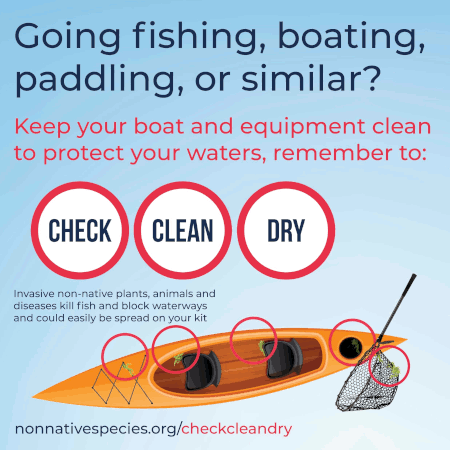
June 2026
- 29 June 2026: Granting rivers rights is not enough: A new report from the influential Stockholm Water Institute warns that granting legal rights to nature will fail to halt ecological collapse unless backed by governance reforms and local community empowerment. As they put it: "Legal recognition must be treated as a tool for mobilization, not a self-executing solution". According to one of the authors, York's Alison Dyke: "Rights of rivers frameworks hold the potential to transform ecological governance structures, they cannot do so in a vacuum. Governments and civil society must be willing to have fundamental conversations regarding the socioeconomic structures currently driving ecological degradation." It's always good to hear people championing grassroots community involvement - the bedrock principle on which we founded the UK Rivers Network over 25 years ago.
- 26 June 2026: Soil Association: Why we are reviewing organic salmon: The Soil Association has just raised some profound questions over whether Scottish salmon certification can continue: "Organic certification is not a static label, it is a commitment to continual progress, grounded in animal welfare, environmental protection and public trust... We have set out a series of clear tests for the organic sector. These include tackling unacceptable mortality rates, reducing and rapidly eliminating the most harmful treatments, ensuring genuinely high welfare, improving the sustainability of feed, and protecting sensitive marine environments".
- 26 June 2026: MCS: From heatwaves to healthy seas: the importance of our ocean against climate change: Recent record‑breaking heat isn't just something we feel on land, it's a signal of what's happening beneath the surface of our seas. As temperatures soared across Europe, the UN Secretary‑General, Antonio Guterres, delivered a stark message in London: "London isn't just calling – it's cooking".
- 17 June 2026: Anglers challenged to prove Trent's 30 species myth: Starting on the first day of coarse fishing season on 16th June, Trent Rivers Trust have been challenging anglers to catch thirty different species on the Trent and its tributaries. The competition, supported by the Angling Trust, is inspired by the Trent's likely naming after the French word for thirty – "trente". It's a name that emerged in the 17th century in a nod to the 30 species of fish that supposedly inhabited the river. Now in a bid to create a river that can support more fish, the Trust is asking anglers to fish for the facts.
- 26 June 2026: The 'failing' river pollution crackdown - with just 1 in 1,000 cases prosecuted: In The I Paper, river champion Lucie Heath explores the Environment Agency's record on prosecuting farm pollution: "New rules meant to stop farms polluting Britain's waterways have led to only nine convictions and fines as low as £137". While it's true that the enforcement and prosecution record is unimpressive, the Agency counters that it "carried out over 19,000 farm inspections and nearly 20,000 improvement actions have been completed by farmers, with the vast majority bringing themselves into compliance without us having to take further action". But the state of our rivers speaks for itself, as Heath points out: "The majority (84 per cent) of water bodies in England are failing to meet ecological health standards... Around 40 per cent of these are failing at least in part due to agricultural pollution..." And more than a few people will be wondering why the Agency has time to threaten community river groups with prosecution (see below), but not chase up egregious farm pollution.
- 26 June 2026: Urgent calls made to protect West Wales rivers: Campaigners from across Ceredigion and north Pembrokeshire are calling for urgent government action to protect the area's rivers. Representatives from river groups will meet on Monday, June 29, to propose and discuss actions with new Senedd member Anna Nichols. Groups representing the Teifi, Cleddau, Nanhyfer and Gwaun rivers will be joined by farming union representatives at the session in Haverfordwest.
- 26 June 2026: BART calls for help to measure river health: People are being invited to join a community effort to measure the health of rivers and streams in the Downend area. Bristol Avon Rivers Trust (BART) runs the annual Bristol Avon RiverBlitz, which this year is taking place from July 25 to August 2.
- 25 June 2026: Buglife: New data on insect pollinators shows dramatic decline in hoverflies: New Official Statistics on insect pollinators have been published from the UK Pollinator Monitoring Scheme (PoMS) during Insect Week 2026. The data collected every year across Great Britain (GB) between 2017 and 2024 show a mixed picture for pollinators across the survey methods and a wide range of insect groups, with hoverflies declining by around a third in both their abundance and number of species recorded during this time, signalling possible risks to the health of our ecosystems.
- 24 June 2026: Dorset River Stour - concerns raised after children fall ill swimming: Concerns over water quality have been raised following reports of children being hospitalised after swimming in a river. North Dorset and Mid Poole MP Vikki Slade has spoken out after a young boy reportedly developed flu-like symptoms and blurred vision after entering the River Stour near Canford School.
- 24 June 2026: CPRE 'Running Out' conference explores growing demands on land use: CPRE hosted a conference in London this week, gathering policymakers, farmers, planners and researchers to confront the growing pressures on England's land and explore what joined-up thinking could make possible. According to the charity, "England is losing countryside at an alarming rate with 17,000 hectares [42,000 acres] lost to development every year. At the same time, finite land is expected to grow food, restore nature, support new homes, generate clean energy and help communities adapt to climate change".
- 25 June 2026: Environment Agency "sets the record straight" on the River Roding?: Following the news that the Environment Agency has threatened Paul Powlesland and The River Roding Trust with prosecution for "remedial work" on their river, we now have a public clarification in the Agency's blog: "To be clear, no decision has been made to prosecute the River Roding Trust. The Environment Agency has issued a warning to the trust following an investigation into unpermitted work carried out at Alders Brook in Ilford [which].... damaged wildlife habitats, and led to the spread of invasive species Japanese knotweed, due to a failure to follow biosecurity protocols". These sound like very fair points. But while we can understand the Agency's concerns ("we would not be fulfilling our statutory role if such work were to proceed without the appropriate environmental permit in place"), the idea that "warning letters were a proportionate response on this occasion, recognising the trust's genuine commitment to improving the local environment" seems utterly ill-judged. What sort of a message does it send to voluntary, community river champions if you threaten them with prosecution? Sadly, it's likely to reinforce the perception that the Agency is massively out-of-touch with public opinion and ill-suited to the daunting task of turning our lifeless, filthy rivers around, which requires a huge team effort and empowered community engagement.
- 24 June 2026: Stephan Desouches: Meet The designer behind the Rivers Trust's stunning new merch!: Graphic designer Stephan Desouches recently joined The Rivers Trust to help create some bold new designs for their teeshirt store; in a new blog post, he talks us through his creative process: "Having worked in watershed protection, environmental regulation, and natural resource enforcement, I've seen firsthand how critical healthy rivers are - not only for wildlife and ecosystems, but for the people and communities that depend on them".
- 24 June 2026: Burnham’s blueprint to seize control of sewage-dumping water firms: According to The I: 'Andy Burnham's allies are drawing up plans to seize control of England's sewage-dumping water companies – using the model that returned Pariss water to public ownership. The blueprint aims to bring the utility firms back under public control, cut household bills and tackle the pollution scandal that has fouled the nation's waterways. The newly elected Makerfield MP launched a scathing attack on 'profiteering' water companies during his campaign to win the by-election for the constituency, arguing that dividend payments to shareholders should instead be used to lower consumer costs". But Burnham will need to overcome intense pressure from the Treasury, and failing water-company creditors, who have doggedly resisted repeated calls for public ownership with bogus claims about "nationalisation" (not the only public-ownership model on the table) costing £100 billion.
- 24 June 2026: Worldview: A river crisis is unfolding in the American West: A great, indepth article in National Geographic looks at growing pressures on one of the United States' iconic rivers: "There is not enough water flowing in the Colorado River to meet the needs of the seven U.S. states and two Mexican states that rely on it. The river has been struggling for decades. This summer could bring it to the brink, threatening endangered wildlife and communities".
- 24 June 2026: Fears for East Anglian rivers as flows 'exceptionally low': A recent Environment Agency report found the rivers Yare, Bure, Wissey, Ely Ouse, Waveney and Wissey, which flow through parts of Norfolk, Suffolk and Cambridgeshire, were all at "exceptionally low" levels. Only two waterways in East Anglia - the Heacham and Burn in west Norfolk - have normal flows following a period of prolonged dry weather.
- 24 June 2026: Warnings of the dangers of river beaches: Rescue crews along the River Severn are warning that "river beaches" (stretches of river bank that resemble sandy beaches) can quickly turn deadly, with hidden dangers including fast-moving tides, unstable sand and cold water shock. Matt Davies, from the Severn Area Rescue Association (SARA), said people are being caught out by conditions that can change in minutes: "It looks like we have a beach on our doorstep, but people don't understand the tides and they put themselves into extreme danger".
- 24 June 2026: Balsam bashing volunteers clearing invasive plant from Shropshire: A group of volunteers in north Shropshire have said they are determined to get rid of an invasive plant which has taken root along their river. River Perry Water Watch, based in Baschurch, is pulling up Himalayan balsam from their riverbanks, one of the most widespread and common invasive plants that are not native to the United Kingdom.
- 24 June 2026: WildFish: Why we are calling for farmed salmon to be banished from The Traitors breakfast table: The WildFish Off The Table campaign is calling on the BBC and its production company - Studio Lambert - to banish farmed salmon from the breakfast table of its hit series, The Traitors. An iconic, much anticipated feature of the show is the morning ritual around the breakfast table, with the buffet itself well known for drawing attention from viewers. But, nestled amongst the pastries and fruit, a real traitor to Scotland’s environment lurks: farmed salmon.
- 23 June 2026: Greenpeace tells PM: "If your government won't protect our seas, we will": Greenpeace UK has today announced its intention to create new underwater boulder barriers in UK Marine Protected Areas (MPAs). A decade after the EU vote, the charity, backed by a raft of celebrities and ocean conservation organisations, has accused the government of failing to use its post-EU powers to properly protect UK seas from destructive industrial fishing.
- 20 June 2026: Wildlife Trusts champion nature-friendly farming at Groundswell: What has been achieved since the "Scale of Need" report made its stark warning to the Treasury about the levels of funding required by the sector? What can butterflies tell us about the health of a hedge? How do you graze a water meadow? And whats next for the future of farming? These questions and many more will be debated at Groundswell, with input from leading experts and those on the frontline of the nature-friendly farming.
- 20 June 2026: Archaeology: River Wear cauldron could be only one found in Britain: An iron cauldron lying in a river bank could be "the only one ever found in a British river", an underwater archaeologist has said. The finding was made in the River Wear at Offerton, near Sunderland, next to a large Roman factory which was discovered previously.
- 20 June 2026: WildFish: The invasion of UK rivers and the SmartRivers volunteers monitoring from the frontline: SmartRivers volunteers are arming themselves with data to combat the aggressive non-native species that are disrupting the delicate natural balance of our freshwater environment. The information collected can be used to inform local conservation efforts and help reduce the impact of these disrupters on our rivers' natural rhythm.
- 20 June 2026: River Action: Government Publishes Its Vision for Farming: River Action has welcomed the Government's recognition that restoring nature and producing food must go hand-in-hand. The Farming Roadmap rightly acknowledges that healthy rivers, soils and ecosystems are fundamental to resilient food production, and its emphasis on nature-friendly farming represents an important step in the right direction. However, River Action argues this vision will only succeed if it is reflected consistently across government policy. Plans that enable further expansion of intensive livestock production, particularly in already polluted catchments, undermine the very objectives the roadmap sets out to achieve.
- 17 June 2026: UK backs communities on the ocean's front line with £13.9 million investment: Ocean ecosystems will be protected and resilience increased in some of the world's most climate-vulnerable coastal communities thanks to £13.9 million UK investment in new funding, Marine Minister Emma Hardy announced today at the eleventh Our Ocean Conference in Mombasa, Kenya.
- 12 June 2026: Performance politics and the Thames Water scandal: Oxford University economist Professor Dieter Helm has just published another compelling "episode" in his ongoing analysis of the failed water industry: "If the current government survives through to 2029, Thames will be very much up there as part of its legacy -- unless, at this last moment, the government reasserts the importance of independent regulation, ensures that there is an SAR [Special Administration Regime], and gets Thames broken up and passed into the hands of new owners who can get on with that ever-elusive 'turnaround plan' promised in December 2023".
- 2 June 2026: UNEP: Restoring the salmon: what lessons can we learn from Canada?: Indigenous and local communities are at the heart of an initiative called "Respectful Returns" that was developed in 2010 by Parks Canada, collaborating with these communities and other partners to restore wild salmon populations in rivers and streams in seven national parks along the Pacific and Atlantic coasts of Canada. By addressing the habitat degradation and over-exploitation that have pushed various species toward extinction, Respectful Returns has seen wild populations of the fish increase in six of the seven areas -- giving hope that both the ecosystems, and the cultural heritage that they represent, can be secured for future generations.
- 20 June 2026: Midsummer Celebration of the Rights of the Cam!: Join the Friends of the Cam for "our 6th Declaration of the Rights of the River Cam and our dedication to defend the river, which will be collectively read at 6pm on Jesus Green on Sunday 21st June 2026. We will be located between the kiosk/footbridge and the tennis courts. The event will start at 4.30 with art activities and river music and the programme will begin at 5pm".
- 20 June 2026: Europe's bathing waters leave Britain's wanting: New figures show that, in 2025, 88% of coastal bathing waters in the EU were classified as excellent, compared to 78% of inland bathing waters. In Britain, 66.1% of designated bathing waters in England were classified as 'Excellent', and 36% of inland bathing sites across were classified as poor, including 12 out of 15 designated river bathing sites. (And a quick reminder that a designation of 'Excellent' does not mean consistently excellent water quality...)
- 19 June 2026: Stop chemicals polluting Thames, petition demands: A plan to swap 75 million litres a day of the River Thames with wastewater has sparked a petition demanding "forever chemicals" be stopped from polluting the waterway. Save Our Lands And River (Solar) said current proposals do not do enough to filter out micropollutants - which can include pesticides and stimulants.
- 19 June 2026: Think before you flush: expert advice on how and when to save water at home: A timely article by Stuart Walker, Research Fellow in Sustainabilty Assessment, University of Sheffield, encourages us all to "follow the principle of reduce, reuse and recycle to use less of this water and to make the most of the water we use this summer".
- 19 June 2026: Exclusive testing finds River Trent water contains more E.coli than a high street pub toilet: "Exclusive testing" reported by LBC News this week found repeated signs of serious faecal contamination, with every sample from downstream of an outlet on the River Trent returning higher levels of E.coli than a sample taken from a pub toilet. Six sets of water samples were taken upstream and downstream of an outlet outside Burton upon Trent in Staffordshire between 31 July 2025 and 12 March 2026 and analysed by a UKAS-accredited laboratory.
- 19 June 2026: Is drought making a comeback?: Just three months after the last drought officially ended, the parched conditions this spring have increased the risk of drought this summer. The National Drought Group met this week and heard that while water resources remain in a relatively healthy position following an exceptionally wet winter, some areas are already seeing the impacts of drier conditions.
- 19 June 2026: High tech buoy to be used to monitor water quality: A high-tech buoy that continuously monitors water quality is to be launched on the River Wye in Herefordshire. The idea is for the buoy to measure indicators such as turbidity, dissolved oxygen, pH and temperature, which is fed into an online platform that provides instant analysis. The project aims to enable Ross Rowing Club and other local groups to gain a better understanding of their local water quality.
- 18 June 2026: The Biodiversity Heritage Library needs YOU!: The Guardian published a wonderful summary of the Biodiversity Library's work this week... and why it's now seeking financial support.
- 18 June 2026: Is citizen science a distraction?: That provocative thought is one of the very challenging ideas floated in Oxford researcher Hope Steadman's piece in The Conversation this week. One of the volunteers she interviewed felt "water companies encouraged participation in citizen science, while ignoring the data... [and] In his view, citizen science risks becoming a tool for keeping volunteers busy and distracted, rather than driving accountability."
- 18 June 2026: Paddling hygiene can help prevent stowaways: Sarah-Kay Purdon and Olivia Pargeter from RSPB Cymru explain how sensible precautions can help paddlers from inadvertently helping to spread invasive species.
- 17 June 2026: Paul Powlesland accused of acting "illegally" after organising volunteers to clean up River Roding: Irony of ironies. When Paul Powlesland, intrepid lawyer and nationally respected river campaigner, organised volunteers to tackle litter, weed and silt from a section of the River Roding, after the Environment Agency repeatedly failed to act, he found himself threatened with prosecution. The nature writer Robert Macfarlane, who has visited the Roding, said on Instagram: “If the Environment Agency do prosecute I guarantee they will meet a tidal wave of objection, ridicule and more". Watch this space as the EA's latest public relations disaster unfolds.
- 17 June 2026: FBA Book Review: "Beyond the Sea: A love letter to freshwaters": FBA's new Species Recovery Manager, Sarah Raubenheimer, takes a look at David Strayer's Beyond the Sea: The Hidden Life in Lakes, Streams, and Wetlands, which was published by Johns Hopkins University Press last year.
- 17 June 2026: Save Windermere's Work Continues to Drive Progress on Pollution Reduction: Clean River Kent Campaign have paid tribute to Save Windermere's work "in keeping water quality at the forefront of public discussion and pushing for meaningful action to protect one of our most treasured landscapes. Their persistence and evidence-led approach continue to drive progress towards a future free from sewage pollution in the catchment".
- 15 June 2026: New microplastics research examines River Thames: A new study into microplastic pollution in the River Thames has been launched by researchers at the University of East London (UEL) in an attempt to influence environmental policy and water quality.
- 15 June 2026: Big Paddle Cleanup: Sports Cover Europe join Lee Valley river clean: Volunteers from Sportscover Europe joined Paddle UK staff and canoe slalom athlete Bethan Forrow, for a cleanup on the River Lee this month.
- 15 June 2026: Real-time monitoring to protect River Test: A scheme to provide real-time pollution monitoring along the entire length of a chalk stream is believed to be the first of its kind in the country. Nearly 20 sensors, known as sondes, have been placed into the River Test to continuously measure key indicators of water quality.
- 15 June 2026: What is Environmental DNA and why is it useful?: Environmental DNA (eDNA) is an exciting scientific tool that allows us to explore the diversity of organisms living in the environment. In this blog post from WildFish, freshwater ecologist Dr Sam Green explains eDNA and the advantages it brings to citizen science when we unlock its full potential.
- 15 June 2026: Cows give a 'helping hoof' to restore rare Oxfordshire wetland: A small herd of cows has been introduced to help protect one of Oxfordshire's rarest and most wildlife-rich habitats. With the help of volunteers, Freshwater Habitats Trust has been restoring the alkaline fen at Hinksey Heights, west of Oxford, since 2018. Now, the Oxford-based charity is introducing five native Dexter cattle to manage vegetation and give rare wetland wildlife a chance to thrive.
- 13 June 2026: Surfers Against Sewage: What is public ownership?: Louise Reddy of SAS explores the "whole spectrum of options" open to the government as it wrestles with growing public scepticism about water reform.
- 13 June 2026: River Action welcomes Burnham call for Thames Water intervention: River Action says: Burnham's intervention comes as concern grows within the Government over Thames Water's future. This week, the Secretary of State for the Environment opposed the company’s latest £10 billion market-led rescue plan, saying it 'doesn’t do enough to protect consumers and the environment'. These developments reinforce the need for a fundamental reset of the water industry, starting with Thames Water."
- 14 June 2026: The River Arun: The man-made river that turned a town's fortunes: Running through Arundel, West Sussex, the river became one of the county's busiest trading routes, carrying coal, timber, tea and salt. Before human intervention, however, it was difficult to navigate, with the tidal reach stopping short of Arundel and limiting access for larger vessels. In the 18th century, major improvements were made to the river to enhance its role in trade.
- 13 June 2026: Is Thames Water moving "closer to nationalisation"?: The BBC was among those reporting that Thames Water had moved "a step closer to a form of nationalisation" this week, following concerns raised by Environment Secretary Emma Reynolds over bailout proposals. It's worth reminding ourselves that "special administration", as this refers to, is not the same thing as nationalisation, by taking a look at the admirably clear explanation Oxford University's Dieter Helm published last year.
- 8 June 2026: WSRT: Cleaning up the River Ems: Western Sussex Rivers Trust published a horrible inventory of their haul from a cleanup of the Ems this week, including: "A car bumper, household door and large gas cannister, a kettle, birthday party debris and a bag of used nappies!" Lovely.
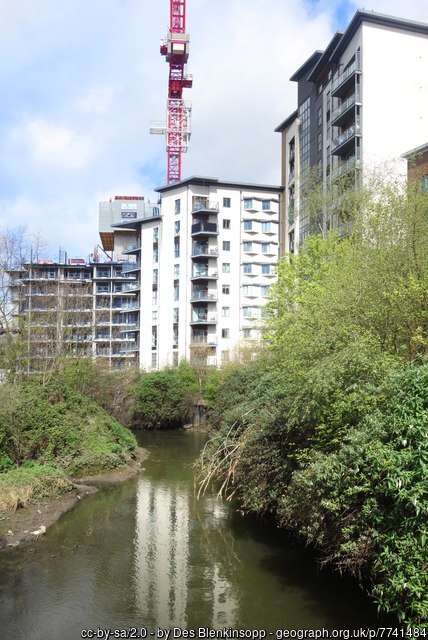
The River Roding at Ilford. Photo © Des Blenkinsopp and licensed for reuse under a Creative Commons (BY-SA 2.0) Licence.
13 June 2026: "Fast-track" regulation could expose Britons to harmful chemicals, say campaigners: An environmental campaign group is taking legal action against the government over proposals that it claims could fast-track chemical hazard classifications from other countries with lower standards into UK law.
13 June 2026: Could a Burnham government return water to public ownership?: According to The Guardian, ambitious water and energy reform are part of Andy Burnham's agenda.
13 June 2026: Ireland: Stop the Spread: Workshop Series Protecting the Maigue Catchment from Invasive Species: "The Maigue Rivers Trust invites you to take part in this series of interactive workshops facilitated by StreamScapes. By raising awareness, building skills, and promoting simple, effective actions we can help prevent the spread of invasive species and protect river health. Through a mix of presentations, guided walks, and hands-on field sessions, participants will gain a deeper understanding of freshwater ecosystems and the role we all play in safeguarding them". The remaining sessions are on 20-22 June and 15 August.
12 June 2026: Popular fishing spot in Shropshire's River Morda "drying up": People have been shocked to see part of a Shropshire river apparently "drying up." The River Morda runs for nearly 17 miles on the English/Wales border. Rising in the hills above Oswestry, it flows eastwards through Trefonen and Morda before meeting the River Vrynwy.
12 June 2026: London Rivers Week sees celebration of nature in the capital: This year’s theme, "Know Your Local River", saw events pop up across the city, encouraging Londoners to explore and connect with their nearest river. There were 70 events across the city, ranging from fish surveys and litter picks to guided walks and river-themed poetry workshops.
12 June 2026: The River Wye recognised as living ecosystem in UK first: here's why it matters: Stretching for around 155 miles, the Wye rises in the Cambrian Mountains in Wales, flows through Herefordshire and Gloucestershire, and winds its way to the Bristol Channel. Long celebrated for its natural beauty, it also stands as a symbol of environmental decline.
12 June 2026: ERN: Bust your dams! Open Rivers Program funding is open until 26 June!: Don't wait any longer to submit your dam removal projects to the Open Rivers program. By 2029, the goal is to fund more than 500 dam removals and reopen more than 5,000 km of waterways. European Open Rivers Programme is a Dutch grant giving foundation funded by Arcadia (and, yes, it does include the UK).
12 June 2026: Funding milestone reached for Rosyth's "struggling" river habitats: The Rosyth River Restoration project has secured funding for its next three phases, offering "huge potential" for local ecology and community benefits. The Scottish Environment Protection Agency's Water Environment Fund has committed £270,000, and Fife Council has allocated £50,000 from the Nature Restoration Fund.
11 June 2026: Race against time to save Endangered native crayfish: As invasive American Signal Crayfish numbers surge at a Derbyshire site, a bold rescue mission gives the UK's White-clawed Crayfish a fighting chance, thanks to a new "Ark site" in neighbouring Staffordshire.
11 June 2026: Worldview: Large-scale McKenzie River restoration "truly moves the needle": A look at how Canada's McKenzie River Trust, along with the Eugene Water and Electric Board, the McKenzie Watershed Council and the National Forest Service, has been incrementally converting hundreds of acres of land near the McKenzie River into a wider floodplain.
10 June 2026: Environment Agency issues new permit for Cornish Davidstow creamery: The Agency argues it has struck the right balance between allowing expansion at the "persistently poorly performing site" while respecting environmental concerns with additional conditions added following a public consultation earlier this year.
10 June 2026: Restoring the River Breamish to a natural course: The next phase in a multi-decade scheme to restore a river to a more natural course is to begin in August. The scheme, led by the charity Tweed Forum, will remove engineering structures which historically straightened the river on a section in the Hedgeley area, north of Rothbury.
10 June 2026: Cotswold citizen scientists find "worrying" river pollution: A group of Gloucestershire neighbours testing their local river every week for more than a year say they are concerned by "worryingly high" levels of phosphates and nitrates recorded.
10 June 2026: How can river groups help farmers?: Ribble Rivers Trust have an interesting blog post this week explaining the agricultural outreach work of their four dedicated farm advisers.
8 June 2026: Thames Path 30th anniversary relay starts at source: A walking relay to celebrate the 30th anniversary of the Thames Path is underway, after it kicked off at the source of the iconic waterway. Over 24 days this month, hundreds of ramblers, community and river-user groups will trek along the route - finishing in Woolwich on 28 June.
8 June 2026: Summer tips for riverfly surveyors: Newly published guidance this week offers top tips for minimising stress to invertebrates, explains how to survey when the water level is too low to sample, looks at particular risks you might encounter during the summer, and explores how riverfly numbers change with the seasons.
8 June 2026: FBA: An inside look at the wildlife banknote battle: While the tabloids froth about replacing Churchill with batty badgers, Steve Ormerod, a professor of freshwater ecology at Cardiff University, explains how candidate animals have been shortlisted for official recognition.
8 June 2026: River wildlife moves freely once dams are removed... but so too can invasive species: Queen's University Belfast researchers studying dam removals report that "more than 2,200 dams, weirs and other barriers have been removed between 2020 and 2025. This may help native species move more freely, but... invasive freshwater invertebrates increased substantially following removal, suggesting that reconnecting rivers can also have unintended consequences".
8 June 2026: Yorkshire storm sewage tank illustrates need for better communication: A Yorkshire Water scheme to solve sewage overflows by building a giant floodwater storage tank has sparked public concern through poor communication.
8 June 2026: Reminder: Discover the Rivers4Life Exhibition: Join the Yorkshire Dales Rivers Trust for an Open Day on Saturday 27 June, taking place within their Rivers4Life exhibition at the Dales Countryside Museum, Hawes, from 1pm: "This unique event offers visitors the chance to explore our family-friendly exhibition celebrating the rivers, wildlife and catchments of the Yorkshire Dales, while also taking part in guided walks, live demonstrations and expert talks showcasing our conservation work across the region." Funded by the National Lottery Heritage Fund, Rivers4Life runs daily from 6 June to 27 September 2026, open 10am–4pm, seven days a week.
8 June 2026: Marine Conservation Society: What a super El Niño could mean for marine life: There are growing concerns that a "Super El Niño" could develop this year. MCS UK explore what this phenomenon is and what it could mean for our ocean - and the life within it.
8 June 2026: Protecting Westfield from East West Rail: The Countryside Regeneration Trust explains why it is fighting to protect Westfield, a wildlife-rich area of farmland at Lark Rise Farm in Cambridgeshire, from the worst impacts of East West Rail's proposed Cambridge-to-Oxford rail line.
8 June 2026: Paddling to wellness through blue-space sport: Paddle UK takes a look at the inpsiring work of Phoenix Watersport, which helps a diverse community of people to find confidence and joy through safe and accessible paddling.
8 June 2026: York rivers trail: shaping river stories: A new riverside experience for York took a significant step forward last week, as residents, partners and contributors came together on the River Ouse to help shape the York rivers trail.
1 June 2026: SAS: What do people think of the Water Reform Bill?: New research from Surfers Against Sewage suggests people think: 1) Current plans from Government don't go far enough; 2) The public are angry and concerned about rising water bills; 3) The public wants people and the planet put before payouts; 4) Water reform is an electoral issue.
5 June 2026: Ofwat finally finds its teeth as regulator with £44.7 million fine: From WildFish: "For years WildFish has been saying the system isn't broken. Instead, what we need are regulators who have the mandate and backing of government to enforce under existing law. And to prove that it can be done, Ofwat has been waking lately from its slumbers with a little more vigour than before and advertising its recent successes in nailing water companies, including the recent enforcement against Dwr Cymru Welsh Water at £44.7 million".
5 June 2026: River Meon chalk stream progress: After a long campaign by locals, and a big protest earlier this year, a traffic survey is finally beginning in Droxford, Hampshire to tackle the problem of 4x4 drivers and motorcyclists trashing a threatened chalk stream.
5 June 2026: Salisbury river polluted with sewage just 13 days after being given bathing status: A picturesque river in Salisbury was granted official designated bathing status, only for tests to reveal it was polluted with sewage a mere 13 days later. The water at Queen Elizabeth Gardens in Salisbury, Wiltshire, was declared unsafe for swimming less than two weeks after its new designation. (Those of you with a long memory might recall it was where we held a picnic during the UK Rivers Network's inaugural conference back in 2001.)
3 June 2026: The row at Hampstead Heath is about far more than a few thoughtless swimmers in a heatwave: Rhiannon Lucy Cosslett has a great, thoughtful article about the problems created not just by thoughtless "wild swimming", but also by unhelpful, emotive polarised debate: "On the one hand, wild swimming has become totally fetishised, tweely marketed as a middle-class lifestyle choice and a cure-all, and spots where you can swim are more and more swamped. On the other, you have 'no swimming' signs but very little clarity about why they are there... let alone a proper national conversation about what our rivers, seas, lakes and ponds are for". Well put.
3 June 2026: Thames21's response to Thames Water's pollution incidents: Recent figures published in The Times have shown that Thames Water was responsible for almost a third of the water sector's most harmful pollution incidents in 2025. A Thames21 spokesman said: "The scale of serious pollution incidents linked to Thames Water is deeply concerning. Preventing sewage pollution at source must be a priority, and water companies need to invest far more urgently in the infrastructure required to protect river health".
3 June 2026: We need to talk about SUVs: Climate change is the biggest future threat to rivers and SUVs are a bigger driver of that (no pun intended) than you might think. An article in The Conservation explores the scale of the problem: "SUV emissions are now so large that, if all SUVs were a country, they would be one of the world’s five biggest CO2 emitters".
2 June 2026: South Downs "Take the lead" campaign recommends keeping dogs out of rivers: The message that dogs and rivers don't mix is finally getting through. South Downs National Park Authority's official dog-walking advice now reads: "Rivers and ponds are wildlife havens: help protect them by keeping your dog away from the water and on the path". Still a long way to go, unfortunately, with many dog owners still unaware of the risk presented by toxic pet flea treatment.
2 June 2026: Inishowen marks World Peatlands Day: Hopefully, most gardeners have now got the message that peat isn't something to put in pots anymore; Inishowen Rivers Trust mark this World Peatlands Day, 2nd June, by pointing out how peatlands play a role in keeping rivers healthy downstream.
2 June 2026: England's 'guerilla litterpickers' trying to save a river: Channel 4's Alex Thomson explores the efforts of Paul Powlesland and his team to rescue the Roding, London's third longest river, with bureaucrats proving at least as troublesome as litter and neglect.
2 June 2026: FoE: Government commits to 87% cut in UK’s climate emissions by 2040: Good news that the government has agreed to accept the recommendation of its advisers, the Climate Change Committee (CCC), and committed itself to a legally binding target to cut carbon emissions by 87 per cent (based on 1990 levels) by 2040.
2 June 2026: Sir Quentin Blake celebrates the New River: A new mural by Sir Quentin Blake has been unveiled in north London ahead of the opening of a new illustration centre dedicated to his work. His new artwork, A Bridge to the Past, explores the history of the New River - the artificial waterway built between London and Hertfordshire in the 1600s - and its relationship with the surrounding community.
2 June 2026: Water voles return to River Wey after 20 years: Water voles are being reintroduced to the River Wey in Farnham after a 20-year absence from the area. About 300 of the animals have been released into the river in the town centre as part of a wider project to help the species recover, after it became Britain's fastest declining mammal because of habitat loss and predation, the National Trust said.
2 June 2026: Congratulations Jeremy Biggs!: Jeremy Biggs of Freshwater Habitats Trust (and formerly Pond Conservation) has been helping to reframe the debate around freshwater conservation for the last four decades, constantly reminding that ponds and small waterbodies really count for biodiversity. He's recently been recognized as an "Unsung Hero" in the ENDS Power List.
2 June 2026: More than 20,000 fish killed in Ireland after River Glyde polluted: Inland Fisheries Ireland (IFI) said the "harmful ecological event", covering a 15 mile (25km) stretch of the River Glyde in County Louth, was first discovered on Tuesday evening. Species of fish discovered dead include Atlantic salmon, eel, brown trout, pike, minnow, and coarse fish species.
2 June 2026: Big Paddle Cleanup: Paddle UK staff clean Nottingham Canal: Paddle UK staff have tackled plastic pollution and junk in the much-loved Nottingham Canal, as part of the Big Paddle Cleanup. The cleanup event, which took place between Binks Yard and along the Nottingham and Beeston Canal, saw about 20 dedicated volunteers take to the water by kayaks, paddleboard, and canoe. In total, the team spent three hours on the water, removing 20 sacks of rubbish, along with surprises like a grit bin, slabs of polysterene, a fire extinguisher and road signs.
2 June 2026: Mushrooms against sewage!: Mushrooms could be used to filter out harmful waste and sewage in rivers, after a trial showed a certain fungi can destroy a type of bacteria that is a risk to human health.
2 June 2026: Natural Flood Management with Ribble Rivers Trust: The Ribble Rivers Trust has been working closely with landowners to help slow the flow of water off Darwen Moors, aiming to reduce flood risk in the Darwen area. Here's a closer look at the Community Catchments initiative and how it works.
2 June 2026: Why is Fair Isle plagued with forever chemicals?: It has the highest levels of toxic Pfas in drinking water in Scotland. But how did this remote island become awash with forever chemicals? Daniel Shailer investigates for The Guardian.
1 June 2026: Ash Smith's petition: an update: WASP water campaigner Ash Smith's petition to "Hold a referendum to bring the water industry into public ownership" has garnered 128,015 signatures (and rising), which means it has to be "considered for a debate in Parliament". But the government has already issued a dismissive response, which you can read here: "Nationalisation would take years and involve complex legal processes, diverting effort from cleaning up rivers, lakes and seas. We are taking action now through stronger regulation and enforcement".
1 June 2026: Yorkshire Dales Rivers Trust Open Day 2026 at the Rivers4Life Exhibition: Join the Yorkshire Dales Rivers Trust Open Day on Saturday 27 June, taking place within their Rivers4Life exhibition at the Dales Countryside Museum, Hawes, from 1pm. This unique event offers visitors the chance to explore a family-friendly exhibition celebrating the rivers, wildlife and catchments of the Yorkshire Dales, while also taking part in guided walks, live demonstrations and expert talks showcasing our conservation work across the region. Funded by the National Lottery Heritage Fund, Rivers4Life runs daily from 6 June to 27 September 2026, open 10am-4pm, seven days a week.
1 June 2026: Finding "Flow" at Dorset's Bere Marsh Farm: The art exhibition, which includes a large oil painting and a drawing of the narrative flow of the imagery for the River Stour, as well as 12 framed monoprints and an animated drawing, will be open every day, except Sunday May 31st, during Dorset Arts Weeks, from 10 am to 5pm, until the exhibition closes on Saturday 6th June. It will then remain at the farm until the Saturday July 4th, available to view on Thursdays, Fridays and Saturdays as part of Evolver magazine's "Festival of Wessex", devoted to promoting 150 art events happening throughout the region, between mid-June and the end of September.
May 2026
30 May 2026: What does a "Catchment Coordinator" do?: Eloise Phillips, newly appointed Catchment Coordinator for Western Sussex Rivers Trust, explains her community outreach work.
30 May 2026: The Big River Watch results are in: Last month, between the 24th and 30th of April 2026, thousands of people across the UK and Ireland stepped outside, spent time by a river, and got involved in the latest Rivers Trust Big River Watch. Now the results are here!
30 May 2026: There Will Be Fish: A Short Film by Charley Yates: The Wild Trout Trust have a new YouTube film for you to watch: "We recently braved the Yorkshire drizzle for a very special project. Jonathan Grey (our Research and Conservation Officer) dived into the world of river conservation with Charley Yates, a Film Production student at the University of Staffordshire. The result was this brilliant short documentary about electrofishing, Christmas trees, and all things wild trout!"
17 May 2026: What is Himalayan Balsam, why’s it a problem, and how do we deal with it?: The River Beane Restoration Association explain their efforts to bring the pesky alien invader to heel.
1 May 2026: How ONE misconnected house polluted the Quaggy: An exasperated recent blog post from QWAG (Quaggy Waterways Action Group) explains why it took four years to stop a single misconnected property from polluting the South London river.
Join The Big Paddle Cleanup 2026!: The Big Paddle Cleanup 2026 is here! Paddle UK's annual national campaign encourages and equips paddlers to remove plastic pollution and litter from UK waterways. The 2026 event which runs until June 7 focuses on accessing hard-to-reach areas to protect blue spaces.
30 May 2026: Wild Salmon Day 2026 - Global Salmon Conservation Leaders Issue Joint Statement: On June 1st, International Wild Salmon Day, a global coalition of conservation organisations is sending a clear message: restoring salmon rivers can't wait.
30 May 2026: Malmesbury River Festival celebrates waterways and wildlife: Malmesbury is celebrating its rivers with a new month-long festival bringing together art, music and environmental events. The Malmesbury River Festival will run from June 12 to July 5, featuring a programme of events, exhibitions, and community activities.
30 May 2026: WildFish: Can the Scottish Government face up to the environmental crisis of salmon decline?: A new Scottish Government now has an opportunity to decide whether wild salmon recovery is genuinely a national priority or destined to become a badge of environmental shame.
29 May 2026: Catchment First on the Cockhaise Brook Barrier Removal Opens 18km of River on the Ouse: This spring, Ouse and Adur Rivers Trust completed the removal of the final major barrier to fish passage on the Cockhaise Brook, replacing a deteriorating concrete culvert with a new clear-span bridge and reconnecting more than 18km of river habitat for fish and wildlife.
29 May 2026: "It's an obsession": one man and his family on a mission to save Europe's glutinous snail: The snails have been driven to extinction in England by the poor quality of the country's freshwater bodies. Pollutants from agriculture and industry have ruined their habitats in ponds, ditches, lakes and streams.
29 May 2026: Cam Valley Forum's Bourn Brook Balsam, Part 2: Over in Cambridge, Himalayan Balsam is back in the firing line, but "bashing" alone isn't enough...
29 May 2026: Worldview: A dangerous dam‑building race is threatening South Asia's shared rivers: Bangladesh has just approved one of the largest river engineering projects its history: the Padma Barrage, a vast river-control project intended to restore water in the country's drought-prone southwest. Rather than easing regional water insecurity, the Padma Barrage risks adding to a cycle of unilateral river engineering across the subcontinent.
29 May 2026: Worldview: Letting a River Act Like a River: Once heavily channelized, the Gila River is reclaiming its big, messy floodplain, with lessons for the rest of the Southwest United States.
28 May 2026: Help shape the future of paddling: Paddle UK is developing its next strategy, and they want to hear from the people who paddle, volunteer, coach, compete, campaign, explore, support and care about the places where they paddle.
28 May 2026: 'This is why rivers and lakes are so dangerous to swim in': Unexpected hot weather inevitably brings tragic river-swimming deaths, but not because "rivers and lakes and so dangerous to swim in", as this BBC article claims. Outdoor swimming is, in fact, a much lower risk than cycling, driving, angling, or sailing, and the health benefits to the many outweigh the risks to the unfortunate few. Sadly, we don't, any longer, have an "outdoor play" culture where young people understand where, when, and how they can safely swim locally without going to expensive, overcrowded, sterile, and joyless municipal pools. Once, when all kids played outdoors, this was readily shared knowledge; everyone knew where and when you could swim and where and when you shouldn't. More inland, designated bathing waters, with decent real-time information, would surely help. For a better understanding of the real risks, check out what the Outdoor Swimming Society has to say.
27 May 2026: Council backs farmer‑led approach to river and nature restoration: Maidstone Borough Council is supporting major river and nature restoration work across the borough with a grant to Kent Wildlife Trust, helping farmers and landowners work together to restore habitats, improve water quality and strengthen climate resilience.
27 May 2026: River Action Yes, the hot weather's lovely... but we're sleepwalking into crisis: James Wallace of River Action explains why we need to get better at managing water: "We must start treating rainwater as something precious to harvest, store and work with, not something to flush away to the sea as quickly as possible. Our land must be re-wetted and become a sponge again".
27 May 2026: River Wye Charter signing and ceremony marks historic moment for Rights of Nature movement in the UK: On Sunday 24 May 2026 a procession made its way from the Hay Festival to The Warren in Hay-on-Wye. There on the shale beach; communities, campaigners, councillors, artists and river guardians gathered to witness a landmark moment in the campaign to Save the Wye -- and in the growing Rights of Nature movement across the UK.
27 May 2026: Cairngorms glen rivers to be safeguarded by 20,000 new trees: Rivers and streams in two of Scotland's most scenic glens are to be protected with new trees which will shelter waterways and provide nutrients for fish. Forestry and Land Scotland (FLS) is planting 20,000 native trees along rivers and streams in Glen Doll and Glen Prosen.
27 May 2026: WWTs Staycation tips for a seasonal journey around the UK's wetlands: As spring blooms and summer stretches into long, golden days, there's never been a better time to explore the UK's wetlands. From tranquil city sanctuaries to vast estuaries and wildflower meadows, WWT sites offer a chance to reconnect with nature, boost your wellbeing, and make lasting memories.
26 May 2026: River will take decades to recover from 'vandalism': An ecologist says it will take 20 to 30 years for a stretch of River Lugg in Herefordshire to recover after being bulldozed by a local farmer. John Price was jailed in 2023 for illegally removing tonnes of gravel from the riverbed to build a road and horse yard at his home and tearing out 71 trees. At the trial, Natural England described the damage as the "worst case of riverside destruction" seen by the organisation.
26 May 2026: Fly counters help to spot signs of river pollution: A safety net against water pollution is widening thanks to a growing army of fly-counting volunteers. More than 60 groups of voluntary river detectives have now been formed since the Riverfly Partnership scheme arrived in Scotland four years ago.
26 May 2026: Riverside nature site to be protected and enhanced for the community: A newly purchased parcel of land will form part of the River Waveney Trust's "River Access for All" project, reconnecting Waveney Valley communities to their rich waterside heritage.
26 May 2026: The misconnected pipes polluting urban rivers: Hidden plumbing errors are sending untreated household sewage into rivers, polluting waterways without residents' knowledge. One south-west London river, the Wandle, has been badly affected by these misconnections, according to Dr Isobel Ollard from the South East Rivers Trust (SERT).
25 May 2026: New poll reveals dramatic loss of 'outdoor joy' as we age: A new poll published today has found that nearly half of UK adults spend just three hours or less outdoors a week, despite fond childhood memories of being outdoors. The survey of over 2,000 people, commissioned by The Wildlife Trusts found that 88% have positive memories spending time outside as a child -- but that 44% of adults spend only three hours or a less a week outdoors. This rose to 48% of 18 to 24-year-olds who were the most indoorsy generation.
24 May 2026: Paddle volunteers sink oars into river cleanup: Volunteers at a watersports club have been clearing rubbish from their local river as part of a national push to clean up waterways and beaches. Tees Valley Dragons, which hosts rowing and paddleboarding events in Stockton, took their boats to the River Tees to take on a new challenge - filling bags with litter.
23 May 2026: WildFish: Barriers and the law: why connectivity of rivers isn't just an ecological matter: Making rivers accessible for fish is set out clearly in our present laws - so why are there still so many redundant barriers in our rivers?
22 May 2026: Muck spreading ban to protect Welsh rivers doesn't work, new minister says: A ban on muck-spreading over winter months to protect rivers doesn't work and will be changed, the Welsh government's new environment minister has said. The regulations - brought in by the previous Labour government - were championed by river campaigners but angered many farmers.
19 May 2026: SAS: Scottish Elections: What happened and what can you do now about water pollution?: Last month, Surfers Against Sewage travelled across Scotland speaking to communities who are sick of sewage pollution, plastic waste and political excuses. From wild swimmers and surfers to parents, campaigners and local residents, one message came through loud and clear: people want clean, safe waterways – and they want politicians to treat this crisis with the urgency it deserves.
19 May 2026: Too little too late. Environment Agency trial set to explore fines for agricultural regulation: The Environment Agency may be shifting its approach to regulating the agricultural sector in England, saying it is in the early stages of a national Fixed Monetary Penalties trial. Environmental campaigners on the River Wye, a waterbody suffering from agricultural pollution, are calling on the EA for more details about the trial and an urgent commitment to enforcing the law.
23 May 2026: Join The Big Paddle Cleanup 2026!: The Big Paddle Cleanup 2026 is here! Paddle UK's annual national campaign encourages and equips paddlers to remove plastic pollution and litter from UK waterways. The 2026 event which runs until June 7 focuses on accessing hard-to-reach areas to protect blue spaces.
23 May 2026: Celebrate London Rivers Week (23 May-31 May 2026)!: London Rivers Week (LRW) is back for the 10th time... and Thames21 has a handy calendar of all the walks, talks, and other events happening over the next few days.
23 May 2026: Staying Cool: Helping Rivers and Wildlife in Hot Weather: Ribble Rivers Trust explain the importance of riverside trees and woodlands for keeping rivers cool by creating a canopy over the water, which slows down warming and helps maintain oxygen levels.
21 May 2026: River Action campaigner cautious on using new bathing site: A campaigner for clean waterways has said there is a risk of pollution, despite part of the River Thames being granted bathing status by the government. James Wallace from River Action said the safety levels depends on factors including how polluted the River Pang has been, which feeds in further upstream: "The River Pang suffers from very high levels of pollution and if there's been a discharge (there) in the last few days that might affect people's health," he said.
21 May 2026: Tales from the dambusters of Europe: National Geographic reports on the "growing movement to remove old and unnecessary dams to improve river health and save species. It comes as pressure on Europe's water resources strengthens". It's worth remembering that Europe's dam removing, free-flowing river campaigns, promoted by ERN, WWF, International Rivers, and others, go back decades.
21 May 2026: An eye-opening journey along Devon's River Dart: Wicked Leeks talks to Julian Carnell, author of a new book on the River Dart, Chair of the Wild Dart Partnership, and Director of The Sharpham Trust.
21 May 2026: Powys County Council adopts Charter for the Rights of the River Wye: Powys County Council has approved the adoption of the Charter for the Rights of the River Wye, marking a significant step in protecting and restoring one of the UK's most iconic rivers. The Charter recognises the intrinsic rights of the River Wye and establishes a framework for action to improve the river's ecological condition: the right to flow and perform natural functions; the right to biodiversity; the right to be free from pollution; the right to be supported by a healthy catchment; the right to regenerate; and the right to representation.
20 May 2026: The English community that brought its river back from the brink:: The Guardian explores the Trent Rivers Trust's 13-year campaign to restore the Mease, culminating in its winning the UK River prize.
20 May 2026: Edisford Bridge: Bathing Water Status and What It Means for You: What does "Designated Bathing Water Status" mean in practice? Ribble Rivers Trust successfully campaigned for designation of Edisford Bridge in Clitheroe and were successful in 2024. In this blog post, they explain what bathing water designation means and how it helps in the grand plan to make rivers cleaner and safer.
20 May 2026: AI app could alert swimmers to river sewage levels: Yorkshire Water: People wanting to swim, paddle or play in Yorkshire's rivers are being promised a new app that will use artificial intelligence (AI) and real-time data to provide regular updates about pollution in the water. The information gathered from 20 popular river swimming locations across the region will be refreshed every 15 minutes, Yorkshire Water said, describing the tool as "the holy grail that people have waited years for". Critics might argue it's another example of "normalizing pollution" instead of doing something about it.
20 May 2026: The UK's worst official bathing spots for getting sick from sewage: Surfers Against Sewage have been keeping a database of sewage-related sickness for decades now; this week, they turned their latest figures over to The I Paper.
20 May 2026: Can science tackle Windermere's pollution?: New research from the Environment Agency argues steps already being taken to reduce pollution in Windermere will help protect the lake's water quality from algae growth, even as the climate changes.
20 May 2026: More than 40 arrests after Greenpeace activists target "bee-killing" pesticides: Greenpeace has accused Syngenta of driving wildlife decline and threatening UK food security by making and selling pesticides that poison British wildlife. A recent report by the NGO found that just one teaspoon of the Syngenta-made pesticide, Hallmark, was enough to kill 13 million bees.
20 May 2026: China is cutting emissions even faster than promised and may already have peaked, study shows: Hardly covered in the news this week, a highly significant finding about China's progress to sustainability that will affect every river on the planet.
20 May 2026: WildFish update on chalk-stream salmon classification: Research by Dr Andrew King and colleagues represents a major step forward in securing the future of chalk stream salmon, providing compelling evidence that the populations inhabiting the globally rare chalk rivers, including the River Test and River Itchen, are not simply local variants of Atlantic salmon, but a distinct and highly specialised evolutionary component shaped by adaptation to the unique, stable conditions of chalk stream environments.
19 May 2026: £7.7m initiative targets pollution at source in England's overlooked headwaters: A major new project will tackle water pollution and environmental decline by focusing on one of the most neglected parts of England's river network: headwater streams, ponds and small wetlands. The programme "Headstart: unlocking the value of headwater catchments" is Led by Anglian Water and Freshwater Habitats Trust.
19 May 2026: Stacey Dooley joins a paddle cleanup for new BBC programme: TV presenter Stacey Dooley has joined volunteers for a cleanup on Rochdale Canal as part of a new documentary series about the UK's litter problems. The filming was timely as the Big Paddle Cleanup begins on 23 May for two weeks of action on our waterways.
18 May 2026: Academics argue "low carbon" projects are fossil fuel greenwash: An interesting new article in The Conservation argues "that fossil fuel companies' deployment of renewable energy, biofuels, carbon capture and storage (CCS), green hydrogen and carbon offsetting isn’t designed to oppose decarbonisation, but to manage the conversation around renewables. False solutions signal compliance while helping to mute calls for a systemic transformation".
18 May 2026: 'Our river is unsafe despite bathing status - but I'm optimistic': In May 2024, more than two years of campaigning paid off for the Nidd Action Group (NAG) in Knaresborough, North Yorkshire, after part of the town's river known as the Lido was given designated bathing status - but two years on, the water quality at the Lido officially remains "poor".
18 May 2026: Charity buys meadow to protect rare river wildlife: Hampshire and Isle of Wight Wildlife Trust said it had acquired Court House Meadows alongside the River Meon, one of only 220 chalk rivers in existence. It said the site will be managed to support wildlife and restore the river's natural floodplain to help reduce flood risk downstream and improve water quality.
17 May 2026: "I used to swim in our rivers – now it might kill me": William Sitwell, the restaurant critic and a columnist for The Telegraph, remarks that it's "utterly, deeply depressing that this week, those bodies of water which have been given the utilitarian moniker of Official Inland River Bathing Sites were deemed unsafe to swim in". On one level, obviously yes; on another, more pragmatic level, campaigners know that even if the glass is half full of "s--t and p--s", as Sitwell claims, this is progress of a sort... and the start of a long journey to put things right.
16 May 2026: SAS protesters paddle out for action on sewage pollution: A nationwide Paddle Out Protest was organised this week by Surfers Against Sewage (SAS): "Saturday’s Paddle-Out Protests were nothing short of historic. Thousands of people took to beaches, rivers and coastlines in 56 locations across the UK to demand an end to sewage pollution – making this our biggest number of Paddle-Out Protests on record".
16 May 2026: Welsh river devoid of life following sewage leak, say residents: More on a story we brought you last week of a particularly nasty sewage spill in the Afon Kenfig.
15 May 2026: Science: Rivers losing oxygen as climate change kicks in: A newly published study of 21,439 world rivers, examined between 1985 and 2023, has found "sustained deoxygenation... with 78.8% experiencing fluvial deoxygenation".
15 May 2026: Major survey of London tap water shows "forever chemicals" within safe limits: A large study of London's tap water has revealed that trace amounts of PFAS "forever chemicals" are present, but their levels are within UK and EU safety limits. The analysis, led by researchers at Imperial College London in 2024, is the largest study of its kind to look at levels of per- and polyfluoroalkyl substances (PFAS) in drinking water in a UK city.
11 May 2026: Wildlife Trusts offer an alternative King's Speech for Nature: The Wildlife Trusts have just published a list of eight Bills to fast-track nature recovery, improve national security and bolster people's health. According to the Trusts: "They are an invitation to the UK Government to do better. The proposed legislation demonstrates the level of ambition UK Ministers should aim for if delivery is to match warm words about wildlife, and to meet the rising public demand for nature action".
16 May 2026: Get ready for London Rivers Week (23 May-31 May 2026)!: London Rivers Week (LRW) is a week-long annual campaign inspiring the public to celebrate all of London's rivers and the many projects taking place to protect them. 2026 will be a landmark year, marking the festival's 10th anniversary. The celebrations will highlight a decade of river restoration successes and showcase the achievements of the communities who have helped bring London's waterways to life.
16 May 2026: You feel you've conquered the world': a Thames swimmer on the river's first bathing site in London: A great article in The Guardian by Mark Rice-Oxley explains how indefatigable "wild" swimmers have successfully championed the designation of new bathing sites.
15 May 2026: 'Don't swim' at 12 of 14 river bathing sites, as more locations announced: Lots of new bathing waters have been designated, but almost all of them are currently too filthy to swim in. Still, the whole point, of course, is to start the process.
15 May 2026: Rivers missing out on stronger sewage testing – because they're too filthy: Meanwhile, campaigners claim lots more potential bathing waters are being overlooked for designation because they are too expensive to clean up.
15 May 2026: River Kenfig 'full of sewage' in what campaigner calls 'worst' pollution incident ever witnessed: A river "full of sewage", that is the grim reality along the River Kenfig in Pyle, where wastewater has been captured continually pumping out of an overflow outlet. The founder of a nature charity tells ITV News it is the "single worst pollution incident" he has ever witnessed in the area, with reports indicating the waste is heading directly toward Sker Beach in Porthcawl.
15 May 2026: The farmers getting paid to help prevent flooding: A £100m project to transform the countryside, boost wildlife and help prevent flooding is now paying farmers for their work for the first time. More than 50 farms are involved in the Evenlode Landscape Recovery Project, restoring three thousand hectares of Cotswold farmland.
15 May 2026: Don't Lose the Ouse: New volunteers hit the river: On a beautiful spring day, new volunteers enjoyed a morning of getting to know each other and their mentors during a training day at Harrold Country Park.
15 May 2026: Wood burning is reintroducing lead pollution into the air, US scientists find: Imperial College pollution buster Gary Fuller reports on the return of lead... and since air pollution often also becomes water pollution through deposition, that should concern clean water campaigners too.
15 May 2026: Removing Barriers to Fish Passage in the Yorkshire Dales: One of the newest members of the Yorkshire Dales Rivers Trust team, Kate Colledge, explains why it's so important for rivers to run freely once more.
15 May 2026: Thames21 reacts to Defra's River Thames bathing water site news: "Congratulations to community group Teddington Bluetits, Simon Griffiths of Outdoor Swimming Magazine, and local resident Rebecca Mole for their dedication and persistence in getting the London bathing water site proposal for Ham and Kingston over the line. Their hard work and commitment to improving water quality and protecting the River Thames are truly inspiring".
14 May 2026: River Thames in London gets first official bathing spot on Friday: The first designated bathing water area on the River Thames in London welcomes swimmers for the official start of the bathing season on Friday as one of 13 new monitored swimming areas across England.
14 May 2026: Yellow Fish Scheme targets hidden pollution entering river: A simple yellow fish symbol is being used across Warminster to highlight a hidden problem affecting local rivers. Warminster Town Council and Wessex Water have launched a campaign marking roadside storm drains that flow directly into the river system, warning that anything entering them goes straight into local waterways.
14 May 2026: Greenpeace: Traditional roast dinner sprayed with cocktail of over 100 pesticides: That finding has just been published in Greenpeace UK's new report, Our Poisoned Land, which warns that intensive pesticide and fertiliser use is not only posing serious risks to human health, it's also pushing British wildlife and our natural environment to the brink.
13 May 2026: The King's Speech announces the Clean Water Bill: From Freshwater Habitats Trust: "The Clean Water Bill (previously referred to as the Water Reform Bill) is the most important policy change affecting freshwater in a generation, and a huge opportunity to get the foundations right for nature recovery. Specifically, Government has the chance to address two persistent failures of the water management framework – exclusion of small waters, and inadequate protection of the best freshwater habitats".
13 May 2026: King's speech: much‑needed water industry reforms do not go far enough: Alex Ford, Professor of Biology, University of Portsmouth, explains why a major overhaul of water regulation falls short in areas such as addressing the impacts of climate change.
13 May 2026: "Flood the streets for Lough Neagh": From River Action: "As toxic blue-green algae begins returning to Lough Neagh for a fourth consecutive year, people across Ireland are being urged to “flood the streets” on Sunday May 17 for a major March for Lough Neagh demanding urgent environmental action and accountability from Stormont".
13 May 2026: Places to Paddle: London's Queen Elizabeth Olympic Park Loop: If you're a frustrated Londoner lacking places to paddle inland, here's an option from PaddleUK: a 2.5-mile loop around Hackey Wick and the Old River Lee.
13 May 2026: Water Friendly Gardens: Small Changes That Make a Big Difference: How we manage our gardens can directly affect the health of our rivers. Charlotte Ireland Pope of the Ribble Rivers Trust offers some top tips for Water Friendly Gardens.
13 May 2026: Norfolk Rivers Trust:Lessons from the field: a strip-tillage review: The connection between soil health and river condition is vital. When soil is stable and porous, less sediment and nutrients are washed into nearby watercourses. Practices such as strip-tillage can play a key role in preventing compacted soil from damaging our important river habitats.
11 May 2026: Restoring Rivers Can Slow Flows and Boost Opportunities for Wildlife: A major river restoration project in Cumbria has shown that reconnecting rivers to their floodplains can slow the movement of water and improve habitats. Research led by Newcastle University and the National Trust found that restoring a straightened, engineered channel to a more natural form significantly delayed the movement of flood waters downstream.
11 May 2026: CPRE launches urban countryside campaign: 'On the Edge': The Campaign to Protect Rural England (CPRE) has launched its 'On the Edge' campaign, which will be showcased in the garden of the same name at the RHS Chelsea Flower Show 2026. Together, they celebrate fragile, often-forgotten countryside on the edges of England's towns and cities – and call for urgent government action to protect it.
8 May 2026: WSRT: DIY Water Harvesting System: To celebrate Water Saving Week 2026, local residents Matt and Ruth kindly took the time to show Western Sussex Rivers Trust their homemade water harvesting system, which they have set up in their garden.
6 May 2026: SAS: Water companies must sort out their priorities: From Surfers Against Sewage: "We are calling on the Government to assess the costs and the benefits of restructuring the water companies. A simple assessment of the options of what would work best. We think they might even realise that currently, it's the shareholders, not customers who're quids in".
6 May 2026: "No-one wants a chemical linked to cancer in their breakfast" - groups call for action on toxic pesticide residues: Campaigners have joined the Soil Association to call for government action to remove glyphosate, a "toxic" pesticide, from everyday foods – just weeks after international scientists declared it can cause cancer.
5 May 2026: Communities urged to lead the charge against invasive Himalayan Balsam: Local people are being urged to roll up their sleeves and take the lead in tackling one of the UK's most widespread invasive non-native plants, Himalayan balsam, as part of a long-term, catchment-wide effort to reduce and ultimately eradicate the species across the West Cumbria catchment.
28 April 2026: The exhibition "The Journey of a Grain of Sand" has just opened: Our old friends at the European Rivers Network have details of a great new exhibition (viewable online, but sadly only in French!), which "invites you to follow the journey of rocks and grains of sand from the headwaters of the Allier to the Atlantic Ocean."
8 May 2026: Wild swimmer Angela Jones in long fight against pollution: The Monmouthshire wild swimmer and guide, known to many as the "Wild Woman of the Wye", has spent years giving talks in schools, setting up local water‑testing groups and training volunteers to monitor the health of rivers such as the Wye and Usk.
7 May 2026: Endangered eel population boost hopes: Endangered European eel numbers in a former industrial river will be boosted thanks to a new project. The Eels of Steel scheme, funded by Natural England, aims to accelerate recovery in the Tees catchment.
7 May 2026: Great Ouse welcomes 1,800 rowers for the 160th Bedford Regatta: The River Great Ouse was front and centre of attention on Saturday, 9 May as 1,800 competitors from 48 different clubs raced in a programme of 282 races.
7 May 2026: Celebrating Attenborough... on rivers!: What better way to celebrate a century of David Attenborough than watching Episode 3 of Planet Earth on the BBC iPlayer: "... an epic river journey following the descent of the planet's mightiest rivers from their mountain sources to the sea".
7 May 2026: Winners of new Wild salmon river conservation award raise more than £44000: The first projects supported by the 'The Orri' Award have raised more than £44,000 for endangered wild salmon conservation in UK rivers, exceeding their initial fundraising targets with more than 300 donors.
7 May 2026: Worldview: New Zealand grapples with how to protect its braided rivers: A fascinating piece in The Guardian explores the conflict between the shifting needs of rivers and the people who live around them.
7 May 2026: The Riverfly Partnership's year of impact: The FBA's Riverfly Partnership has just released its latest progess and impact report for the year ending March 2026.
6 May 2026: Fears for 'hundreds' of young fish after pollution incident: Anglers fear "hundreds" of young salmon may have been killed in a pollution incident on a tributary of the Derg River in County Tyrone, a short distance upstream from where drinking water is abstracted.
6 May 2026: Drought Advice For Paddlers - How Low is Low?: Are we heading for another summer of drought? Paddle Cymru is well prepared with some timely advice for paddling at low river levels that could affect fish and wildlife.
6 May 2026: Alliance launches to tackle river and habitat decline: The Wiltshire and Swindon Local Nature Partnership aims to "restore nature at scale, improve water resilience and reconnect people with the environment", with a major focus on the area's rivers.
6 May 2026: How to build cities for wildlife, not just people: In a new study, an international team of freshwater scientists and planning experts highlights that, while our towns and cities contain some of the world's most degraded rivers, wetlands and ponds, they also provide huge opportunities for protecting and restoring freshwater wildlife.
6 May 2026: Rivers in crisis: how water companies dodge prosecution: If you missed Channel4's hard-hitting 33-minute report about river pollution this week, catch up with it here. Krishnan Guru-Murthy speaks to Chief Correspondent Alex Thomson, who has been researching the story, campaigner Feargal Sharkey, and whistleblower Robert Forrester.
6 May 2026: River Action: Thousands of serious pollution incidents downgraded without direct inspection: Commenting on the Channel 4 report, CEO of River Action James Wallace said: "We are deeply concerned that thousands of the most serious pollution incidents in England have been downgraded without direct inspection over the past decade. These findings raise profound questions about the state of environmental enforcement in England and whether regulators are being properly resourced and empowered to uphold the law".
6 May 2026: Free wildlife walk to take place along River Trent's Victoria Embankment: Nottingham City Council is hosting a free wildlife walk along the River Trent on 13 May as part of a series of events encouraging people to explore the city's parks, riversides and green spaces.
6 May 2026: Wildlife Trusts demand more protection for chalk streams: The government has been urged to help save England's chalk streams by several wildlife trusts. In an open letter, backed by 5,400 signatures, the Trusts accused the government of having "fallen short" in its previous assurances to act.
6 May 2026: International scientists urge urban planners to stop burying rivers to build cities: Freshwater wildlife has collapsed by 84 per cent in recent decades - and urban planners are a critical missing link in the effort to reverse it, according to a new report.
5 May 2026: Big Paddle Cleanup: Welsh Paddlers Making a Difference on the Water: The Big Paddle Cleanup 2026 will take place between 23 May and 7 June, and across Wales, clubs and volunteers are once again stepping up to make a real difference to rivers and other inland waters.
5 May 2026: Cumbria announces Nutrient Credit Scheme to unlock housing growth and protect river water quality: The Cumbria Nutrient Neutrality Partnership has just announced its Nutrient Credit Scheme, which it says is "helping unlock new homes and local investment while preventing further phosphorus nutrient pollution across Cumbria's most protected rivers and lakes".
5 May 2026: New research starts to unlock the wild secrets of vast nature recovery project: The biggest landscape investigation ever undertaken by The Wildlife Trusts is underway on The Rothbury Estate in Northumberland. The unique scientific surveys into the wildlife, ecology and history of this vast 9,500-acre estate will unlock the secrets of its wildlife and historic landscape.
5 May 2026: Bourn Brook Balsam Project in Cambridge: The Cam Valley Forum have an update on their latest efforts to tackle that most unwelcome of riverside "visitors", Himalayan Balsam.
4 May 2026: Project White Hart: Mayday call for wild chalk stream salmon: Over the May Day bank holiday weekend, Project White Hart joined forces with world renowned street artist, Julian Beever, to unveil a striking public art installation in the heart of Winchester. The art piece, a spectacular 3D chalk salmon which appeared to leap out from the pavement outside Winchester City Museum, was a high profile public focal point intended to build a broader public understanding of chalk stream salmon and what is at stake. Over the weekend, hundreds of members of the public came to see the salmon – and learned more about why they matter.
1 May 2026: How strategically creating clean water ponds can boost freshwater wildlife across a landscape: Freshwater Habitats Trust CEO Jeremy Biggs says clean water ponds being created by the Newt Conservation Partnership are boosting biodiversity across landscapes: "The good news is that we can halt and reverse the decline of freshwater species by creating new, clean water ponds in the right places. And the latest monitoring results from the Newt Conservation Partnership shows what a difference this is making to landscapes across England."
1 May 2026: Fill your summer with flying colours as Dragonfly Festival returns: WWT has announced that its family-fun Dragonfly Festival will be returning this summer, running throughout the school holidays at nine WWT wetland centres.
2 May 2026: Sewage and agricultural pollution having 'alarming' impact on UK's underwater forests : Pollution in rivers is having an "alarming" knock-on impact on marine life in underwater forests along the British coastline, according to new research. Scientists found seagrass meadows affected by excessive nutrients in the water - caused by sewage, fertilisers, manure and industry wastewater - had far fewer and less variety of small invertebrates like crabs, shrimps and snails.
1 May 2026: Citizen scientists praised for work in keeping Tweed healthy: Keen volunteers have played a key role in monitoring the health of the River Tweed as part of a month-long initiative. April's Citizen Science Month has seen a surge in activity across the catchment, with citizen scientists helping to support the Riverfly Partnership.
April 2026
30 April 2026: "Floodgates open for sewage" fear as protection lifted in Cornish river: A Cornish council has spoken out against a decision by Natural England to remove environmental protection from a section of the River Camel, which councillors say will leave the "floodgates open for sewage".
30 April 2026: Car-Free Paddling Adventure to the English Riviera: The challenge was to travel from Nottingham to the English Riviera car-free with a stand-up paddleboard, along with other luggage, for a two-night stay. How difficult would it be? Paddle UK's Neil Heath went to find out.
30 April 2026: Wensum Riverkin and me... in conversation with Tim Ellis: In September last year Simon Johnson, Executive Director of the FBA, issued a call to action to save the Wensum. People's eagerness to support this beautiful chalk river in Norfolk was so great that a core collection of advocates for the Wensum's recovery mobilised forces and formed Wensum Riverkin.
30 April 2026: River Action: When a fisherman must go to court to save a lough: For several summers, Lough Neagh in Northern Ireland has been smothered by severe blue-green algal blooms driven by excessive nutrient pollution. Wildlife is disappearing, fish stocks are under pressure, and communities around the lough are increasingly concerned about the consequences of prolonged pollution. Against this backdrop, local eel fisherman Declan Conlon has brought a legal challenge against the Department of Agriculture, Environment and Rural Affairs (DAERA). His case asks the courts to examine whether the authorities have fulfilled their legal responsibilities to protect Lough Neagh and those who depend upon it from nutrient pollution.
29 April 2026: Write a new chapter in history of the River Tweed: Borderers are being asked to bring their stories about the Tweed to Innerleithen on Saturday, May 9, as part of a free drop-in storytelling and story-gathering event celebrating the river and its surrounding woodlands.
29 April 2026: Welsh countryside: what Greens and Reform are promising they would change after election: In the last of The Conversation's series on environmental issues and the Wales election campaign, Michael Woods, Professor of Human Geography, Aberystwyth University, looks at the countryside policies of two parties that are new contenders for seats in the Senedd.
29 April 2026: Greens promise Clean Water Bill to protect rivers and lochs: The Scottish Greens have pledged to introduce a Clean Water Bill that would require full monitoring of sewage overflows and impose strict new penalties on polluters fouling Scotland's waterways. The party says the legislation would set statutory requirements for action when pollution is recorded and place tighter controls on chemicals used in and around rivers, lochs and wetlands.
29 April 2026: How barriers fragmented our river ecosystems and their effects on wild fish: Only 1% of rivers are completely free of artificial barriers, and just 3.3% of the river network allows unrestricted movement of aquatic species. Across Great Britain, there are an estimated 0.75 barriers per kilometre of river, creating a heavily disrupted landscape for wildlife. But what does that actually mean for the fish trying to navigate these rivers? WildFish campaigns researcher Danny Nixon looks at how barriers affect fish populations and why even a single small weir can have consequences that ripple through an entire river system.
27 April 2026: UK's biggest ever environmental pollution claim reaches High Court: More than 4,500 people who live or work near the rivers along the Welsh-English border have signed up to take part in what's being seen as a landmark case against Avara Foods and Welsh Water. But...
27 April 2026: Southern Water admits outrageous sea pollution: The deeply unimpressive water company pleaded guilty to releasing sewage into water weeks after getting a record £90 million fine for almost 7,000 (count them) illegal discharges.
27 April 2026: Industrial chicken producer hits out over Wye and Usk river pollution claim: Lawyers for Avara (one of the country's biggest producers of industrially farmed chicken) have attacked a claim that they are responsible for pollution in the River Wye and River Usk.
27 April 2026: Invasive floating Pennywort in river is 'big problem', says Canal and River Trust: The Canal and River Trust has launched an appeal to help raise funds to tackle floating pennywort in the River Soar in Leicestershire. The trust said floating pennywort, which was introduced into the UK in the 1980s as a plant for garden ponds, can grow up to 20cm (8in) and double its weight in as little as three days.
27 April 2026: New report finds UK laws failing to protect whales and dolphins: The Wildlife Trusts are calling for urgent action to strengthen marine protection in a North Sea hotspot.
27 April 2026: Wear Rivers Trust completes huge river bank tree planting project: Hundreds of trees have been added to the banks of a river to help prevent erosion and provide more habitat for wildlife. The project saw 1,700 saplings planted at a range of sites between November and March at spots along the River Wear which runs through County Durham to its mouth at Sunderland.
27 April 2026: Get ready for Leicester's Riverside Festival (6-7 June): If you're in the Midlands, here's a date for the diary: Leicester’s Biggest Arts Festival is back in June, for a weekend bursting with music, food, arts, family fun and vibrant waterside activity.
27 April 2026: Bristol Avon Rivers Trust: Delivering healthy, resilient rivers: BART has just published its impressive new impact report
26 April 2026: Help the River Sid Catchment Group at Sea Fest '26: Sidmouth's homegrown festival kicks off again on Friday 15th and Saturday 16th May 2026... and the River Sid Catchment Group are looking for volunteers to help out on their river-education stall.
26 April 2026: Take part in DMU Leicester's Big River Clean-up: Students are being urged to volunteer for De Montfort University's Big River Clean-up in Leicester aimed at stopping plastics getting into our seas and oceans. Volunteers will take to boats and canoes as well as working on the riverbanks to clean-up plastic and other rubbish from the Grand Union Canal and River Soar, in Leicester. The event on Wednesday 20 May, from 9.30am to 12.30pm, is part of the Canal and River Trust's nationwide Stop Plastics Getting into Oceans campaign.
26 April 2026: "We're living in a shed because of river pollution": People living and working in Herefordshire say ongoing pollution in the River Lugg is causing "significant damage" to the local economy.
26 April 2026: Lostwithiel WI make waves for clean rivers: Last month, the BBC and the Cornish Times featured the collective hard work of a local consortium who are working to make a river in Lostwithiel, Cornwall, into an official bathing spot. Lostwithiel WI have been vital in putting the bathing water application together, as part of the WI's long-running Clean Rivers campaign.
26 April 2026: Real-time data driving real action - The Wensum water-quality dashboard is live!: Norfolk Rivers Trust explain the thinking behind their new citizen science tool.
22 April 2026: Glasgow council to look at restoring pontoons and river buses: Glasgow City council is investigating bringing back waterfront pontoons and a river bus. SNP Councillor Graham Campbell said: "I'm very much a champion of getting us back to having a river bus, having river travel and having the river as a transit mechanism and people being able to access it again".
24 April 2026: The Big River Watch is Here!: The Rivers Trust's Big River Watch is happening right now, from 24th to 30th April. It's super-easy and takes just 15 minutes, as this step-by-step guide from the Eden Rivers Trust explains.
24 April 2026: How is climate change and river pollution shaking up the Senedd Election?: According to this report from ITV News, green issues are registering as an important campaign issue in the forthcoming Welsh Senedd election on 7th May. And that will come as no surprise when you read the next story...
24 April 2026: Top of the Poops: River Teifi ranked poopiest place in England and Wales: Statistics from the Top of the Poops website reveal that the winding river has won the accolade for the highest number of hours of untreated sewage spilt in 2025, up from fifth place last year. What a brilliant achievement! (not).
24 April 2026: Largest-ever ban on toxic chemicals in EU hit by "extremely frustrating" delays: Harmful compounds in children's nappies and toxic "forever chemicals" in everyday products are among 14 hazardous substance groups hit by lengthy delays to EU pollution controls, according to report findings described by scientists as "extremely frustrating".
24 April 2026: An update on WildFish's legal work to combat chemical pollution in rivers: WildFish's legal team continues to hold regulators to account, and they've just published updates in two separate cases: the first, an upcoming tribunal hearing on pesticide records, and the second, a disappointing decision by the Information Commissioner on veterinary medicines records.
24 April 2026: River Elwy astonishes with dramatic change of course: Part of the River Elwy near Llannefydd on the Conwy-Denbighshire border has moved about 50 metres, including around some trees, to the bafflement of local residents. Although the cause of the change is unknown, Natural Resources Wales (NRW) said rivers like the Elwy were sensitive to activities such as gravel removal, bank reshaping or channel straightening, with evidence this type of work had taken place historically.
23 April 2026: Ban "forever chemicals" in uniforms and frying pans, MPs urge: A group of MPs has now called for a complete ban on PFAS "forever chemicals", unless manufacturers can demonstrate they are either essential for their product or there is no alternative.
23 April 2026: Jo Bateman: Why I'm taking a water company to court: In a new article for River Action, sea swimmer and clean-water campaigner Jo Bateman from Exmouth explains why she took South West Water to court.
23 April 2026: Simple change in food handling process can cut exposure to toxic plastic chemicals by half: Is it really possible to go plastic-free? New research in The Independent suggests levels of potentially toxic phthalates and bisphenols could be cut by about 50 per cent with intervention.
23 April 2026: New water vole populations found in Yorkshire streams: Surveys have revealed that endangered water voles are found more widely in upland areas than previously thought. Yorkshire Water said the aquatic rodents had been spotted at new locations across the Peak District National Park and South Pennines in the moorland catchments of the River Don and River Holme.
22 April 2026: Worldview: The Colorado River vanished for 5 million years. Scientists have just figured out where it went: Known for carving the Grand Canyon, the Colorado River is one of the most famous waterways in North America. However, this river hasn't always flowed through the Grand Canyon and it's unclear exactly when, and how, the relationship between the two began. This mystery has long been debated by geologists, but a new study published last week in the journal Science may have finally provided an answer.
22 April 2026: Cornish council votes "no confidence" in South West Water: Councillors this week agreed unanimously that Helston Town Council would formally declare a vote of no confidence in South West Water, sign a collective letter to the Secretary of State calling for the company's management to be removed through a Special Administration Order, and ask other town and parish councils to do the same.
22 April 2026: How do drugs in water affect fish behaviour?: According to a new report in The Angling Times, Australian scientists have shed more light on how recreational substances such as cocaine, even when detected at low levels, may be influencing movement and activity in aquatic species, particularly salmon.
22 April 2026: Sewage on the road for the Scottish Election: Here's the latest update in the Surfers Against Sewage rolling blog of their Scottish election tour ahead of the Holyrood Elections on May 7th.
22 April 2026: Friends of the River Wye: Introducing the Riverside Code: Friends of the River Wye have launched The Riverside Code, a new guide endorsed by author Robert Macfarlane (Is a River Alive?) and actor and activist Jim Murray (The Crown, Masters of the Air), to equip the public with the tools to help protect and restore rivers.
22 April 2026: Chalk-stream salmon could become an official sub-species: Scientists from the University of Exeter and INRAe (France) have carried out detailed genetic testing of salmon from 42 rivers in England, Ireland and France -- including fish from chalk streams in southern England and northern France. They found that salmon from chalk streams are closely related to each other -- and genetically distinct from salmon in nearby non-chalk rivers.
22 April 2026: Atlantic salmon: Their Future is in our Hands: Mark Bilsby, CEO Atlantic Salmon Trust, marks Earth Day with a call for action to save wild salmon in a rapidly warming world with more tree planting and other conservation measures.
22 April 2026: Soil Association celebrates 80 years of organic passion!: Congratulations to the newly octogenarian Soil Association! For 80 years, they've helped pioneer organic food and farming, working alongside farmers, food businesses, schools, caterers and communities to build a shared vision of nature-friendly farming and healthier diets.
22 April 2026: Double your impact: restoring Atlantic salmon in the River Teme: Severn Rivers Trust is taking part in the Big Give Earth Raise, which means every donation made during this week will be doubled. This is a limited, one-week opportunity and once match funding is used, it's gone.
17 April 2026: Growing ambitions: a new chapter for the Riverfly Partnership: The Riverfly Partnership continues to grow, with new groups coming aboard from the rivers of Cornwall to the west coast of Wales, over to Northern Ireland and all the way up to the Highlands of Scotland.
17 April 2026: BugLife writes open letter to ministers on veterinary parasiticides in the environment: BugLife is asking people to ask their MPs to sign the Early Day Motion (EDM) about toxic pesticides used in tick and flea treatments. Here's their open letter
17 April 2026: Conflicts to canoes: Ex-BBC News producer tells his story: Former BBC News producer Dominic Hirst covered conflict and unrest in the world's most dangerous places. Life is now much calmer and safer overseeing the growth a canoe club he founded. He tells his story to PaddleUK.
17 April 2026: New advice on avoiding British cod: how to make sure your fish and chips are sustainably sourced: The Marine Conservation Society recently downgraded all UK cod stocks and removed them from its list of sustainable seafood. So... what to eat instead? The MCS Good Fish Guide recommends cod lovers seek out fish from further north, from Icelandic waters, where it’s still available in quantity.
17 April 2026: In conversation with Stuart Crofts: fisherman, entomologist and environmental campaigner: Champion of riverflies, the FBA talks to Stuart Crofts, the dedicated driving force behind the Adult Caddisfly Occurrence Scheme, now in its 20th, and final, year.
17 April 2026: Natural Flood Management in Malmesbury: NFM projects are popping up all over the place at the moment. Here's a report from BART about some work they've been doing recently at a farm near Malmesbury in Wiltshire.
17 April 2026: Dorset beavers prompt mixed feelings: Dorset Wildlife Trust made national deadlines this week with plans to release up to 50 beavers on 10 sites over several years. Less well-reported were concerns from fishing groups, including the Frome, Piddle and West Dorset Fisheries Association, who described their reaction as "very alarmed" at the potential impact on their own smolt to salmon project.
17 April 2026: Western Sussex Rivers Trust reacts to "Dirty Business": WSRT's CEO Aimee Felus offers a personal commentary on the recent Channel 4 docu-drama.
17 April 2026: Keighley artists celebrate rivers with "Beyond the Banks": A new art exhibition is celebrating the rivers that flow through the Keighley area. Beyond the Banks is the result of a collaboration between Keighley Healthy Living's Art4All groups and the Aire Rivers Trust.
16 April 2026: Emerging approaches for freshwater science: FBA ASM on 11 June: Building on the success of last year's Annual Scientific Meeting (ASM), the Freshwater Biological Association has announced that its 2026 ASM, in partnership with Edinburgh Napier University, will be shining a light on "Emerging approaches for freshwater science", including bio/hydro acoustics, eDNA, citizen science, drones and the emerging role of machine learning for pattern recognition.
16 April 2026: Ammonia pollution hotspots found around factory farms: A new map for the first time reveals the most severe concentrations of ammonia emissions are clustered in Lincolnshire, Herefordshire and Norfolk. These regions all have a high density of intensive poultry and pig units that drive dangerous levels of ammonia, according to researchers from Compassion in World Farming (CiWF) and Sustain. The research comes as the government attempts to rewrite planning rules to make it easier to build intensive livestock farms despite concerns about water pollution, air quality and local opposition, the Guardian revealed earlier this month.
16 April 2026: Sheffield singers celebrate their river despite "horrific" sewage spill: About 20 members of Sheffield Climate Choir set out last Sunday for a singing river walk, stopping in strategic spots to sing songs warning of water pollution.
16 April 2026: Paddle UK backs calls to change definition of "bather": Paddle UK is backing calls to expand the definition of bather to include ALL recreational water users. Under current regulations a bather is defined as a "swimmer" when designating new bathing waters, and that excludes paddlers and surfers. Surfers Against Sewage (SAS) is leading the campaign to change the definition to include other water users in order to protect public health when accessing blue space.
16 April 2026: Government call for evidence launches on pet flea and tick treatments in UK waterways: A new call for evidence to address the presence of chemicals from flea and tick treatments in rivers and streams across the UK has just launched. Monitoring by the Environment Agency has found concentrations of these chemicals in surface water that frequently exceed toxicity thresholds for aquatic insects. Residues have also been found in river sediments, fish tissue, wild bird nests and coastal waters, suggesting multiple pathways by which contamination may occur. The call for evidence is seeking views on the data on environmental contamination, and information on how any potential changes to their supply routes might affect animal welfare, pet owners, businesses, and access to these medicines.
16 April 2026: Do polluted rivers have hidden health impacts?: Most certainly yes, according to this opinion piece by environmental waters chemist Brian Morgan: "We must build larger sewage works so that we can stop dumping raw sewage into our rivers and seas. If we do not, the complexity of diseases and mortality rates will continue to worsen until, at some point, our antibiotic armoury fails. Then, serious trouble will follow".
16 April 2026: Anglers asked to help protect UK rivers as concerns grow: The Angling Times put out a welcome call this week inviting anglers to join in The Big River Watch.
16 April 2026: Anger as Ayrshire potential SSSI sand dunes are destroyed: From Buglife: "Wildlife experts have been left devastated by the continued intentional destruction of dune habitat on the Ardeer Peninsula in Ayrshire by its landowners, despite the dunes being ear-marked as part of a potential Site of Special Scientific Interest. Roger Hissett from the Ardeer Action Group said, 'After more than a decade of campaigning by local naturalists it is tragic to see a developer determined to destroy the special and rare habitats and wildlife of this part of the Ardeer Peninsula. It is so sad that this attitude still persists into the 21st century just when the area is being considered for protection for the benefit of future generations'."
16 April 2026: Is there something fishy about the MSC blue tick?: The Marine Stewardship Council (MSC), which operates a "blue tick" scheme to indicate the sustainability of fish, has been accused of creating an "illusion" of ethical sourcing, after a study reported that widespread labour abuses have taken place on the fishing vessels it approves.
16 April 2026: Hundreds turn out to celebrate River Brue - and discuss its future: The Somerset Leveller celebrates a successful community event in Glastonbury last month, attended by over 170 people and featuring river-legal-eagle-activist Paul Powlesland.
16 April 2026: Impressive progress on single-use plastics... but not in Britain: An uplifting press release from the European Commission this week shows that Belgium, Denmark and Germany are among the Member States to have already met the 2025 single-use plastic (SUP) collection target of 77%, far ahead of what we manage in the UK. (The last time I looked, the figure here was nearer to 40%.)
16 April 2026: Worldview: Rusting Rivers: Alarm Grows Over Uptick in Acidic Arctic Waters: We've featured this fascinating story before, but it's worth another visit. From Yale's Environment 360 magazine: "Climate change has thawed permafrost and increased rainfall in the Far North, producing sulfuric acid that is turning rivers and lakes yellow or rusty orange. Scientists are scrambling to parse the impacts on wildlife, fish, and the drinking water of Indigenous communities".
15 April 2026: UK scientists unite for seabed survey off the south‑west coast: A four‑week seabed mapping survey will bring together scientists from 11 organisations to improve understanding of the marine environment. The UK Centre for Seabed Mapping (UK CSM), a group of over 30 public sector organisations with a shared commitment to collect and share high-quality marine data, will undertake a seabed mapping survey (CSM2026) to explore and map the seabed along the UK's south-west coastline.
15 April 2026: Science: The surprising, pollution-busting power of seashells: New research from Trinity College Dublin explores an interesting connection between discarded seafood waste and the critically needed rare earth elements. TCD scientists found that common seashells, particularly oyster shells, can capture and trap rare earth elements from water. In doing so, the seashells transform from waste into a potential tool for cleaning up pollution linked to the green energy transition.
15 April 2026: Fish behind the scenes at the Natural History Museum: Behind the scenes at the Natural History Museum, a team of dedicated curators look after more than 8 million specimens and objects spanning the history of life on Earth. In the latest in a new series of blog posts, ichthyologist (fish scientist) Dr Diego Vaz dives into some of the extraordinary species in the NHM collection.
15 April 2026: Are Environment Agency's £8.5 million in "environmental improvements " any such thing?: Money is flooding into "environmental improvement" projects almost as fast as sewage is flooding into rivers, thanks to "enforcement undertakings" by polluting water companies. According to the Environment Agency, this money is "part of a record £8.5 million paid by water companies into environmental restoration projects across the country as part of a strengthened crackdown on pollution and poor performance across the sector". Well it sounds great, but let's consider it a bit further. First, although many of these projects will certainly improve inland waters and their biodiversity, overall, the money is still "compensation" for damage: it would be better not to have the damage, which means much more fundamental reform. Second, having said that, the "improvements" today are not necessarily direct compensation for unquantifiable damage in the past, and perhaps in entirely different places: water vole recovery projects in one town don't make up for continued pumping and dumping in another. Third, there's a real risk that river groups might come to rely on this "dirty business" money as a key source of funding. It's dangerous for green groups to have a "business model" based on (and, arguably, legitimizing) ongoing environmental damage. Finally, let's remember that the promise from Defra was "more than £100 million" in fines and penalties would be reinvested in projects to clean up water. Maybe the other £91.5 million has been spent beefing up Environment Agency enforcement or something similarly useful... but we do need to know exactly where's it's gone.
15 April 2026: Science: A bucket of New York City river water contains a world of information: Scientists scooping eDNA from buckets of East River water discovered a powerful new tool for monitoring cities - one that costs far less than the alternatives, and misses very little. According to researcher Mark Stoeckle from The Rockefeller University: "Environmental DNA doesn’t just tell us what lives in the water, it reveals insights into the entire ecosystem surrounding it, including the city itself".
15 April 2026: River diesel pollution costs firm more than £4m: A long-running diesel pollution incident, which damaged a nature reserve near Southampton and provoked the ire of campaigners Paul Whitehouse and Feargal Sharkey, among others, has cost Watson Fuels £4m in improvements and sanctions.
14 April 2026: Basingstoke marchers call for better chalk stream protection: Over 100 campaigners marched alongside a rare chalk stream, calling for action to protect it from pollution. The Old Basing and Lychpit Environmental Campaign highlighted Thames Water's storm overflow figures showing that raw sewage has flowed into the River Loddon near Basingstoke for 650 hours already this year.
13 April 2026: WASP campaigners launch petition calling for public water ownership: Ash Smith and colleagues from Windrush Against Sewage Pollution (WASP), recently featured in Channel 4's Dirty Business, have launched a petition calling for a referendum on water company ownership. Ash said: "I think people are sick of being told they can't have healthy rivers and seas, just because powerful financiers want to keep making money from our water bills".
13 April 2026: Eels are making a welcome return to our waterways: The magically mysterious European eel is critically endangered, but it's now being reintroduced across the country in a bid to boost numbers and restore balance to ecosystems. In this BBC article, Dr Emily Best, who's working with Action for the River Kennet (ARK) on the eel reintroduction project, describes her work.
13 April 2026: Wildlife Trusts: Government must accelerate policies for nature recovery: A group of MPs gathered in Parliament this week to support calls on the UK Government to expand and accelerate policies for nature recovery.
12 April 2026: Finally, water firms in sewage scandal hit by record 96 criminal investigations: Lucie Heath, the I's river campaigner, celebrates a rise in "enforcement activity" by the Environment Agency.
10 April 2026: Welsh Elections 2026: What Are Parties Promising on Sewage and Plastic Pollution?: As the 2026 Senedd Election inches nearer, Surfers Against Sewage explores the environmental promises of the rival parties.
10 April 2026: Five warning signs that rivers are polluted - even when they look clean: In 2024 alone, raw and partially treated sewage was discharged in to watercourses for more than 3.6 million hours. With around 15,000 sites regularly discharging effluent, in addition to ongoing inputs from agriculture, transport and other industries, the 2025 results due to be published this year are not expected to show significant improvement. Given this, many people who spend time around rivers want to know how to identify pollution. Jess Neumann, Associate Professor of Hydrology, University of Reading, explains how to recognize five key signs: 1. Sewage fungus; 2. Algal blooms; 3. Murky water; 4. White foam; 5. Distressed aquatic life.
10 April 2026: The Salmon Story: Why Atlantic Salmon Need Our Help: The Ribble Rivers Trust explore how habitat improvements and river restoration are making a positive difference: "Salmon can recover when rivers are restored and given the space to function naturally. While there are many factors behind declining numbers of salmon, carefully planned projects can tackle several of these pressures at once, helping to rebuild the conditions salmon need to survive and thrive".
10 April 2026: Ironbridge Coracle Regatta cancelled this year: Sad news that the Ironbridge Coracle Trust has had to cancel its annual autumn regatta -- a river-world fixture for decades that we try to promote every year -- due to a lack of volunteers.
10 April 2026: Jo in the Water - at a cinema/library near you: A new East Devon documentary is sparking conversations about the environmental impact of sewage pollution. Jo in the Water, which follows Exmouth-based swimmer and campaigner Jo Bateman as she takes on South West Water over sewage dumping, is being widely screened across Devon at the moment (and further afield too).
10 April 2026: Can Farming Save the Cleddau? Lessons from the Pembrokeshire Pasture: River Action's Chloe Peck and Ellie Roxburgh meet Ric Cooper of The Cleddau Project to see how more thoughtful farming is key to saving rivers like the Cleddau.
9 April 2026: Wear Rivers Trust volunteers shift 15 bags of trash: Well done to our friends from the WRT, who've been doggedly clearing the River Gaunless and its floodplain in a two-hour purge this week.
9 April 2026: Welsh Water's daily sewage spills declared "illegal": Overflows at a Herefordshire sewage plant lasting more than a month were illegal and could lead to enforcement action. The Environment Agency (EA) has said: "We are actively investigating the situation and will not hesitate to take appropriate enforcement action." Well, this has been going on for weeks now so, erm, stop hesitating... and take action! David Gillam, chairman of Save the Wye Coalition, said: "It's not clear to us from Welsh Water's response how they mean to prevent the spillage.
9 April 2026: Historic juvenile salmon found in river for first time: In a remarkable moment for the species, a juvenile salmon has been observed in a Midlands river for the first time on record. The tiny fish, discovered during a Trent Rivers Trust survey on the Bottle Brook, offers key insight into salmon movement and supports conservationists' efforts to promote their recovery across the Derwent catchment.
9 April 2026: Over 370 hectares of coastal wetlands enhanced and restored in Somerset: WWT, the wetland charity, has restored almost 400 hectares of wetland habitat across WWT Steart Marshes and Bridgwater Bay Somerset Wetlands National Nature Reserve (SWNNR). New scrapes have been created, existing ditches and saline lagoons have been enhanced, and a tidal inlet has been installed to help the reserves retain water; benefitting nesting birds like avocets. An expansive boardwalk has been built to help visitors get up close to saltmarsh habitats and the wildlife that call it home.
9 April 2026: Drinking water contaminated with 'forever chemicals' during pregnancy linked to an increased risk of childhood asthma: A new study from Lund University suggests that children are more likely to develop asthma if their mothers were exposed to very high levels of Pfas (polyfluoroalkyl substances, aka 'forever chemicals') during pregnancy.
9 April 2026: MCS: Good Fish Guide update shows some UK seafood staples under pressure: The Marine Conservation Society has updated its Good Fish Guide in line with new scientific advice. The latest ratings show growing pressure on some of the nation's most familiar seafood choices, including cod and scampi.
7 April 2026: Welsh landowners urged to get river work right first time: Landowners in Wales are being urged to get expert advice before carrying out any work in rivers or streams to avoid costly mistakes, accidental damage and environmental harm that can be difficult to undo. Poorly planned work in rivers and streams, such as removing gravel, reshaping banks or straightening channels, can quickly create new problems including increasing erosion and flood risk as well as harm to wildlife. Natural Resources Wales (NRW) says many of these issues could easily be avoided if landowners checked with them before starting work. Getting the right advice to properly plan work can help landowners understand what permissions they need and how to approach the work effectively, sustainably and legally.
7 April 2026: Birdlife on rivers, lakes and canals; top tips for paddling, watching and avoiding disturbance: Paddle Cymru have teamed up with the RSPB Cymru to raise the awareness of avoiding disturbance to birds when we paddle inland waters, with a new guide from RSPB Head of species, Julian Hughes.
7 April 2026: Restoring Rivers and Supporting Healthier Communities: Severn Rivers Trust explain how their river-restoration mission creates wider community benefits.
7 April 2026: Worldview: Marine pollution will be a major legacy of Iran War: Think of oil spills and you might think of something like the 1989 Exxon Valdez catastrophe, but incidents of that kind are puny compared to the vast amount of oil spilled during the 1991 Gulf War, which was 30 times bigger. Now, conflict in the Gulf 35 years on threatens marine catastrophe once more, as The Guardian reports.
7 April 2026: London Rivers Photography Competition continues until May: To mark London Rivers Week 2026, Thames21 launched a photography competition celebrating the vital role that rivers play in the life of the city. The competition aims to highlight the beauty, diversity, and importance of London's waterways, as well as the people and wildlife that depend on them. Entries close on 1 May 2026.
7 April 2026: Worldview: Sea-level rise is a health crisis and we must hold polluters accountable: Writing in The Guardian, Christiana Figueres, former head of the UN climate change convention from 2010 to 2016, explains why sea-level rise is a present-day health crisis: "When saltwater intrudes into freshwater supplies, health suffers. When floods overwhelm sanitation systems, diseases spread. When farmland is inundated by king tides, nutrition deteriorates. And when people are forced to contemplate leaving the land of their ancestors, they face a painful mix of physical, financial, emotional, cultural and spiritual harm".
5 April 2026: Without new volunteers, historic Chilterns watermill may fall silent: The Ford End Watermill Society, which operates and maintains the mill entirely through voluntary effort, says it urgently needs new people to help run, maintain and administer the operation. Without fresh support, the mill on the Whistle Brook (the only remaining working watermill in Buckinghamshire with original machinery) could fall silent. Possibly for good.
4 April 2026: Postcode Lottery and the Wildlife Trusts: success for pioneering wildlife projects: "Postcode lottery" used to be a disparaging term for the poor luck of the geographical draw; but, as the Wildlife Trusts report, the popular fundraising scheme of the same name has brought very good luck to many innovative national wildlife projects to the tune of £31 million.
3 April 2026: More beavers for Studland!: With two pairs of beavers now successfully settled into the wild in Studland, Dorset, there's a plan to introduce more of the large rodents across the wider Purbeck Heaths area in autumn 2026.
2 April 2026: Thames Water could avoid fines under controversial new Ofwat deal: Ofwat is preparing a controversial new deal with the UK's largest water company which would allow the beleaguered utility firm to avoid any new fines over the next four years in exchange for a commitment to invest new cash in the business.
1 April 2026: More than 100 species set to go extinct in Britain by 2080: A new report from the Natural History Museum explores how "Climate change and habitat loss will see numerous plants, butterflies and birds lost by the end of the century".
1 April 2026: Soil sampling for river improvement: Yorkshire Dales Rivers Trust explains the science behind cleaning up a river landscape plagued by historic mine pollution. Soil sampling is a crucial part of the early testing and analysis stage of any metal mine remediation project. The data gathered help identify priority areas and inform decisions about the most appropriate restoration techniques.
1 April 2026: Voice of the River Wye speaks: Ecologist Dr Louise Bodnar has been appointed as the 'Voice of the River Wye' to represent the river's interests and vote on its behalf. Friends of the River Wye explain: "Dr Bodnar finds herself as a pioneer in the wider movement of Rights for Nature, which seeks to encourage greater recognition of the natural world in both everyday actions and in law, and is showing what happens when you put Nature on the Board... she communicates a scientific and ecological understanding of the living world, whilst drawing on ancient indigenous wisdom."
1 April 2026: New creative installations unveiled at Walkmill Community Woodland: The Wilder Walkmill project, led by West Cumbria Rivers Trust, has been in development and delivery for four years and uses set of creative installations to bring the story of the woodland to life.
3 April 2026: Science: New maths shows how chaos shapes meandering rivers: Finally, mathematicians have turned their attention to meanders! A new analysis from New York University paints river evolution as an essentially unpredictable (mathematically chaotic) process: "Rivers are rarely the calm, orderly streams we imagine on maps. Over time, their winding paths - called meanders - shift, bend, and occasionally snap off in sudden 'cutoff' events that shorten loops and reshape the landscape. While scientists have long suspected that such cutoffs inject a dose of unpredictability into river evolution, a new study demonstrates that these abrupt events are, by themselves, enough to produce chaos in river channels".
3 April 2026: The Underwater Awakening: How Spring Ignites our Freshwaters: We don't necessarily think of rivers coming alive in spring but, of course, they do! In this fascinating long-read, Wild Fish's Luis Moliner Cachazo looks at what's happening beneath the water surface.
3 April 2026: Campaign to save heathland from mineral extraction: Conservationists are hoping to save 110 acres of heathland at the centre of a nature reserve that has been put up for sale at Upton Heath, near Poole, Dorset. Dorset Wildlife Trust (DWT) says the plot, which used to be part of its Upton Heath Nature Reserve, is also a protected Site of Special Scientific Interest (SSSI) and a Special Area of Conservation, and plans to launch a fundraising campaign to buy the site.
3 April 2026: National Waterways Museum celebrates 50 years!: A flotilla of historical narrowboats and barges has arrived in Cheshire as part of celebrations marking the 50th anniversary of the National Waterways Museum in Ellesmere Port, run by the Canal and River Trust. About 40 vessels from across the UK travelled along the Shropshire Union Canal for the four-day event at the museum, which is home to the nation's largest collection of historical boats.
3 April 2026: Swimmable Cities... now in 37 countries!: The grassroots campaign to make cities swimmable is now a global phenomenon, comprising 236 diverse organisations across 115 cities and towns in 37 countries.
3 April 2026: Sir James Bevan: the man who wrecked our rivers?: The I's Simon Kelner takes a lengthy swipe at Sir James Bevan in its "people who broke Britain" series. Kelner writes: "Bevan, one-time head of the Environment Agency, is, in many eyes, seen as emblematic of the failures in oversight of privatised water companies, the personification of a system that has failed us all", "effectively, a friend to the water companies rather than a law enforcer" in "a disaster that outstrips even the Post Office Horizon scandal" and "a sordid story that shames our nation".
3 April 2026: Councillors back River Cleddau public petition: A few weeks ago, we reported on a stormingly successful public petition to save Pembrokeshire's River Cleddau, which attracted more than 2,200 signatures and called on "Pembrokeshire County Council to create and enact a Clean Rivers Policy to restore the Cleddau to good health after decades of neglect and degradation". Happily, local councillors have got the message and are now getting behind the campaign.
2 April 2026: Sellafield shrugs off river challenge: A judge has thrown out a legal challenge against a plan to extract water at the UK's largest nuclear site. The judicial review, mounted by Leigh Day solicitors and Campaigners for Lakes Against Nuclear Dump (LAND), argued that the nuclear plant's plans had not been properly assessed and could contaminate the rivers Calder and Ehen.
2 April 2026: Yorkshire Dales Rivers Trust to tackle heavy metal pollution in the Rivers Nidd and Swale: YDRT has launched twin projects to tackle heavy metal pollution in water in the Nidd and Swale caused by Nidderdale's industrial heritage.
1 April 2026: Funding for Welsh rivers group to tackle climate emergency: Members of Welsh river group Ffrindiau Afonydd Llanidloes Rivers' Friends have received more than £2,000 in funding to purchase citizen-science water testing kits. The kits will provide the ability for common field tests, such as temperature, conductivity, pH levels, alkalinity, hardness, nitrates, and phosphates.
1 April 2026: Sewage discharges in England: what the latest data really show: Here's a welcome follow-up from Surfers Against Sewage to the "fake news" about falling sewage discharges last week: "In 2025, water companies discharged raw sewage into England’s rivers and seas nearly 300,000 times. While that figure is lower than the previous year, it’s not evidence of a system improving, it’s a reflection of unusually dry weather. And for water users, the reality hasn’t changed: pollution persists and people are still getting sick... 2026 is already on track to be worse... This is not a system recovering".
1 April 2026: RSPB: Good news as DEFRA commits to targeting nature-friendly farming funding: There's mixed messaging from the NGOs on farming reforms at the moment. In this new piece, RSPB welcomes "the positive impact this could have for nature on farmland". But drilling down into some of the details, there remain concerns, as Buglife, The Wildlife Trusts, and others have pointed out (see below).
1 April 2026: New briefing to help farmers become beaver-ready: New guidance published today by The Wildlife Trusts and Beaver Trust sets out the practical support and funding needed to welcome beavers back across England while ensuring both farmers and beavers can thrive. The charities are urging the UK Government to provide long-term support and warn that future cuts to nature-friendly farming grants could undermine the successful return of this native species.
1 April 2026: WWT celebrates the end of toxic lead ammunition: After a decades-long campaign by WWT and others, legislation banning poisonous lead ammunition in outdoor shooting has finally been enacted, throwing a lifeline to the country's wildlife. Sarah Fowler, Chief Executive at WWT, the wetland charity, said: "Today has been decades in the making. With lead ammunition claiming the lives of up to 100,000 waterbirds every year in the UK, this is a major and historic win for wildlife and the habitats they depend on. This is truly a moment worth celebrating".
March 2026
31 March 2026: Greenpeace: More than 1.3 million tonnes of fish taken from UK's marine protected areas since 2020: Between 2020 and 2024, 1.347 million tonnes of fish were caught inside the UK's Marine Protected Areas (MPAs) according to new analysis by Greenpeace of official data. That's enough fish to fill around 500 Olympic swimming pools. UK MPAs are designated to protect marine wildlife and fragile ocean habitats but, as the analysis of European fisheries landings data proves, these designations are currently nothing more than lines on a map.
31 March 2026: Storm made river near untreatable, says water boss: The boss of the water company responsible for thousands of homes losing water in January has said water from one river had been "almost untreatable" at the time. South East Water executives appeared in front of Wealden councillors this week to answer questions about the widespread supply failures in Kent and Sussex.
31 March 2026: Species-rich grassland action removal? No thanks!: A number of organisations, including Buglife, have joined together to share a statement with the Food Security Minister and Defra Director Mike Rowe calling on the UK Government to consider the impacts of the removal of species-rich grassland action from the Sustainable Farming Incentive 2026. According to Buglife, "Farmers have been dealt a new blow... [that] creates further financial pressures... puts at further risk England's most threatened and irreplaceable farmland habitats and species... [and] makes it harder, not easier, for farmers to deliver [positive environmental] action". Equally, the NGOs are guilty of mixed messaging on nature-friendly farming and need to make their position much clearer.
31 March 2026: UWE Bristol wins £1m to lead River Wye farm pollution research: The University of the West of England (UWE Bristol) has been awarded £1 million to lead research into agricultural pollution in the River Wye, one of the UK's most historic and ecologically significant river systems. The three-year project will identify and test the most effective, practical interventions to reduce agricultural pollution entering the River Wye, and to produce evidence that governments and farmers can act on.
30 March 2026: Environment Agency claims "Largest ever enforcement workforce protecting waterways from pollution": Meanwhile, the Environment Agency is officially keen to reassure us its eye is back on the ball, claiming it has "increased its water enforcement workforce almost fivefold, from 41 roles in 2023 to 195 by March 2026, with a further increase planned later in 2026. Water company environmental performance has continued to decline in recent years, and this has driven the need for stronger, more visible enforcement action". As usual for Environment Agency press releases, that last sentence gets things the wrong way around: the lack of enforcement action directly encouraged poor performance and compliance.
30 March 2026: Livestock helping to restore freshwater habitats in the River Irfon catchment: Do cows, as many people automatically suppose, wreck rivers? Not necessarily. In a new blog post, Freshwater Habitats Trust explain how cows and goats are playing a vital role in restoring some of the most important freshwater wildlife habitats in mid-Wales, including carefully chosen sites in the River Irfon catchment.
30 March 2026: Country diary: Taking the plunge - and marrying a river: The Guardian looks at how a group of creative XR activists recently pledged their allegiance to the River Tone at Hurstone nature reserve in Exmoor.
30 March 2026: Community cleanup brightens the Severn: Dozens of eager volunteers, working with the Severn Area Rescue Association, have spring cleaned the riverfront along Upton upon Severn this week. Organiser Steve Dunwell said: "We've had a great day with between 30 and 40 volunteers working in groups, litter picking, cleaning the High Street and cleaning our Riverfront".
30 March 2026: Saltmarsh restoration boosts River Wear habitats: Environment charity Groundwork NE and Cumbria has secured more than £1.4m funding for the restoration on the River Wear in Sunderland, in a saltmash restoration project that will tackle losses of natural habitats and improve water quality, as well as increase the numbers of fish, crabs and other marine life.
28 March 2026: The 36 areas in the UK facing water shortages by 2035 - mapped: Over a quarter of England is at risk of not having enough water to meet demand by 2035, according to Lucie Heath, the I's intrepid river champion.
28 March 2026: Get ready for The Big River Watch: Are you ready for The Rivers Trust's next Big River Watch, which happens in a month's time between 24th and 30th April 2026? You don't need to be part of a river group to take part: all you need is 15 minutes to watch your local river and fill in a simple questionnaire. You can complete the Big River Watch at your favourite local spot, or get to know somewhere new. The survey will ask you about what you see, from wildlife and plants to any signs of pollution. Not sure what you're looking at? The in-app pollution and wildlife guides can help you make an identification.
26 March 2026: Green Party: Bridlington water investment hasn't solved pollution: The East Riding's Green Party has called for greater detail over Yorkshire Water's £100m Bridlington investment plan: despite the Environment Agency recently upgrading the South Beach's bathing water quality from Poor to Sufficient, the number of pollution alerts has increased. The area saw 80 in 2024, which increased to 192 in 2025, 184 of which were sewage overflow activations by Yorkshire Water.
27 March 2026: What could Derry's riverfront do with £45 million?: BBC News asks residents of Derry/Londonderry what could be done to improve the riverfront along the River Foyle.
26 March 2026: Blue closes in on West Coast in her walk to save rivers, seas and wildlife: Another long-distance, awareness-raising marathon! Blue is a 51-year-old woman from Selby, North Yorkshire walking solo around the entire geographical UK coastline in aid of two marine conservation charities. So far she has walked 4,233.87 miles in 247 days completing all the north, east and south coasts of mainland Great Britain and many islands all on her annual leave from work!
26 March 2026: Environment Agency still spinning good news from bad river quality: We've been highlighting the Environment Agency's disturbing tendency to put a positive spin on appalling water quality for over 25 years now, but they never seem to get the message. This week's EA headline: "Fewer and shorter storm overflow spills in 2025, new monitoring data shows" went on to explain how "New data published today by the Environment Agency shows a significant reduction in both the number and duration of storm overflow spills across England compared to 2024". Somewhat further down, they did eventually concede that most of the improvement was due to 2025's drought, not any positive change in infrastructure, policy, or process. If you plot a graph of sewage discharges over the last decade, it's pretty clear where the alarming trend (red line) is heading. The Guardian and The I Paper (see below) wisely reported exactly the same story with much more realistic headlines.
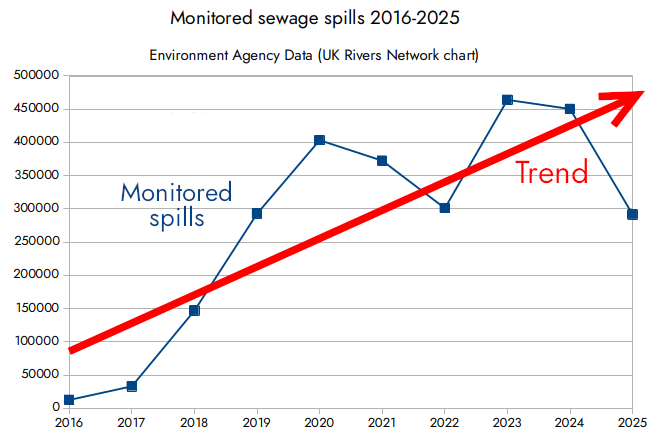
26 March 2026: Sewage released into England’s rivers and seas nearly 300,000 times last year: From The Guardian's Sandra Laville, a very different take on the EA's data: "Raw sewage was discharged into rivers and seas almost 300,000 times last year after the driest spring for more than 100 years and the sunniest and warmest year on record in England."
26 March 2026: The Cornish beach swimming in sewage even on the driest days: From The I, Lucie Heath offers a similar take on the EA's data: "The number of sewage spills in England dropped by 35 per cent in 2025 to the lowest number ever recorded, new official data has shown. The sharp drop in pollution is largely due to the exceptionally dry weather last year, which followed a particularly wet 2024, The worst affected bathing location for dry day spills was Portreath in Cornwall, where sewage was emitted for 661 hours during dry weather. This is despite the fact Portreath has an “excellent” rating for bathing quality."
26 March 2026: [£££]:"Our filthy rivers need a saviour" - The Times, 26 March 1926: The Times carries a timely reminder of how slowly things change by reprinting a letter from Bishop James Welldon, Dean of Durham Cathedral, first published exactly a century ago, highlighting "the ever extending contamination of English rivers", noting that "most of our rivers were being turned into sewers". [Paywalled]
26 March 2026: Campaigner who refused to pay Southern Water bill over sewage discharges ordered to pay by court: An environmental campaigner ordered to pay unpaid Southern Water wastewater bills by a court after a four-year boycott, has said the case "will not stop us continuing to highlight the basic injustice" for water customers. Julie Wassmer has withheld paying for the sewage portion of her water bill since 2021, after the company was handed a record £90 million fine for 6,971 unpermitted sewage discharges.
26 March 2026: Sewage overflows may pose greater threat to England's rivers than previously thought: Combined sewer overflows (CSOs) could be contributing far more pollution to England's rivers than previously recognised, according to new research involving scientists from Imperial College London and Brunel University London. The research provides the first national assessment of the pollution loads released during sewage overflow events, and the risks they pose to England's waterbodies.
26 March 2026: Bristol Pavement art highlights plight of local rivers: Shoegazers around Bristol will be rewarded with views of colourful artworks depicting local aquatic life, but only for the next fortnight. A campaign to improve river health has drawn on the talents of visual artists to beautify its message. Four local artists have created pavement murals depicting Bristol river wildlife to help encourage people to look after neighbourhood waterways, under the banner 'only rain down the drain'.
26 March 2026: Salmon, eels and sturgeon heading towards extinction as migratory fish populations collapse: A new report on migratory freshwater fishes reveals that their population has dropped by more than 80% since 1970. This decline not only puts biodiversity at risk, but the people whose lives depend on them too.
26 March 2026: Bugs Matter 2026: Popular UK Insect Survey crosses the Channel: The UK's popular insect citizen science survey is back – bigger, earlier and bolder than ever. Bugs Matter the bug-splat-counting survey, organised by Buglife and Kent Wildlife Trust, launches on Wednesday 1 April and runs through to Wednesday 30 September. That's a full month earlier than previous years, timed to coincide with Citizen Science Month and to capture precious early-season data, and the survey also extends to France this year.
25 March 2026: Reconnecting Rivers for Wild Fish: Why Removing Barriers Is Essential: Janina Gray of WildFish writes: "River fragmentation in the UK is extensive. Only 1% of rivers are completely free of artificial barriers, and just 3.3% of the river network allows unrestricted movement of aquatic species. Across Great Britain, there are an estimated 0.75 barriers per kilometre of river, creating a heavily disrupted landscape for wildlife.We believe restoring river connectivity – primarily by removing redundant barriers – is one of the most effective and cost-efficient actions we can take to rebuild healthy freshwater ecosystems".
25 March 2026: Community efforts to tackle nature's recovery get triple funding boost: The Wildlife Trusts are encouraging community groups to check out the Green Community Grants Programme. The grants award up to £25,000 to small charities and not-for-profit groups and will now be available at greater scale than ever before with three times the amount of community initiatives to be funded in 2026.
24 March 2026: Fisherman launches High Court challenge against DAERA: From River Action: "Eel fisherman Mr Declan Conlon, whose family has fished Lough Neagh for generations, has brought a judicial review against the Department of Agriculture, Environment and Rural Affairs (DAERA) in Northern Ireland. The case argues that DAERA continues to rely on inadequate plans and unenforced pollution regimes despite clear evidence of ecological collapse over several years. It raises serious questions about how agricultural pollution is addressed by DAERA."
24 March 2026: Pensioners sue Environment Agency for £4.5m over damage to historic royal riverside home: A retired couple are suing the Environment Agency for £4.5m over severe damp issues in their historic riverside home, a Tudor royal residence in Sandwich, Kent, from which King Henry VIII once surveyed his fleet before embarking for France.
24 March 2026: AI-powered smart signs have come to Worthing's bathing waters: Smart signs which answer questions about bathing waters are now at Goring Beach, Worthing and Worthing Beach House. The signs look like simple QR codes to be scanned with a mobile phone. But behind them is an artificial intelligence (AI) ready to share its knowledge with visitors about bathing water quality and any live issues.
24 March 2026: Yorkshire Rivers to Reef campaign aims to cut pollution at source: A four-year campaign has been launched to protect Yorkshire's rivers, estuaries and coastal reefs. Rivers to Reef, launched in Keighley by the Yorkshire Wildlife Trust, is targeted at rivers from their source areas in the hills and moorlands down to the North Sea. The primary focus is on the rivers Aire in West Yorkshire and Derwent in North Yorkshire with the Aire Rivers Trust, the Yorkshire Derwent Catchment Partnership and Yorkshire Water all involved.
24 March 2026: Oxfordshire treatment site is top of the poops: Campaigners from Windrush Against Sewage Pollution (Wasp) found that South Moreton sewage treatment works, near Wallingford, carried out 287 "illegal spills" between 2021 and 2025.
23 March 2026: Labour doesn’t care about protecting countryside, voters say: Britain's nature and countryside is the biggest source of national pride behind the NHS, but only 15 per cent of people think the Government is doing a good job of protecting it, according to research by the National Trust.
23 March 2026: SAS: Return to offender is back!: Surfers Against Sewage have dusted off their popular "Return to offender" campaign, which encourages people to send beach trash packaging back to the companies who make it.
22 March 2026: Up Sewage Creek! River campaigners on the march over the Severn: A protest has been held over the condition of the River Severn, which campaigners say needs protecting. Up Sewage Creek marched through Shrewsbury on Sunday, and called for the water industry to be put back into public ownership. About 100 people gathered on the river bank with banners and placards angry at sewage spills and pollution in the river, which flows through Shropshire and Worcestershire in the West Midlands.
22 March 2026: Eating fish at dirty river is idiotic, says charity: An environmental charity has warned people it would be idiotic to eat fish caught in a "very dirty" part of the River Great Ouse. Recent testing had uncovered "horrendous" levels of pollution in the waterway, according to the Bedfordshire Great Ouse Valley Environmental Trust.
20 March 2026: If rivers had legal rights, sewage scandals would be much harder to ignore: Philippe Cullet, Professor of International and Environmental Law, University of London, explains how river rights might work: "A growing movement of campaigners and researchers say rivers should be granted their own rights, independent of their value to humans. In this framework, rivers are not just resources to be used, but entities with the legal right to flow and to remain unpolluted. Crucially, those rights could be enforced in court by designated human guardians. Advocates of these 'rights of nature' say it could give rivers a powerful new way to challenge pollution."
22 March 2026: London is opening a Thames bathing spot… full of toxic chemicals: Plans for a new designated bathing spot at Ham are set to clash with rival plans to create a new water abstraction and treated sewage discharge plant at the same location, reports Lucie Heath in the I Paper.
19 March 2026: Law: High Court quashes river dredge disposal licence: The High Court has quashed a licence for disposing of material dredged from the River Tees in north-east England, which campaigner Simon Gibbon fears was responsible for seal pup deaths. You can help fund Simon's ongoing (and partly crowd-funded) legal campaign at Crowd Justice.
19 March 2026: Ilkley 'World Water Wedding' ceremony to celebrate River Wharfe: Climate activists and residents from Ilkley Extinction Rebellion (XR) are inviting people to gather with them this week for a 'World Water Wedding'. The Ilkley event will feature a short, family-friendly procession led by the Blue Water Beings, whose flowing blue costumes symbolise water and the life it sustains. The procession will be followed by a reading and a simple offering of flowers to the river. Those attending will be invited to make a personal pledge to look after the Wharfe and to share what they love about the river, while activists speak with the public about the pressures facing local waterways, especially the River Wharfe, including pollution and biodiversity loss.
19 March 2026: Yorkshire Dales Rivers Trust - March 2026 update!: Lots of progress to report from the North, including plans to record non-native species, the Earth Raise fund raiser, YDRT's take on "Dirty Business", celebrating the River Ure, and more....
18 March 2026: Developer-funded ponds boosting newts and rare wildlife: "Developers" and their "mitigation schemes" often raise eyebrows: are they just greenwashing destruction of irreplaceable places? When it comes to ponds, new research suggests not. According to Freshwater Habitats Trust: "A pioneering conservation programme funded entirely by developers appears to be helping Great Crested Newts and other threatened species recover across England. Nine out of 10 compensation sites where new ponds are created or restored through the NatureSpace Licensing Schemes are occupied by Great Crested Newts once ponds become established. Researchers analysed hundreds of ponds created and restored under the NatureSpace schemes. As well as being colonised by Great Crested Newts, 58% of ponds support regionally or nationally threatened wetland plants, while 91% qualify as 'Priority Ponds', a national designation for waterbodies that are important for rare or threatened species".
18 March 2026: Beavers can turn streams into carbon stores: we measured how much: From Joshua Larsen, Associate Professor in Water Science, University of Birmingham: "Across Europe, beaver numbers are increasing after a long period of decline. As these aquatic mammals recolonise rivers, they are gradually rebuilding wetlands that once existed across many river valleys. Our new study shows that a wetland created by beaver damming can store carbon at rates up to ten times higher than an equivalent stretch of river and floodplain without beavers".
17 March 2026: SAS investigation exposes illegal sewage dumping at England's 'cleanest' beaches: Wild swimmers and surfers won't be surprised by a new SAS report on "dry spills", which reveals that water companies discharged sewage illegally for more than 204,000 hours during dry weather in 2025. Even more alarming, 142 bathing waters experienced 8,477 hours of illegal dry spills, and 80% of those locations are classified as "good" or "excellent" bathing waters.
17 March 2026: Law: Surfers Against Sewage vs the government: More from SAS in the shape of a new legal challenge of how flawed "feasibility tests" are used to refuse bathing water designations. SAS say: "We believe [the government] have legally overstepped and are endangering water users across the UK by prioritising profit over our health".
17 March 2026: Pioneering saltmarsh restoration project launches at RSPB reserve: RSPB Stour Estuary on the Suffolk/Essex border, is working closely with the Harwich Haven Authority (HHA) to help restore saltmarsh habitat on the nature reserve. The saltmarsh has succumbed to erosion, meaning this rare and special habitat which normally attracts a multitude of threatened species including Black-tailed Godwits, Redshank and Curlew, is gradually disappearing.
17 March 2026: Bath creates new "linear river park": Bath and North East Somerset Council has completed the first phase of works on the ambitious Bath River Line project, marking a significant milestone in creating a 10km linear park that connects Bath's riverside spaces, improves biodiversity and enhances active travel routes across the city.
17 March 2026: Citizen scientists inspire new national river monitoring tool: Pollution in England’s rivers has become a growing concern in recent years, prompting volunteers across the country to begin testing waterways themselves. In Suffolk, citizen scientists monitoring the River Deben regularly uncover evidence of sewage contamination. East Anglia Bylines takes a look at their work... and its wider implications.
17 March 2026: Clean-river champion John Mildmay-White completes 10-day run!: Congratulations once more to John for finishing his 380 mile (611km) running challenge from the River Erme in Devon to central London to highlight concerns about pollution in his local waterway. The 40‑year‑old landowner was inspired to complete the challenge after the Erme Estuary's popular swimming beach failed official bathing water tests.
17 March 2026: Roe Valley angler expresses fears that local rivers are being 'poisoned': A lifelong angler from County Derry has expressed fears that local rivers are being 'poisoned' by illegal discharges.
17 March 2026: Update on conservation breeding of the freshwater pearl mussel population in the River Irfon: In 2018, a collaborative project commenced between Natural Resources Wales (NRW), the Freshwater Habitats Trust (FHT) and the Freshwater Biological Association to begin conservation breeding of the Afon Irfon freshwater pearl mussel population. The FBA has just published this update on the project.
17 March 2026: Law: River Action: High Court rules on lawfulness of Ofwat's approach to customers not paying twice: From River Action: "The High Court has handed down its decision on the lawfulness of Ofwat's approach to its policy that water company customers should 'not pay twice' for sewer overflow upgrades to achieve environmental compliance and reduce pollution of our waterways. Although River Action's claim was dismissed, the case has resulted in important clarity and should result in a better regulatory approach".
16 March 2026: WWT to create bigger, more connected wetlands in Wales thanks to funding boost: Made possible by funding from the Nature Networks Programme, WWT will carry out extensive wetland habitat creation and restoration works at WWT Llanelli. The wetland charity's only Welsh site, as well as the surrounding Tir Morfa coastline and wider Burry Inlet, will benefit from new and restored wetland habitats that will provide shelter for internationally important wintering birds and bring local people closer to nature.
16 March 2026: Heritage Fund support Wye and Usk Ranunculus surveying: The Heritage Lottery has awarded £174,633 to Friends of the River Wye, working with Save the River Usk, to investigate the decline of Water Crowfoot in the River Wye and the River Usk as a three year development project. Large swathes of the River Wye and River Usk used to be covered in white flowers every summer, yet over the last decade, the water crowfoot which carpeted the rivers has largely disappeared.
16 March 2026: Riverside land to be maintained as a wildlife haven: A council has bought almost eight acres of land so it can be preserved as a riverside haven for nature and wildlife. Mid Suffolk District Council has taken on the land in Stowmarket between Takers Lane and the River Rat adjoining Pikes Meadow and near the A14.
16 March 2026: Is it safe to swim in Windermere?: Save Windermere, leading the charge against pollution of the lake, share stories from two people who have suffered serious illness after entering the water.
16 March 2026: Carrot cake and chalk streams at the Cam Valley Forum: This year's Cam Valley Forum AGM reviewed the group's progress over the last 25 years, celebrated with a vegan carrot cake, and enjoyed an informative lecture from Alison Matthews, Chalk Stream Programme manager at The Rivers Trust. You'll find a link to the slides of her presentation, "Finding a way to protect and restore our Chalk Streams", in the minutes here.
14 March 2026: Law: South West Water pleads guilty to six years of pollutions: South West Water (SWW) has pleaded guilty to a catalogue of pollution-related charges spanning six years across Devon and Cornwall. Of the charges, 17 are for illegal discharge activities including sewage discharges and one is for failing to take reasonable remedial measures following failure at a sewage pumping station. The offences took place between January 2015 and July 2021 in five locations: Bodmin, Harlyn, Playing Place, Polperro and Plymouth. Three of the offences that took place occurred across an August Bank Holiday weekend.
14 March 2026: Norfolk Rivers Trust celebrates the International Day of Action for Rivers: To mark the occasion, NRT is looking back at one of their favourite recent success stories: the wiggle-tastic restoration of the River Stiffkey at Fulmodeston with some majestic new meanders!
13 March 2026: Law: Government grants nature a partial reprieve... but risks to wildlife remain: From The Wildlife Trusts: "Today, the Government has published its 'plan to overhaul nuclear system will speed up building, strengthen national and energy security, and cut costs'. There have been signs for some months that the Government would use the opportunity to deregulate and replace some of the laws that protect nature. The Government has pulled back, for now, from a wholesale legal weakening of the Habitats Regulations which protect nature sites and will not now remove the legal duty that helps National Park and National Landscape authorities to protect landscapes; both would have had devastating consequences for what remains of the natural world."
11 March 2026: Law: WildFish loses at Court of Appeal but wins fight for protection of Great Ouse: The Court of Appeal has just given its judgment in the case of WildFish v Buckinghamshire, Wilson Homes and Anglian Water, standing by the ruling of the High Court overall, but clarifying that the sewage capacity plans for a development in Buckinghamshire must be sorted out before the development goes ahead. The case comes at the end of a year-long struggle.
11 March 2026: "I'm a flooding expert: these are the biggest mistakes people make when buying a property": When it comes to buying a new home, you may be choosing the location based on amenities, safety, structural integrity and financial viability. But how seriously have you thought about the flood risk? Over 3 million homes are at risk of flooding from surface water or blocked drains and overflowing sewers; the I Paper explains how to find out if you're likely to be one of them.
11 March 2026: Grantham RiverCare's David Martin named a Leading Litter Hero!: Keep Britain Tidy has just named David Martin one of the winners of its Spring Clean awards. Grantham RiverCare (co-lead by David Martin and Ian Simmonds) has a vibrant team of over 65 volunteers who have tirelessly prevented countless pollutants from entering their precious local waterways. Keep Britain Tidy say: "Their two decades of dedication, their immediate response to the January floods, and their ongoing commitment to environmental protection and community resilience make them true champions of the River Witham and the entire Grantham community".
14 March 2026: 29th International Day of Action for Rivers on March 14, 2026: From our friends at International Rivers: "The International Day of Action for Rivers is a time to come together in solidarity with rivers and the communities that protect and defend them. By taking action on behalf of rivers, we affirm that we have the power to protect rivers and ensure that communities have access to clean, free-flowing water and the right to participate in decisions directly affecting rivers, and ultimately, their lives. The theme of this year's International Day of Action for Rivers is 'Protect Rivers, Protect People'."
14 March 2026: Webinar (April 7): Restoring Free-Flowing Rivers by Removing Obsolete Barriers: Also from International Rivers: "Across the world, rivers have been fragmented by thousands of dams and barriers built over the past century. Many of these structures are now aging, obsolete, or increasingly risky under changing climate conditions. As their environmental, economic, and safety costs become clearer, a global movement is emerging to restore rivers by removing outdated infrastructure. This webinar brings together a global coalition of experts, practitioners, and advocates working at the forefront of river restoration. From Europe and the United States to Africa and Indigenous territories in North America, speakers will share lessons from dam removal projects, policy reforms, and community-led initiatives that are transforming how societies rethink water infrastructure." Register now if you're interested in watching the live feed.
14 March 2026: Singing to Source on the River Thames!: On Saturday March 14th, Oxford river lovers are celebrating their local waterways with an imaginative cultural event called Singing to Source. "Inspired by our ancestors, who held water as sacred and protected the headwaters of their drinking water both practically and through ritual, they "honour the sources of the rivers of the Thames Headwaters, at the Thames, Churn, Cherwell, Evenlode, Ock, Ray, Windrush, and Boundary Brook" with walks, offerings, and singing.
14 March 2026: Run for the Rivers: John's fundraiser for Wild About The Erme River: Run for the Rivers is John Mildmay-White's 10-day, 600 km charity solo run from the mouth of the River Erme in South Devon to London, following a chain of river catchments all the way to the Thames. At the time of writing, John has raised an amazing £20,779, but that's only just over two thirds of his target. Please chip in a bit more to help the Wild About The Erme River (WATER) campaign if you can.
13 March 2026: Worldview: 'Blackwater' lakes and rivers in the Congo Basin are now emitting ancient carbon into the atmosphere: Carbon that has been buried in the Congo Basin's peatlands for millennia is now seeping into lakes and rivers. Why this is happening remains unclear, but researchers warn that tropical peatlands could be nearing a frightening new tipping point.
13 March 2026: Building ponds for natural flood management on the Ribble: Work has officially begun at Blacksnape in Darwen, where Ribble Rivers Trust has started creating a series of new ponds to help with Natural Flood Management. While reducing flood risk is a key aim, the project will also create valuable new habitats for wildlife, helping to boost biodiversity in the area.
12 March 2026: How 'conservation walkovers' help us protect and restore freshwaters: In freshwater conservation, there's often a lot of planning and work to do before the practical work can get started on the ground. Freshwater Habitats Trust's Sian Vincent shares what 'conservation walkovers' involve and how they have helped identify opportunities for nature recovery in the River Irfon Catchment.
12 March 2026: Lancashire gardeners offered free planters to stop floods: Back in the '90s, power companies gave away millions of lightbulbs to save building new power plants. Could we tackle river problems the same way? In a sign of things to come, United Utilities is offering gardeners in one village free water-retaining planters to slow surface-water drainage and reduce flooding; more widely applied, could schemes like this help to reduce storm sewage overflows?
12 March 2026: Access Isn't About Conflict - It's About Connection: From Paddle Cymru: "If you spend enough time on Welsh rivers, you'll hear the same stories. A paddler who felt unwelcome. An angler whose peaceful moment was disturbed. A swimmer who didn't feel seen. A landowner unsure who has the right to be where. For years, access conversations in Wales have been framed around conflict, who can go where, when, and why. But that framing misses the heart of the matter entirely. Because access isn’t really about permission: it's about respectful shared use".
12 March 2026: Over £900,000 funding secured for ambitious project to restore and protect two Powys rivers: The investment through the Nature Networks Fund, which is being delivered by the Heritage Fund, on behalf of the Welsh Government, will enable Radnorshire Wildlife Trust to protect and enhance two of the county's most important rivers (parts of the River Ithon/Afon Ieithon, a major left-bank tributary of the River Wye near Llandrindod Wells and the River Marteg/Afon Marteg in Rhayader).
12 March 2026: Tribunal to rule whether farmer's data on 'harmful' pesticides can be released to WildFish: WildFish appeared at a tribunal hearing (HSE v ICO and WildFish) on 12 March to fight for access to information on harmful plant protection products (PPPs) used by farmers. PPPs include chemicals such as insecticides, weedkillers and fungicides which wash into rivers and streams when it rains. These chemicals wreak havoc with aquatic invertebrates, the base of the food chain, and impact fish.
12 March 2026: New film: "All Rivers Spill Their Stories to the Sea": When a plague of poisoned crabs washes ashore across the North East coast of England, livelihoods are at risk and fisherman are sounding the alarm. Based on a true story, British filmmaker Jeanie Finlay's documentary, All Rivers Spill Their Stories to the Sea, offers a new slant on water pollution through the eyes of veteran fisherman Stan Rennie.
11 March 2026: Salmon fishing banned from Hampshire's River Test: Salmon fishing on a section of the River Test (a world-class chalk-stream angling spot) has been banned for the first time. A week after the fishing season officially opened, the Test's managers decided to suspend it for the year after evidence was brought forward showing that fish were at "critically low levels".
11 March 2026: Glastonbury celebrates the River Brue... and tackles its pollution: A free community event in Glastonbury this week brought residents together to celebrate the River Brue while raising awareness of the environmental challenges facing local waterways. Living Brue Day featured a programme of talks (by speakers including Paul Powesland), discussions and creative activities focused on protecting rivers and wetlands across the Somerset Levels.
11 March 2026: RSPB: Don't let nature-friendly farming stall: When it comes to fixing our rivers, tackling agricultural pollution is at least as important as fixing sewage, if not more so, but, being "diffuse" rather than "point-source", it's clearly a much tougher nut to crack. Vital to the effort is a growing push to nature-friendly farming.
11 March 2026: Flea-treatments and sheep-dips at damaging levels in Welsh rivers: Pesticides used in pet flea-treatments occur widely in Welsh rivers and were detected in over three quarters of river water samples, according to new research by Cardiff University and Natural Resources Wales.
10 March 2026: Government risks breaking the law over plans to weaken nature protections: This week The Wildlife Trusts wait to hear whether the Government will weaken some of nature's strongest protections, including slashing the habitats regulations and rules affecting national parks. Matt Browne, head of public affairs at The Wildlife Trusts, says: "It will prove catastrophic if Government bows to industry lobbyists and ploughs ahead with the proposals to downgrade nature laws at a time when our natural world is already in crisis. This would shatter the Government's election promise to save nature, and risk breaking trade commitments and international law".
8 March 2026: WCRT "wins" £430,000 from clay-company pollution: Imerys Minerals (formerly English China Clays) has been "fined" £430,000 (technically, agreed to an "enforcement undertaking" as an alternative to prosecution) for a series of pollution episodes across Cornwall over a two-year period. More happily, the "fine" is destined for the West Country Rivers Trust for a series of river improvement projects.
6 March 2026: Pumped-up poo protest over water pollution: A group of 14 large, inflatable poo "emojis" have found their way to the banks of the Rye Dyke in Buckinghamshire this week in a protest against Thames Water's request for leniency over pollution rules. The campaign group, We Own It, said the plan was part of a deal to settle billions of pounds worth of Thames Water's debts, and wants the company to be brought into public ownership instead.
6 March 2026: Archaeological work begins on land for Lower Thames Crossing: A team of 50 archaeologists has been excavating at Coalhouse Fort in East Tilbury in advance of construction of the highly controversial £10 billion road project.
5 March 2026: [£££] Why I want to give Britain’s rivers their wiggle back: Wealth-fund manager and green capitalist Rob Gardner plans to "rewiggle" the River Evenlode in the Cotswolds. He believes pension funds and banks could make money by investing their billions in repairing the country's polluted and degraded waterways. It seems a very odd suggestion at a time when many of us would like to rip up the privatized water system entirely, but... who knows?
5 March 2026: Fish Legal launches Judicial Review to protect River Wye: Fish Legal has launched a Judicial Review after the Environment Agency admitted that their own plan to tackle pollution in the River Wye will not work, yet declined to take decisive action to fix it. The legal challenge targets the River Wye Diffuse Water Pollution Plan, published by the Environment Agency in November 2025. In that plan, regulators accept that existing measures have failed and that even the additional steps now proposed are unlikely to reduce pollution enough to meet legally binding environmental standards.
5 March 2026: National Resources Wales blasted over condition of River Cleddau: National Resources Wales (NRW) has been criticised over shocking levels of pollution in the River Cleddau. At a council meeting on 5 March, Pembrokeshire County Councillors voted unanimously to back the Save the Cleddau petition, signed by over 2,200 individuals, and agreed that concerns about the river should be explored by the council's scrutiny committee.
4 March 2026: SAS: 2026 Plastic Pollution Policy Wins for UK Waters (so far)!: How about some good news for a change? SAS review some of the progress made on plastic pollution this year, including the Welsh Deposit Return Scheme (DRS) and the Scottish ban on plastic wet wipes.
4 March 2026: Nationalisation Means Nationalisation: In a pair of recent blog posts, Philip Greenwood of Waterways Protection articulates his argument that "Nationalisation means nationalisation, not Special Administration": while placing failing water companies into special administration "buys time", it does not amount to "true nationalisation" and, Greenwood argues, it's vitally important not to mix the two things up.
4 March 2026: FoE: 1 in 5 households lack access to green or blue space: The government has just published new data on access to green and blue spaces in England, which reveals that 20% of people do not live within a 15 minute walk of nature. Such areas include parks, nature reserves, lakes, rivers and canals. Responding from Friends of the Earth, nature campaigner Paul de Zylva, said: "Everyone deserves access to natural spaces that are teeming with life, and the many benefits they bring for the health and wellbeing of our communities and the planet".
4 March 2026: SAS: Should we nationalise water companies in the UK?: Louise Reddy, Sewage Pollution Policy Officer for SAS, crisply summarizes the arguments against privately owned water companies in a helpful blog post this week: "Water companies are currently operating as privatised monopolies. Their primary motive is to make profit and therefore, they will never operate primarily for environmental and public good. Water companies cannot be regulated to deliver for the public if their key function is to extract profit. A change in ownership won;t in of itself end sewage pollution, but with water under democratic control, accountable to the people, we – bill payers, water users, coastal and inland communities alike – will have far greater tools at our disposal to guide the priorities of the industry. Water is not and should never be treated as a commodity. It’s a basic human right. Therefore, in the interest of the health of people and planet, it must be owned and managed for the public good".
3 March 2026: University of Stirling and Environment Agency publish new report on phosphorus in English rivers: The Environment Agency and the University of Stirling have published a new report on the links between phosphorus concentrations and ecology in English rivers. Phosphorus remains one of the most significant river pollutants. In recent decades, the overall concentration of phosphorous in English rivers has declined, most likely due to the introduction of phosphorus removal technologies at Sewage Treatment Works (STWs), changes to fertiliser use and adoption of best management practices in agriculture.
3 March 2026: Hampshire councillors wake up to 4x4 River Meon threat: Following a mass protest by 150 locals earlier this year, Hampshire County Council has been urged to step in and restrict vehicle access through a 200-metre stretch of the River Meon in Droxford, where repeated vehicle crossings are damaging the fragile chalk stream.
3 March 2026: New ponds and wetlands will benefit wildlife and people in mid-Wales: Farmers, landowners and communities across mid-Wales are working with Freshwater Habitats Trust to create ponds and wetlands that will bring clean water, richer wildlife and opportunities for people to connect with nature. With its partners, the charity is creating 20 new ponds and three new wetlands across the River Irfon catchment. Due to be completed in March, they will provide high-quality, unpolluted habitat for freshwater plants and animals that are declining across much of the UK.
3 March 2026: Farmer John is on the run to save the Westcountry's rivers: A reminder that farmer and campaigner John Mildmay-White is now firmly on-route in his 372-mile, 10-day solo run from South Devon to Westminster to highlight the dramatic decline of the Westcountry's rivers and to raise money to improve them.
3 March 2026: BART: Why rivers matter: Another thought-provoking piece from Simon Hunter of Bristol Avon Rivers Trust: "We often talk about rivers in terms of water quality and wildlife, but the health of our rivers is fundamentally connected to some of the biggest societal challenges we face".
3 March 2026: Connecting Limbs: "We built a hotel for fish!" How architects are 'designing for life' on Sheffield's hidden rivers: As part of the Connecting Limbs project, which aims to revive an 800-metre stretch of the River Sheaf using techniques that mimic those found in nature, Architecture Masters students at Sheffield Hallam University have been asked to come up with designs to boost biodiversity in the river and along its banks.
3 March 2026: Theatre group tells tales of the River Avon: Birmingham-based Stan's Cafe theatre group is appealing for stories about the River Avon through Warwickshire for the latest in a series of performances about great rivers of the world: "It might be swimming in the river, falling in it, boating on it, or you've spotted an otter on it. How has it changed, or stayed the same. Any little memory or stories we'd love to hear".
3 March 2026: Shrewsbury campaigners defeat their bypass: The misleadingly named Shrewsbury North West Relief Road was finally cancelled this week - and, with it, an ugly 670-m concrete viaduct across the River Severn floodplain, a dodgy roundabout threatening to pollute a key drinking-water borehole, and assorted other environmental impacts.
2 March 2026: Former River Tweed bosses credited with keeping salmon numbers healthy: Jamie Stewart, clerk to the Tweed Commission, has paid tribute to the people who filled his waders in previous decades. He said: "We need to give great credit to those who came before us for opening up the waterways by removing barriers and taking us from being a Tweed mill industry to a Tweed fishing industry."
1 March 2026: WWF-UK and others secure plans from the government to tackle pollution of key rivers in England: WWF-UK, Angling Trust and Fish Legal have received 32 plans from the government to tackle diffuse pollution of some of England's best-loved rivers, following a lengthy legal battle launched by the three groups way back in 2015. Here, Jake White and Katrina Walter, WWF's lawyers, explain what they've achieved... and how.
1 March 2026: An(other) interview with Chris Hines: Fresh on the back of Channel 4's Dirty Business drama, The Spaceship Earth podcast has reissued an hour-long interview with SAS founder Chris Hines, recorded a few years ago, in which he discusses how the group formed in 1990 to tackle sewage pollution in Porthtowan... and beyond.
1 March 2026: Forever chemicals are in our tap water - but there is a £15 solution: The I looks at water filters and other simple ways of tackling PFAS chemicals in your drinking water.
1 March 2026: Wales welcomes beavers... at last!: The Wildlife Trusts in Wales and Beaver Trust warmly welcome new Welsh Government legislation recognising the Eurasian beaver (Castor fiber) as a native species and granting it protected status – a major milestone for restoring the species to the Welsh landscape. This move aligns legislation in Wales with protection legislation elsewhere in Britain and reflects strong public and conservation support for the return of beavers and their ecological benefits.
1 March 2026: An interview with Chris Hines, MBE ("Moaning Bloody Environmentalist"): Channel 4's Dirty Business has been attracting great and very welcome attention on the sewage scandal this week, but it's worth remembering that we've been here... 35 years ago! Back in 1990, Chris Hines and friends founded Surfers Against Sewage, combining direct action with savvy legal campaigns that forced a major rethink about water pollution. One high point was a 1996 Judicial Review by legendary eco lawyer Charlie Hopkins, on behalf of campaigning mums Rachel Shelley and Sara Delaney, over pollution at Porthtowan in Cornwall, which established that local authorities had a duty to crack down on errant water companies. Somehow the lessons learned back then were forgotten. Three decades on, we need to ensure that today's momentum for change really does deliver lasting, permanent improvements.
1 March 2026: An interview with Chris Hines, MBE ("Moaning Bloody Environmentalist"): Channel 4's Dirty Business has been attracting great and very welcome attention on the sewage scandal this week, but it's worth remembering that we've been here... 35 years ago! Back in 1990, Chris Hines and friends founded Surfers Against Sewage, combining direct action with savvy legal campaigns that forced a major rethink about water pollution. One high point was a 1996 Judicial Review by legendary eco lawyer Charlie Hopkins, on behalf of campaigning mums Rachel Shelley and Sara Delaney, over pollution at Porthtowan in Cornwall, which established that local authorities had a duty to crack down on errant water companies. Somehow the lessons learned back then were forgotten. Three decades on, we need to ensure that today's momentum for change really does deliver lasting, permanent improvements.
February 2026
28 February 2026: Dirty water, death and decline: the inside story of a privatisation scandal: Sandra Laville explores the dirty dealings behind Channel 4's Dirty Business in a Guardian Big Read.
28 February 2026: Keep Britain Tidy: Spring clean your river!: The Great British Spring Clean and Great Big School Clean are back for 2026 and will take place from 13 to 29 March 2026. This high-profile national event offers a great opportunity for local river groups to draw in more supporters.
28 February 2026: All Hands on the River Don conservation and restoration scheme: From the Don Catchment, news of the Sprotbrough Ings and Great Ings projects.
27 February 2026: Worldview: The river won: how campaigners in Brazilian Amazon stopped privatisation of waterway: In The Guardian, Jonathan Watts reports on an inspiring direct action campaign against one of the world's biggest commodity trading companies.
26 February 2026: Lincolnshire beaver 'engineers' set to work creating new wetlands: A family of beavers has been released into a Lincolnshire river to live in what officials claim is England's largest beaver enclosure. The four animals are expected to help return the West Glen River near Grantham to a more natural course after centuries of being straightened and deepened to drain farmland.
26 February 2026: Isle of Wight river restoration reaps rewards: A technique that encourages rivers to re-shape themselves has transformed a precious Isle of Wight chalk stream. Stage Zero Restoration (SZR) is an approach popular in the USA and gaining traction in the UK in which rivers are reconnected with their floodplains.
26 February 2026: Water companies flushing antibiotic-resistant bacteria into UK rivers: From the Angling Times: "A pilot study of the rivers in a major UK city has found high concentrations of harmful bacteria that pose a huge risk to anglers and the wider public. The study, led by Dr Rob Morley of Index Microbiology and supported by Windrush Against Sewage Pollution (WASP), the Angling Trust and HoT Water, investigated the presence of ESBL-producing bacteria in the rivers of Oxford."
26 February 2026: Public urged to keep out of River Itchen to protect salmon: Conservation experts have issued a warning to avoid entering the River Itchen until May, one of only six chalk streams in England that still supports wild Atlantic salmon.
26 February 2026: Positive ocean news: February '26 edition: The Marine Conservation Society presents a roundup of good news from the oceans, including the High Seas Treaty and the Scottish ban on plastic in wet wipes.
26 February 2026: "Clean Water Now" campaign sets out actions needed to restore our freshwater environment: Dozens of green NGOs represented by Wildlife and Countryside Link have just launched a campaign for Clean Water Now. The campaign is focused on improving the upcoming Water Bill, with three priorities: fixing the system, stopping the polluters, and restoring freshwater wildlife.
25 February 2026: 2.4 million people at highest risk of flooding, Friends of the Earth finds: One million homes (home to 2.4 million people across England) are at the highest risk of flooding from rivers, seas and surface water, new analysis by Friends of the Earth reveals.
25 February 2026: Number of homes at high risk of flooding set to treble in next 50 years: Greenpeace: As flood warnings and alerts remain in place across large swathes of Great Britain, Greenpeace warns that over 866,000 homes – equivalent to the total of those in Birmingham, Liverpool and Sheffield – could be at "high" or "very high" risk from increased levels of severe flooding fuelled by climate change by the year 2080.
25 February 2026: Channel 4: Dirty Business - watch it here!: The new Channel 4 series about the sewage-pollution crisis is available on-demand here: "In an idyllic Oxfordshire hamlet, the fish in the river keep dying. Why? David Thewlis and Jason Watkins lead this shocking real-life drama of victims, whistleblowers and England's water companies".
25 February 2026: Dirty Business should cause fury over the sewage crisis: The I reviews the background to "Dirty Business", the new Channel 4 dramatization about the excellent work of Ash Smith and Peter Hammond at Windrush Against Sewage Pollution (WASP) in the Cotswolds.
25 February 2026: BBC Countryfile Visits the River Tweed: The BBC Countryfile team visited the River Tweed last month on the eve of the 2026 salmon fishing season, capturing the atmosphere, heritage and science that underpin one of the United Kingdom's most renowned salmon rivers. The programme goes out on Sunday 1 March.
25 February 2026: Extreme weather is transforming the world's rivers. We need new ways to protect them: In The Conversation, Professor Jonathan Tonkin and colleagues write: "Around the world, rivers are no longer changing gradually. Rather, they are being increasingly transformed by extreme climatic events such as floods, droughts and heatwaves. Our newly published global review finds these events are pushing ecosystems beyond their limits and eroding biodiversity and core functions. In bringing together global evidence, our research sets out a roadmap for how science and management can respond to these mounting ecological pressures".
25 February 2026: Lucy Burden's "Flow / Llif" opens at Chepstow Museum: A major new exhibition celebrating the ever-changing rhythms and beauty of the River Wye has opened at Chepstow Museum. "Flow / Llif: The River Wye from Source to Sea" is the latest body of work by Welsh artist Lucy Burden..
25 February 2026: Herts chalk river restoration is complete after two years: A £1.72m chalk river restoration project has been completed after two years of work which is set to enhance local wildlife. Herts and Middlesex Wildlife Trust was awarded money from the government's Species Survival Fund early in 2024 for its Chalk Rivers project.
25 February 2026: Pippa Heylings MP calls for chalk streams to become UNESCO Natural World Heritage Site: The Liberal Democrat Spokesperson on Energy Security and Net Zero called for greater river protection in parliament this week. Here's the full text of her speech.
24 February 2026: Rising to the occasion: how nature can fight flooding: RSPB explores why flooding is becoming more frequent and how nature can help to prevent and minimise its impact.
24 February 2026: UNEP seeks young people with big ideas to protect the planet: The UN Environment Programme (UNEP) today launched a call for nominations for the 2026 cycle of the Young Champions of the Earth award, which honours outstanding young people driving innovative solutions to protect the planet.
24 February 2026: WildFish: Veterinary medicines: an overlooked source of aquatic pollution in the UK: Although this is far from a new story, it's a welcome reminder: veterinary medicines (from pet flea and tick treatments to livestock parasiticides) are becoming a significant and under-recognised threat to our rivers.
23 February 2026: Yorkshire Water fined £733k after polluting country park stream: Brazen and unapologetic Yorkshire Water was sentenced this week for polluting Pools Brook Country Park stream three times in less than a year.
23 February 2026: MPs and Clean Water Sports Alliance Call For Faster Action on Water Pollution: A number of MPs have called for further and faster action on pollution following a Parliamentary event organised by the Clean Water Sports Alliance (CWSA).The drop-in session brought together Parliamentarians and representatives of the CWSA (including Paddle UK, Swim England, British Rowing, RYA, and British Triathlon) to discuss the Water Reform White Paper.
20 February 2026: Send in the Drones: how Digital Imaging Technology Supports River Restoration: Drones certainly aren't getting a good press at the moment, but here's a more positive application, described by Yorkshire Dales Rivers Trust: "We use drone surveys to support a wide range of river and catchment restoration work, including Natural Flood Management (NFM), fish passage barrier removal, and the remediation of pollution from historic metal mining. Drone technology saves time and money, improves accuracy, and enables more effective long-term monitoring. It also helps us communicate project outcomes to partners, funders, stakeholders and the public. In some cases modelling software allows us to virtually test different restoration scenarios before any work takes place".
17 February 2026: River Action: Natural Resources Wales Must Prevent Pollution – Not Pass the Buck as the Wye and Severn Decline: Emma Dearnaley, River Action's Head of Legal, explains why the group has launched a judicial review challenging Natural Resources Wales (NRW)'s decision to approve permit variations allowing three intensive poultry units in Powys to expand.
17 February 2026: Save our Swale's Review of 2025: An inspiring and uplifting review of SoS volunteers and their river-efforts over the last year!
20 February 2026: Restoration work in the River Usk will help rare and protected fish: Work is now complete to improve access for migratory salmon at Brecon weir on the River Usk. A new fish pass was installed last year as part of the Natural Resources Wales's (NRW) Four Rivers for LIFE Project.
20 February 2026: Can 'natural' defences stop homes being flooded?: A closer look at several natural flood protection schemes recently installed with help from the Ribble Rivers Trust in Lancashire.
20 February 2026: Coming soon: the Spongeworks Project!: If you're over in Wicklow, be sure to check out the launch of the exciting new Spongeworks Project on 26 February, which focuses on nature-based solutions for climate resilience, and how we can better prepare for and respond to extreme weather events.
20 February 2026: Love Your Pet, Not Pesticides: New Report Warns of Flea and Tick Treatment Threat to Rivers: From Buglife: "Pesticides banned for outdoor agricultural use are regularly used as pet tick and flea treatments. The two most commonly used pesticides, imidacloprid and fipronil, are known to cause significant harm to aquatic invertebrates and are found in waterways across the UK. A recent Welsh river survey linked high concentrations of the chemicals to over a 90% decline in invertebrates. One survey found 100% of wash-off samples from treated dogs contained both chemicals".
19 February 2026: Could studying river sewage improve global health?: The fact that antibiotic-resistant bacteria has recently been found in the river system comes as no surprise. However, little is known still of just how high the level of risk this poses to public health - in particular to people who use our waterways for recreational purposes - which is of concern to anti-pollution campaigners in the UK.
19 February 2026: Connecting Limbs: In the race to restore Sheffield's hidden rivers, can natural and industrial heritage coexist?: A closer look at the Connecting Limbs project to restore and revive Sheffield's hidden rivers, with help from the Environment Agency and Sheaf and Porter Rivers Trust.
19 February 2026: "Profitable negligence": Oxford plant pumps sewage into River Thames for 335 hours: The Oxford Mail probes pump and dumping in the Thames with help from Ash Smith, a campaigner from Windrush Against Sewage Pollution.
19 February 2026: Country diary: Kneeling by the river, hoping the water is clean: Mary Montague goes riverfly surveying with conservation officers from Belfast Hills Partnership (BHP), an environmental charity, in a wooded glen below Wolf Hill, close to the former mill village of Ligoniel.
18 February 2026: British crops still sprayed with pesticides banned by EU due to cancer, fertility and fetal health warnings: British crops, including strawberries, onions, potatoes, barley, and wheat, are being sprayed with pesticides banned across the European Union due to serious human and environmental health risks. Analysis by Unearthed, Greenpeace's investigative journalism unit, revealed that out of 14 chemicals banned by the EU since Brexit but still allowed in the UK, 10 were found to pose serious hazards to human health, wildlife or the environment.
18 February 2026: Natural flood defence plan to protect the River Erme: Thousands of trees are being planted to improve water quality in the River Erme, Devon, which gained official bathing water status in 2024 but is currently unsafe for swimming.
18 February 2026: Freshwater scientists urge action to defend Europe's water protections: Europe’s environmental safeguards are currently facing unprecedented pressure. Under the banner of "simplification" and "cutting red tape", key laws designed to protect clean water, biodiversity, and public health risk being weakened. The scientific and freshwater community has an important voice in this moment. You can support efforts to defend Europe’s nature laws by signing and sharing the Hands Off Nature petition. Within its first week, the petition gathered more than 130,000 signatures, demonstrating strong public support for maintaining robust environmental protections. Continued engagement from scientists and freshwater professionals is essential to ensure that policy decisions remain grounded in scientific evidence and the urgent need to protect freshwater ecosystems.
18 February 2026: Science: How threatened rivers change over time: Colby Assistant Professor of Earth Sciences Evan Dethier is studying how rivers change over space and time, particularly in response to environmental and anthropogenic disturbances, using a combination of satellite imagery and computer modeling.
18 February 2026: Runners trace polluted Welsh river in bid to raise awareness: A team of runners have completed a 50-kilometre journey along a Welsh river to highlight the environmental challenges the river and the wildlife using it are facing. The runners documented their journey via a short film they released on YouTube.
18 February 2026: Run for the Rivers, a WATER fundraiser like no other, March 2026: A reminder that John Mildmay-White is on a mission to raise awareness of pollution in our rivers and to raise funds to support the work of Wild About The Erme River (WATER), in restoring water quality and habitat across the Erme catchment. His 400 mile Ultramarathon will start at the mouth of the Erme, then follow the river up onto Dartmoor before heading to Princetown. His route then turns north east to Taunton and on to join the upper reaches of the River Exe before arriving at Exmoor’s North Devon coast. Here he heads due east to Bristol and on to the Cotswolds where he will join the River Thames and follow it down to London, arriving on International Day of Action for Rivers on March 14th.
18 February 2026: Agencies warn of unsettled weather expected until at least mid-March: Homeowners and businesses across the south west of England are being urged to remain vigilant as the Environment Agency and Met Office today (Wednesday 18 February) warn that wet weather is set to continue for another month. High tides and strong winds may also bring tidal flood risk in some places during this period. The start of 2026 has been exceptionally wet – with a strong and unusually southernly jet stream bringing frequent rain, strong winds and wintry hazards. The south west of England has been particularly battered, experiencing 216 millimetres of rainfall so far – 184% of the long-term average for this time of the year.
17 February 2026: River Action launches legal challenge, accusing NRW of "washing its hands" of intensive poultry pollution: From River Action: "We have launched a judicial review challenging Natural Resources Wales (NRW) approval of three expanded poultry farms in Powys, accusing the regulator of 'washing its hands' of manure pollution by taking an unlawfully narrow view of its powers. The case focuses on whether NRW is properly using its role as environmental regulator to prevent pollution from intensive farming or whether responsibility is being passed to others while Welsh river catchments such as the Wye and the Severn continue to deteriorate."
16 February 2026: Riverfly surveys continue to make progress: Impressive results in the latest report from the Riverfly Partnership. 2025 saw no fewer than 10,443 approved surveys, including 632 from BART and 631 from ARK, the top two surveying groups this year.
16 February 2026: Why does the Beane turn brown after heavy rain?: A question people often ask of their local rivers, neatly and concisely answered by the River Beane Restoration Association.
15 February 2026: Rivers and other green issues set to be major election issue: From filthy rivers to the threat of flooding, Wales is facing "mounting environmental crises on multiple fronts", campaigners have warned in advanced of the forthcoming election campaign. Friends of the Earth Cymru said a "stark gap" was developing between the public's desire for action on pollution and what politicians were proposing.
15 February 2026: Sewage spills in London and South East worse than ever this year: Almost 80,000 hours of sewage spills have been recorded by Thames Water this year as Britain's sewerage network is overwhelmed by the ongoing wet weather, according to a report from Lucie Heath in The I.
13 February 2026: Swimming spots that could become designated dips: Lots of coverage on the 13 proposed new inland bathing waters. It's wonderful to see the community-driven enthusiasm here, something the UK Rivers Network first called for when we were formed back in the late 1990s.
13 February 2026: River Thames spot among 13 sites shortlisted for swimming status: An alternative take on the story from Sandra Laville at The Guardian explores some of the tricky conflicts that will need to be resolved before new bathing waters can be designated.
13 February 2026: Grassroots River Avon documentary announces online premiere: A multi-award winning documentary about a female-led grassroots campaign to clean up Bristol's waterways will be made available to stream online for the first time. Rave on for the Avon captured the joy, frustration and creativity at the heart of the Conham Bathing group's determined efforts to make their local river safe for swimming.
13 February 2026: Transforming the River Ribble for people and wildlife: Supporting communities to appreciate their river environments was at the heart of the Ribble Life Together project. Industrial pollution, agricultural impacts and the changing climate had put stress on habitats and endangered wildlife in the river's catchment. To tackle these problems, community groups joined forces with environmental organisations, businesses and local authorities.
12 February 2026: Salmon numbers in some premier angling rivers 'exceptionally low': The Loughs Agency says the Atlantic salmon needs "urgent" conservation measures. New rules to protect Atlantic salmon are to be introduced on four of Northern Ireland's premier angling rivers after fish numbers dropped to "exceptionally low levels".
12 February 2026: New Japanese Study Reveals Floods Are the Biggest Drivers of Plastic Pollution in Rivers: Many previous studies have examined microplastic and mesoplastic (MMP) concentrations in river water during normal, low-flow conditions. However, they have largely overlooked what happens during floods.
12 February 2026: Worldview: China's draconian Yangtze fishing ban seems to be working: Decades of overfishing and habitat degradation led to huge declines in freshwater biodiversity in China's longest river, but there are signs of recovery after a fishing ban was implemented in 2021.
12 February 2026: 'Encounters with the Calder': a photographic exploration: A new exhibition, "Encounters with the Calder", is a personal exploration of the impact and influence of human activity along West Yorkshire's River Calder, by local photographer and riverfly monitor Jim Souper.
12 February 2026: Winterbournes: The Disappearing Rivers Returning This Season: Alex Mackay explores and explains the wonderful phenomena of the chalk-catchment winterbournes for Wessex Rivers Trust.
12 February 2026: More than 26.8 million UK adults (nearly half) admit to littering: Research released ahead of Keep Britain Tidy's Great British Spring Clean reveals nation's shocking littering habits that hard-working volunteers are battling to deal with.
12 February 2026: The Radley Lakes Story: Celebrating 20 Years of Environmental Success: A reminder from the Radley Lakes Trust: "Celebrate 20 years since the Save Radley Lakes campaign began with The Radley Lakes Story. This beautifully illustrated 152-page book tells the remarkable tale of how local residents united to protect the Radley Lakes area, transforming it into a thriving hub for wildlife and a tranquil retreat for the community".
11 February 2026: Environment Agency (finally) steps up enforcement workforce: Yet another misleading press release from the Environment Agency tells us: "The regulator has increased its water enforcement workforce almost fivefold – from 41 roles in 2023 to 195 by March 2026, with a further increase planned later in 2026. Water company environmental performance has continued to decline in recent years, and this has driven the need for stronger, more visible enforcement action". Or was it that the lack of enforcement action caused the decline, perhaps...?
11 February 2026: Gloucester exhibition celebrates Britain's longest river, the Severn: The River Severn is in the spotlight at the National Waterways Museum in Gloucester until 14 April, with a photography exhibition, model boat trail and activities focussing on the waterway.
11 February 2026: Webinar: River Restoration with Pete King: Find out how river restoration projects are delivered and what a good river looks like through "Wet Wednesday Webinar: River Restoration - The Practicalities of Delivering Successful Projects" with Peter King, Director Ouse and Adur Rivers Trust. So just how do you restore a river? What does a good river even look like? What's all this about re-wiggling? This talk guides us through the processes involved in delivering river restoration. From the use of data and evidence, through developing ideas to completion of works we will look at the successes, the lessons learnt and the hurdles to overcome across a variety of projects from small scale to large engineering approaches.
11 February 2026: Severn Rivers Trust: Invitation to Tender: Wetland Creation at Worthen Hall, Shropshire: Severn Rivers Trust is inviting suitably qualified contractors to submit tenders for the construction and delivery of a Natural Flood Management scheme at Worthen Hall Farm, Shrewsbury, Shropshire SY5 9HN.
11 February 2026: More beavering away on Cornish rivers: Beavers have been released into the wild in Cornwall in a bid to help nature recover. Two pairs of beavers have now been let out at a Cornwall Wildlife Trust (CWT) nature reserve at Helman Tor within the Par and Fowey river catchment area.
11 February 2026: What's it really like to work in science at the RSPB?: To mark International Day of Women and Girls in Science, RSPB spotlights six of its female Conservation Scientists.
11 February 2026: WildFish spotlights stale river data: More on that story we first brought you last week: "WildFish has released a startling new report compiled from files obtained by freedom of information requests to the Environment Agency (EA), which reveals that more than half of the invertebrate river health assessments by the EA have been relying on outdated data. Our analysis of the Agency's data for its river monitoring during 2019 shows 52% of invertebrate assessments in England were recycled from past data and not newly assessed. While 3,645 water bodies were 'assessed' in that year, only 1,781 had new monitoring while the rest were assessed using only 'rolled over' data from the previous cycle."
11 February 2026: WildFish: SmartRivers 2025 Progress Report shows impact of citizen science!: WildFish has released its 2025 SmartRivers Progress Report, showcasing the impact of the 6,000 volunteer training hours delivered since the project's inception. The findings underscore the vital role of citizen science in reversing the decline of our rivers and wild fish populations.
10 February 2026: The EU is working on a blanket ban of 'forever chemicals'. Why isn't Britain?: In The Guardian, Pippa Neill wonders why Britain is lagging on the issue of river-contaminating PFAS (per- and poly-fluoroalkyl substances, commonly known as "forever chemicals" due to their persistence in the environment).
10 February 2026: The EDF makes distorted claims about Hinkley C fish deterrent: Matt Browne, head of public affairs at The Wildlife Trusts, says: "The developers of Hinkley C continue to misrepresent the impact that the nuclear plant will have on nature. Today's press release claims that a number of plant safety measures are fish protection measures. This is highly misleading and allows EDF to pretend that £700 million is being spent to protect nature, when the real figure is closer to £50m. It also misrepresents the number of fish affected by the proposed plant - they spotlight the suggestion that just two salmon will be killed per year when Environment Agency experts warn that 4.6 million fish will die every year – including critically endangered species such as European eel."
3 February 2026: Afonydd Cymru welcomes "beacon of hope" green paper on Welsh rivers: According to the association of Welsh river trusts: "The Green Paper describes Welsh Government's thinking on change to the sector. After years of deterioration of the quality of rivers, inertia and lack of effective action from those responsible for their protection, it is just possible that these proposals provide a beacon of hope".
1 February 2026: The hidden history flowing through British river names: Professor Christian Dunn, WWT Trustee and Associate Pro Vice-Chancellor at Bangor University, explores the history of river names: "Stand on the bank of any British river and you are standing beside a story that is thousands of years old. Not just a physical story of water shaping land, but a cultural one - of people naming, using, fearing and revering flowing water long before there was a map of the UK; or even a concept of Britain itself."
1 February 2026: River Wye Citizen Scientists surpass 50,000 samples!: Citizen scientists in the catchment of the River Wye have now taken over 50,000 water samples in an extraordinary show of people-power to monitor the health of an ailing river. Over 500 volunteers have contributed to this effort since 2020 to test the water quality of the River Wye and its surrounding rivers and streams. This community effort monitors far more locations, more regularly, than the government agencies, providing a more granular view of the health of the Wye catchment.
1 February 2026: Reintroducing Species back to the River Don: A blog post from Sally Hyslop of the Don Catchment Rivers Trust explains how they reintroduced two species back to the River Don, True Fox Sedge and the Wild Tulip.
6 February 2026: WildFish calls out stale data: WildFish has spotted the Environment Agency's (EA) upcoming 2025 river health classifications using long out-of-date biodiversity research dating back to 2016. Sam Green, senior freshwater ecologist at WildFish, said: "We can only take action to save Britain's rivers when we know what's going on under the surface, and so a lack of up-to-date science and a reliance on rollover data from previous years is deeply concerning."
6 February 2026: Big Paddle Cleanup 2026: Invite your MP: PaddleUK is starting preparations for this year Big Paddle Cleanup, scheduled for 23 May to 7 June, where canoeists and other water users help to clean their local patch. This year, they're suggesting paddlers invite MPs along to keep up the political pressure for cleaner, safer recreational waters.
6 February 2026: Measuring the Difference: How We Monitor Natural Flood Management Projects: Charlotte Ireland Pope from the Ribble Rivers Trust talks us through some methods of measuring the effectiveness of natural flood defences.
6 February 2026: Kent waters are 10 times dirtier than the Seine: One of Kent's historic waterways has 10 times more bacteria than the River Seine in Paris when Olympic events were postponed because of pollution, according to Chris Foster of maritime heritage community company Raybel Charters. Here's an update on his brilliant campaign to put things right.
5 February 2026: Environmental and nature-friendly farming groups warn Government risk missing river clean-up targets without action on agricultural pollution: Leading environmental and nature-friendly farming organisations, including River Action, Nature-Friendly Farming Network, The Rivers Trusts, Surfers Against Sewage, Wildlife and Countryside Link, WWF-UK, Wildfarmed, RSPB and the Soil Association, have written to the Secretary of State for Environment, Food and Rural Affairs calling for urgent government action to tackle agricultural water pollution. The letter follows the launch by River Action in December 2025 of a dedicated Agricultural Water Pollution Strategy, warning that current efforts to clean up rivers risk falling short by focusing too narrowly on sewage while neglecting a major source of pollution.
5 February 2026: Anger over Scottish salmon farm inspections amid 35m unexpected fish deaths: The Guardian reports a shocking disconnect between government claims of "a really robust regulatory regime" and the tens of millions of fish deaths officially recorded in Scottish salmon farms over the last three years.
5 February 2026: Yorkshire Dales Rivers Trust: Rivers4Life Photography Competition: From the YDRT: "From macro images of microscopic life to marvellous mammals, from waterfalls to water voles – we're launching a competition to find the best photographs of our Yorkshire Dales rivers and wildlife, to be included in our Rivers 4 Life exhibition, which will be mounted at the Dales Countryside Museum in 2026. Photos will also feature in our 2027 calendar".
5 February 2026: Worldview: The beautiful river that becomes a dump every year: Environmental activist Dejan Furtula, from Bosnia's Eko Centar environmental group, voices frustration about debris building up in the Drina River.
5 February 2026: Marine Conservation Society Policy Roundup: February 2026: What's happening in Whitehall? The latest MCS roundup covers the High Seas Treaty, Water Reform, PFAS... and much more.
4 February 2026: Millions more for canals: The Canal and River Trust (CRT) has secured a £6.5 million funding boost from the government to help secure its 200-year-old, 2000-mile waterway network.
4 February 2026: Kurt Fausch: A Reverence for Rivers: FBA has a great interview this month with river conservationist Dr Kurt Fausch, author of the recent book "A Reverence for Rivers: Imagining an Ethic for Running Waters" (2025. Oregon State University Press): "My hope is that once people become inspired to clamour for real rivers, then the hard-won science that has been developed can be brought to bear on the problems. Yet, without that public advocacy, science can be easily ignored. Both are critical for having real rivers."
4 February 2026: Anti-nature rhetoric turns off voters, new poll finds: A new poll published today reveals that Labour's anti-nature rhetoric is damaging the confidence of voters across both the right and left. According to a poll carried out by Savanta, nearly a third of Reform voters (28%) and Green voters (28%) are less likely to vote for Labour at the next election, as a result of the Prime Minister's recent speech which described environmental regulations as "well-intentioned but fundamentally misguided".
3 February 2026: Just how do you tackle a blocked river?: Natural Resources Wales (NRW) explain how they deal with trees, natural blockages, and debris in rivers: "These features can influence flood risk, but they can also have ecological benefits. So, when does NRW intervene; when do we expect others to act; and when might nature be allowed to take its course?"
3 February 2026: Chalk-stream 4x4 boy racers cause consternation: BBC News reports the strange tale of an ancient byway in Hampshire, where it's perfectly legal to thrash your SUV up and down the River Meon.
3 February 2026: CPRE: Three-quarters want more protection for UK countryside, new poll reveals: A new poll by More in Common, for countryside charity CPRE, reveals that 86% of Britons support Green Belt and three-quarters of young people want more of the UK countryside protected, though most don't trust leaders to deliver on this.
3 February 2026: 'Last-ditch' effort by volunteers to save River Leven footpath: Up in Yorkshire, volunteers have been making a last-ditch attempt to halt rapid erosion before a footpath collapses. The Tees Rivers Trust was contacted by North Yorkshire Council at the end of 2025 about halting damage being caused by the River Leven in Little Ayton.
3 February 2026: "Cleaner rivers, stronger regulation, better accountability": Wales charts new course for water governance: The Welsh Government has published a Green Paper setting out once-in-a-generation proposals for fundamental reform of the water system in Wales, which it claims "will mean cleaner rivers, stronger regulation and better accountability". Shaping the Future of Water Governance in Wales responds to the findings of the Independent Water Commission, established jointly by the Welsh Government and UK Government and published in July 2025.
2 February 2026: Worldview: These Four States Are in Denial Over a Looming Water Crisis: Meanwhile, across the Atlantic, The New York Times has an interesting opinion piece on how "seven Western states that rely on the Colorado River are fighting over how to keep [their] reservoirs from crashing -- an event that could spur water shortages from Denver to Las Vegas to Los Angeles" for tens of millions of people.
2 February 2026: The toxic chemicals in your clothes and frying pans polluting rivers and seas: Lucie Heath, The I's intrepid river-champion, looks at PFAS "forever chemicals" and new plans for testing their prevalence in rivers and coastal waters.
2 February 2026: How Dorset river restorations are tackling sudden floods: A closer look at how the Wild Woodbury project in Bere Regis is slowing and spreading rainwater to ease flooding and create new wildlife habitats.
2 February 2026: Science: How can a river flow uphill?: Scientists have long sought an answer to the question of how the Green River, the largest tributary of the Colorado River, managed to create a 700‑metre‑deep canyon through Utah’s 4km-high Uinta Mountains instead of simply flowing around them. Now, researchers from universities in the UK and the USA have gathered persuasive evidence that a phenomenon called "lithospheric dripping", which causes mountains to subside and rebound over millions of years, is likely to be the cause of the Green River's unusual route.
1 February 2026: River Mole River Watch catches sewage overflows in the act!: Citizen scientists from River Mole River Watch in Surrey found nearly 800 cumulative hours of sewage was pumped into the river in just five days, from 20-24 January, pushing levels of E-coli bacteria over 10 times the legally safe limit.
January 2026
30 January 2026: Worrying trends for the UK's protected freshwater species and habitats: The Habitats Regulations have been the bedrock of nature protection for over three decades. But in all four nations of the UK, according to the Freshwater Habitats Trust, "Most species and habitats which should be protected by the Habitats Regulations are in fact in peril. Many are reliant on clean freshwater – which across the UK is an increasingly scarce resource... In England, the upcoming Water Reform Bill is a huge opportunity to join up water management with the restoration of protected freshwater habitats and species. To make the best of this opportunity, the Bill must focus on outcomes for nature, not just technocratic changes to water industry governance and regulation."
30 January 2026: Petition to save Pembrokeshire's River Cleddau exceeds 2,200 signatures: A petition call for a public commitment to save Pembrokeshire's River Cleddau which has attracted more than 2,200 signatures, and is due to be heard by full council, ends this weekend. The e-petition on Pembrokeshire County Councils own website, started by James Harrison-Allen, says: "We call on Pembrokeshire County Council to create and enact a Clean Rivers Policy to restore the Cleddau to good health after decades of neglect and degradation."
29 January 2026: The "Make a Nuisance" Campaign: Using the Law to Speak Up for Our Rivers: Chloe Peck, Senior Engagement Coordinator at River Action, explains how campaigners can use legal tactics to stand up for threatened rivers.
29 January 2026: Thames21 unveils community-led data tool to help build picture of river health: Environmental charity Thames21 has launched a new online dashboard that – for the first time – brings together key datasets on river health gathered by citizen scientists across London and the Thames Basin. Thames21’s 'Citizen Science Dashboard' currently holds more than 6,000 water quality samples and 2,000 riverfly surveys, making it, as the charity describes, one of the most complete citizen science tools in the UK. By centralising this information, stakeholders can easily access vital data and have a clear understanding of river health. The launch of the dashboard platforms the work of a growing citizen science movement, empowering communities to monitor and protect their local rivers. This puts people at the centre of taking action for the UK’s waterways, helping identify and tackle pollution from sewage, road run-off, and agriculture.
29 January 2026: Wales: Collapsing wildlife and polluted rivers now a life or death issue: A major review of the state of the Welsh environment has warned of "polluted rivers, failing soils" and "collapsing wildlife". Parts of the country also have some of the worst air quality in Britain - causing up to 1,400 premature deaths a year - according to Natural Resources Wales (NRW).
29 January 2026: "I waded through a river of raw sewage to meet the man trying to save London's waterways": Lottie Elton of the Big Issue meets and chats with London river champion Paul Powlesland.
28 January 2026: Controversial Oxford bridge inches toward construction: Work on a controversial Oxpens River Bridge was first granted planning permission in 2024, and would provide a walking and cycling route between Oxpens Meadow to Grandpont Nature Park. There have been a number of delays to building the bridge, including a judicial review brought by campaigners which was dismissed in March last year.
28 January 2026: Protecting one of Europe's last wild rivers: a volunteering trip to the Vjosa in Albania: Oliver Balch explores a tree-planting project designed to protect the Vjosa's fragile ecosystem.
28 January 2026: Building a clearer picture of pollution in the River Wandle: what sediment sampling tells us: What can you tell from sediment? South East Rivers Trust explains their new, proactive approach -- a "wider step-change in how the River Wandle is monitored. Working alongside volunteer citizen scientists and partners at King’s College London, we are developing a catchment-wide monitoring network that will be publicly accessible. Over time, this will allow us to track how the river responds to different pressures, spot emerging risks earlier, and continually refine where and how restoration and protection work is delivered".
28 January 2026: River Thames heat pump will power the South Bank: A new £72.7million communal heat network could provide low-carbon heating for the National Theatre and other London landmarks near Waterloo and the South Bank in central London. Under the plans, a water source heat pump will take heat from the River Thames and transport it through a network of underground pipes around the area, giving buildings the chance to switch to low-carbon heating without affecting their external appearance.
26 January 2026: A landmark victory for our oceans: the Global Ocean Treaty comes to life: According to Greenpeace's Ariana Densham: "The Global Ocean Treaty has the power to change everything. For the first time, governments have a legal framework to create High Seas sanctuaries – vast protected areas outside of any country’s national waters, where fragile ecosystems can recover and thrive. If fully implemented, the Treaty could establish the largest network of ocean sanctuaries in history, covering over a third of our global oceans".
26 January 2026: Defra claims farming rules shake-up will "cut pollution and support farmers": More government support for farmers will "help to improve water quality, reduce pollution in our rivers and give farmers the confidence to grow food sustainably", a new announcement from Defra has claimed.
26 January 2026: House of Commons debate on protecting and restoring river habitats: Background debates and notes from a recent commons debate on rivers are well worth browsing.
26 January 2026: Flagship for Change: Restoring the River Beane together: A look at how the River Beane Restoration Association is working with its partners to make the Beane "an exemplar for chalk stream restoration, ecological health and as a community asset" as part of the wider, national Chalk Stream Restoration Strategy.
26 January 2026: Somerset Levels pumps installed after 'wettest week in 12 years': Life grows ever-more difficult in Somerset. Speaking to The Guardian, Mike Stanton, the chair of the Somerset Rivers Authority, commented: "At the moment it feels like a losing battle. Intense rainfall is hitting us more often because of climate change. It may be that in the next 50 years, perhaps in the next 20, some homes around here will have to be abandoned".
25 January 2026: Britain is building nine new reservoirs - but doesn't know how to fill them: It's full(ish)-steam ahead for nine new reservoirs, including the controversial Abingdon project, but some believe "demand management" (an emphasis on using less water, more wisely) must come first.
25 January 2026: Parliamentary event saw rare cross-party consensus of concern about the future of nature protections: According to The Wildlife Trusts, A parliamentary event last night saw a rare cross-party consensus of concern as nature experts, MPs and peers spoke out about the potential environmental impact of Nuclear Regulatory Review's recommendations - some expressing 'horror' at the flawed evidence in the review.
24 January 2026: New report looks at sewage pollution in Cumbria's River Kent: The Clean River Kent Campaign (CRKC), in collaboration with the University of Sheffield, has published a new study looking at the nature of faecal pollution in the river, focused on samples taken above and below two wastewater treatment works (WwTW) at Staveley and Kendal.
24 January 2026: WASP tears down "New Vision for Water": Windrush Against Sewage Pollution offers an alternative take on the government's new Water White Paper, where it's really coming from, and why it fails to address the key issue: water is for nature and people, not an investment vehicle for private profit.
22 January 2026: Harmful investments outpace nature protection by 30 to 1 - UNEP: For every (US) dollar the world invests in protecting nature, it spends 30 dollars destroying it. This stark imbalance is the central finding of a new UN Environment Programme (UNEP) report released today. It calls for a major shift in global financing of Nature-based Solutions (NbS) and phasing out harmful investments to deliver high returns, reduce risk exposure, and enhance resilience.
16 January 2026: Environment Agency "minded" to support dodgy Dairy Crest creamery expansion: The Environment Agency has said it is "minded to issue the new permit" to Saputo Dairy UK (aka Dairy Crest) for Davidstow Creamery, in Cornwall, despite multiple air and water pollution breaches of its existing permit. Martin Harmer, chairman of Launceston Anglers' Association, based on the River Inny and River Tamar, has said: "As far as are we are concerned, Dairy Crest is not fit to run this industrial site at current levels of production, let alone at increased capacity".
11 January 2026: River Thames receives spiritual blessing London's River Thames has received a blessing by the Bishop of Southwark, in a ceremony which saw a cross thrown into its murky and fabled waters.
1 January 2026: Pollution from Construction Sites is Smothering Our Streams to Death: Communities are Calling for Urgent Action BART (Bristol Avon Rivers Trust) looks at the ever-increasing problem of sediment pollution in South Gloucestershire and beyond.
1 January 2026: Martin Salter: Droughts, Floods and Fine Fishes For those who missed it, here's Martin's pre-Christmas review of an action-packed 2025 for the Angling Trust blog.
20 January 2026: Government unveils biggest overhaul to water in a generation: Here's the official press release in which the Government unveils its proposed Water Reform White Paper promising "once-in-a-generation reforms for our water system -- tough oversight, real accountability, and no more excuses." But responses from environmental NGOs (a few of them listed below) have been notably lukewarm.
20 January 2026: Surfers Against Sewage: Government Vision for Water Announced: "Despite presenting the Government with the opportunity of a generation, with the public backing to make significant reforms to the water sector – their plan has fallen rather flat... The 50 page plan is a vague skirting of the issue, making broad brush statements which lock us into the same old profit driven pollution machine."
20 January 2026: Marine Conservation Society: The UK Government's new vision for water: "The UK Government has published its Water White Paper, which sets out their proposals for future legislation for the water industry and wider water system in England. But dive a little deeper, and too many of these commitments have been made before, falling short of the bold action that is desperately needed to protect our seas."
20 January 2026: Paddle UK: Response to the Water Reform White Paper: "The new Water Reform White Paper ‘A New Vision for Water', sets out powers to provide 'tougher' oversight and 'stronger' accountability for water firms, but we believe it is a missed opportunity to strengthen protections for recreational users... while the Independent Water Commission report recognised the importance of public health, the government's White Paper today seems to give very little detail about what action it intends to take..."
20 January 2026: River Action: The Government's Water White Paper: The Good, the Bad and the Ugly: "The White Paper still treats the profit-driven model as the default and focuses on constraining its worst excesses... We need a government that is bold in ambition and willing to implement reforms fast enough to deliver the measurable improvements needed to fulfil its election promise to clean up our rivers, lakes and seas."
20 January 2026: The Rivers Trust: Welcome signals, worrying gaps, and vital work still to do: "There are positive aspirations in this paper, but it is short on detail, has some significant omissions and presents an apparent lack of urgency that risks undermining the transformation our water environment so desperately needs now... The risk is that reform stalls behind vague commitments and slow timetables. The opportunity is that, because so much detail is still missing, there remains space to influence the design of a system that can genuinely deliver cleaner, more resilient rivers. That opportunity must be seized now. We need these reforms to succeed, but to succeed the government must be prepared to go further – much further."
20 January 2026: Freshwater Habitats Trust: A critical moment for freshwater: our response to the Water White Paper: "Ignoring small waters has left a blind spot at the heart of water policy. Today’s commitment by Government to optimise monitoring to 'improve our ability to assess the condition of the whole water environment' could mend this gap in our understanding of freshwaters. This could create a much-needed driver for the management of small waters, unlocking their potential to power freshwater biodiversity recovery."
20 January 2026: The I: Water firms will be forced to pass 'MOTs' to stop sewage spills and supply cuts: Water companies will be forced to undergo "MOTs" to proactively prevent sewage spills and water shortages under a new beefed up regulator, reports Lucie Health in The I.
18 January 2026: The I: Water bosses face being fined from their own pockets for leaks and sewage spills: Environment Secretary Emma Reynolds claims water bosses will "have nowhere to hide" under the new water-monitoring regime that "will make senior leaders more accountable for their actions".
22 January 2026: What happens when the taps run dry? England is about to find out: Aditya Chakrabortty, writing in The Guardian, looks at the water-short future scheduled to arrive sooner than we might think.
22 January 2026: More than eight miles of the River Dulais is unlocked for fish: Natural Resources Wales's (NRW) Four Rivers for LIFE project has completed an additional fish pass on the Llanwrda Dulais, an important salmon and trout spawning tributary of the River Tywi. This is the third fish pass improvement scheme to be installed on this stretch of river, meaning more than eight miles will now be accessible for migratory fish.
22 January 2026: On a wild, misty river I learned I have the strength for almost anything: Stephanie Wood describes how a later-life white-water rafting trip in Tasmania changed her outlook on life.
20 January 2026: Millions in water company fines to power local-led restoration: The government claims it's reinvesting £29 million from water company fines into local projects which clean up our environment, funding over 100 projects which will improve 450km of rivers, restore 650 acres of natural habitats and plant 100,000 new trees.
20 January 2026: Worldview: This Is Why Our Rivers Are Turning Into Sewers: It's not just Britain wrestling with polluted rivers, of course. In an article from this week's New York Times Michael Grunwald considers how industrial farming is wrecking some of America's most beloved waterways.
20 January 2026: Wales welcomes long-awaited Seabird Conservation Strategy: Following a seven-year long campaign, the Seabird Conservation Strategy for Wales, published by the Welsh Government this week, could be a critical lifeline for Wales' seabirds.
19 January 2026: Thames river health is looking up!: Decades of dedication have contributed to the River Thames enjoying a new lease of life, a report from London Zoological Society (ZSL) has found. In the 1950s, the Thames was declared "biologically dead" due to industries disposing of chemicals, heavy metals, oils and dyes into the water. Since then, continued action and policy have seen the return of beloved species such as harbour porpoises and wading birds.
18 January 2026: A buzz of hope: will you help the River Tweed's amazing pollinators?: In the face of growing threats to wildlife along the River Tweed from habitat loss, fragmentation, climate change and chemicals, Buglife is calling on people to do their bit by creating pollinator-friendly habitats and adding these to the local B-Lines network. Every piece of land can help, no matter the size--from balcony herb garden or sprawling meadows.
15 January 2026: Successful community event held by River Sid Group: The River Sid Catchment Group (RSCG) held a successful community consultation event last week, when more than 60 people packed into Kennaway House for New Year's Riverlutions, a presentation about the River Sid Catchment Plan This plan aims to improve the Sid for nature, including access for migrating fish such as Atlantic salmon, sea trout, and European eels.
10 January 2026: Corby "Toxic Town" parents find metal pollution in water: Families involved in the toxic waste scandal in Corby have used "citizen science" techniques to test waterways in the town and found the presence of metals "that could pose a risk to aquatic life".
9 January 2026: Alarming news from the warming oceans: The world's oceans absorbed more heat in 2025 than in any year since modern records began, according to a major international analysis published in Advances in Atmospheric Sciences.
9 January 2026: Afonydd Cymru: Manifesto For Welsh Rivers: The Welsh river trusts offer some pointers for politicians in advance of the 2026 Senedd election.
9 January 2026: Canal and River Trust launches appeal to fix Langollen breach: A fundraising appeal has been launched to pay for repairs to a canal which suffered a serious breach just before Christmas. The Canal and River Trust charity said it would cost millions of pounds to fix the damage to the Llangollen Canal and the work could take a large part of the year.
16 January 2026: Public confidence in the state of Britain's rivers has hit a historic low: UK Water Partnership.: Trust in the management of our water environment is at a historic low, according to a new report from the UK Water Partnership written by Adrian Rees from ARC, Jim Marshall from AECOM and Lauren McMillan from Northumbria University.
16 January 2026: Butt Boxes: How a simple solution changed behaviours: Keep Britain Tidy argue that their portable ashtray "isn't just reducing litter - it's helping change attitudes and norms, encouraging a wide range of people who smoke to think 'don’t litter', even beyond cigarette butts".
16 January 2026: The return of greywater!: Architects and designers have recycled ancient practice of collecting rainwater to make buildings ecologically friendly, according to a report from The Guardian in China.
15 January 2026: River Action has a new legal eagle: Christian Fuller, the new legal coordinator at River Action, introduces himself and explains the work he'll be doing for the group.
15 January 2026: How River Severn floodplain could become a wildlife haven: A stretch of the River Severn could be restored as a wildlife haven over the next 20 years. The Eelscapes project would allow endangered European eels and other vulnerable wildlife to thrive again in the Severn Vale in Gloucestershire.
15 January 2026: Bewick's swan, Galina, spotted in the UK for the first time after 20 years!: The arrival of a 20-year-old Bewick’s swan at WWT Slimbridge shows how protected wetlands across Europe are helping migratory birds adapt to climate change.
15 January 2026: Counting swans this weekend: Volunteer birders across the UK and Ireland will be among those taking part in the six-yearly international swan census this weekend, counting numbers of the countries' two wintering species, whooper and Bewick's swans.
15 January 2026: Worldview: Why we fail to save our rivers: Tuhin Wadud, the Director of Riverine People and a Professor in the Department of Bengali at Begum Rokeya University, Rangpur, looks at the difficulties in getting people to appreciate and value rivers, with lessons from Bangladesh.
15 January 2026: Thousands of fish released to revive River Nene: A long-term fish conservation project combining restocking with habitat improvement is under way along the River Nene in Peterborough.
15 January 2026: 'I’m both humbled and heartened' - National rivers guardian from Ludlow recognised by King with OBE: Jonathan White, who grew up near Ludlow and now divides his time between Shropshire and Buckinghamshire, was named in the 2026 New Year's Honours List, receiving an OBE for his services to river conservation, most recently, through the Severn Rivers Trust and The Rivers Trust.
15 January 2026: Abingdon Reservoir consultation extended after online glitch: People who want to share fuller views on a proposed reservoir have been given more time to comment after a technical glitch. Thames Water's South East Strategic Reservoir Option, near Abingdon in Oxfordshire, would be filled in the winter with water from the River Thames and supply 15 million people.
14 January 2026: Worldview: The Vast Majority of US Rivers Lack Any Protections from Human Activities, New Research Finds: The U.S. boasts more than 4 million miles of rivers, peppered with laws and regulations to protect access to drinking water and essential habitat for fish and wildlife. But in the first comprehensive review of river protection, research co-led by the University of Washington shows that the existing regulations account for less than 20% of total river length and vary widely by region.
13 January 2026: 'England's canals are not valued by government': England's canals are not valued enough by the government and need more funding support, the chair of a waterways trust says. Michael Limbrey has spoken out after the collapse of the Llangollen canal in Shropshire that left narrowboat owners stranded, just before Christmas.
13 January 2026: Countryfile reignites the debate on access to inland waters: Paddle UK's Head of Access and Environment, Ben Seal, made the case for more blue space access on the BBC's Countryfile programme. Along with Paddle UK, representatives from the Blue Tits swimmers, the Outdoor Swimming Society, The Angling Trust and the Countryside Landowners Association gave their views.
10 January 2026: The race to stop England running out of water, from timed showers to bill hikes: Ofwat is launching an educational campaign to nudge us into wiser use of water... but why has it taken them so long?
10 January 2026: Worldview: 18 of Earth's biggest river deltas - including the Nile and Amazon - are sinking faster than global sea levels are rising: In a new study published today in Nature, scientists report that land subsidence caused by humans - through the extraction of groundwater - is the main culprit. It also quantified the relative contributions of specific human drivers: groundwater extraction, sediment starvation and urbanization across these deltas, allowing the researchers to identify the dominant cause of the sinking.
7 January 2026: Failure of Thames Water inevitable, says MP: During a Westminster debate into the future of Thames Water on Tuesday, Layla Moran, Liberal Democrat MP for Oxford West and Abingdon, called the failure of the company "inevitable" and questioned its ability to lead a project to build the proposed Abingdon super reservoir.
1 January 2026: River cleaner 'could have cried' over rubbish: A BBC story from August last year that somehow slipped past the radar: 'A volunteer says he "could have cried" after finding a wheelie bin full of rubbish, along with other waste, dumped in a waterway. Mr Elliot, who is known locally as the Canoe River Cleaner, said he hoped people would learn to "respect" waterways and recognise their beauty.'
1 January 2026: Celebrating 25 years of the Water Framework Directive: For a quarter of a century, the Water Framework Directive (WFD) has been the cornerstone of EU water management. It protects rivers, lakes, groundwater, coastal waters and establishes the principle that clean water is a shared public good. To celebrate this milestone, Friedrich Barth, former team leader for the European Commission, takes us back to the day it was adopted.
1 January 2026: How global seafood trade is moving 'forever chemicals' from contaminated waters to dinner plates: A new study finds consumption patterns and trade matter as much as where fish are caught.
10 January 2026: Chip in for the new Kennet boardwalk?: ARK, the Rivers Trust for the Kennet and Pang catchment, is fundraising for a new boardwalk at at Stonebridge Wild River Reserve, Marlborough: "The boardwalk is a valued community asset, well-loved and well used by local residents of all ages and visitors to the town. It provides a beautiful walk throughout the seasons along the banks of the Kennet (a rare chalk stream). A chance to experience nature first hand, with every chance of seeing species such as kingfisher, water vole and brown trout."
10 January 2026: Paddle UK makes the case for better access on Countryfile: Paddle UK's Head of Access and Environment is set to appear on the BBC's Countryfile programme (11 January) to make the case for more blue space access. Ben Seal was interviewed by presenter and journalist Tom Heap while paddling on the Cromford Canal, Derbyshire, in December.
10 January 2026: Mole scientists dig into the data: River Mole River Watch offers a great example of what you can do with citizen science data on water quality in their new blog post: "December 2025 Water Quality: Floods, Sewage, and Emerging Patterns in the Mole".
9 January 2026: Binning medicine could do 'untold harm' to river: A conservation group has warned that the ways people get rid of medication and household chemicals could be doing "untold harm" to a river in York. Flushing or binning medicine, garden pesticides and cleaning products was causing the waterway to become polluted, the River Foss Society said.
9 January 2026: Himalayan balsam's damaging impact on rivers revealed in new study: University of Stirling led research has revealed the diverse and damaging impact Himalayan balsam has on river ecosystems. A three-year study led by Dr James Hardwick, a Lecturer in Earth Sciences at the University’s Faculty of Natural Sciences, has shown that the invasive species is doing more than just replacing native plants.
9 January 2026: Environment Agency releases fresh fish into Wiltshire rivers: Thousands of fresh fish have been released into rivers to boost fish populations and support the wider environment. The Environment Agency (EA) carried out the seasonal restocking across Somerset, Dorset and Wiltshire, releasing 6,750 coarse fish.
9 January 2026: Science: New River Chemistry Insights May Boost Coastal Ocean Modeling: Rivers deliver freshwater, nutrients, and carbon to Earth’s oceans, influencing the chemistry of coastal seawater worldwide. Notably, a river's alkalinity and the levels of dissolved inorganic carbon it brings to the sea help to shape regional conditions for marine life, including shellfish and corals. These factors also affect the ability of coastal seawater to absorb carbon dioxide from Earth's atmosphere--which can have major implications for climate change.
9 January 2026: River 'restoration' project announced after £500k City Hall grant: Enfield Council says the money will be used to return a 3.4km stretch of Salmons Brook "to a more natural state".
9 January 2026: Science: Safeguarding, strengthening and expanding river protections for nature and people: River protection in the United States remains scant, with just over one-tenth of river length in the contiguous states protected at viable levels, often by land-based protection measures that fail to capture the full diversity of the nation’s river systems. There is an urgent need for policies that safeguard, strengthen and expand freshwater protections to secure rivers that sustain both people and nature. A new review published in Nature Sustainability this week offers a way forward.
8 January 2026: Tough new legal duties on water companies to cut pollution: According to the Department for Environment, Food and Rural Affairs: "Water companies must now publish annual pollution-cutting plans under tough new powers introduced by the government. Pollution Incident Reduction Plans (PIRPs) were previously voluntary, with only some water companies electing to produce and deliver them. Through powers in the Water (Special Measures) Act, they will now be mandatory and must be made public, creating unprecedented transparency and accountability in the sector".
8 January 2026: Why Leicestershire is flooding more often - and what could be done: A thoughtful exploration from BBC News of why flooding is more of an issue, including input from The Trent Rivers Trust, which argues for better catchment management, including slowing the flow of water upstream through ditches, bogs and soft ground.
8 January 2026: Microplastics are making it harder for oceans to absorb greenhouse gases, study warns: Researchers say tackling plastic pollution is now part of fight against global warming.
7 January 2026: A hopeful future for nature and farming: Every January, two parallel conferences transform Oxford into the beating heart of the farming debate. The Oxford Farming Conference (OFC), 7-9 January, draws politicians, business leaders, agricultural companies and farmer entrepreneurs, while the Oxford Real Farming Conference (ORFC), 8-9 January, typically attracts growers, activists, and researchers, championing community action and pioneering green ideas.
7 January 2026: Everyday ocean heroes: The power of community action: Ciara Taylor from the Marine Conservation Soceity explains the power of the grassroots!
4 January 2026: 'Storm-battered' canals need more volunteers: More volunteers are needed to protect the canal network which has been "battered" by storms and floods, a charity has said. The Canal and River Trust has about 750 volunteers across the Yorkshire and North East region – but said it wanted more people to come forward in the new year.
3 January 2026: Explosion' of water vole numbers across the East: Until recently, the River Colne in Essex had struggled with water vole numbers because of mink, an invasive non-native species introduced to the UK in the 1960s. But a programme to boost numbers by partners including Essex Wildlife Trust (EWT) and Waterlife Recovery Trust has seen an "absolute explosion of wildlife and particularly the water voles", said the EWT's Darren Tansley.
3 January 2026: Construction Site Pollution: The Silent Threat Smothering Our Rivers: Simon Hunter, CEO of Bristol Avon Rivers Trust, writes that: "Pollution from construction sites might not make the headlines like oil spills or chemical disasters, but make no mistake: it’s a silent killer of river health. Every time heavy rainfall washes sediment, concrete washout, fuels, lubricants, and other contaminants off poorly managed sites and into watercourses, our rivers suffer."
1 January 2026: A Huge Win for the River Chess: Slightly old news from The Chiltern Society, from November, that slipped past our radar: "After two years of campaigning with our partners, we've just been told by the Environment Agency they have officially revoked Affinity Water's licence to abstract groundwater at Chesham Pumping Station. Abstracting water from the top of a chalk stream has the biggest impact on river flow, often leaving vital stretches dry. Ending this abstraction means more water can stay in the river where it belongs, which helps restore natural flow, protects wildlife, and brings the Chess back to life. Many thanks to everyone who has helped us to fight for this outcome – from local campaigners and the River Chess Association to the Chilterns Chalk Stream Project and other partners across the Chilterns. This is a huge milestone in the journey to protect and revive our chalk streams."
1 January 2026: Lower Itchen restoration - a proposal for Southampton city: Who cares about the Lower Itchen and her potential to be something other than a boat navigation strip or industrial waste dump? Southampton National Park City do: "Together with Friends of the Itchen Estuary supported by the Maritime Volunteer Service, we set about mapping the riverbank to spot opportunities for interventions that would encourage biodiversity."
1 January 2026: Dibden Bay: Parish council voices 'critical gaps' concerns: The worrying resurgence of ABP's Didben Bay port expansion plan has prompted concerns from a local parish council.
2 January 2026: More rain needed to restore water levels in East Anglia: Anglian Water has said further measures to conserve water may be required in 2026 if drier conditions return over winter.
2 January 2026: Plenty of cause for hope’ as nature has 'bumper year' on Wildlife Trust reserves: The Wildlife Trusts are hailing 2025 as a 'bumper year' for new arrivals and discoveries across their nature reserves, following multiple reports of species making a comeback despite their rarity nationwide.
1 January 2026: How to reduce ocean plastic pollution in 2026: Ocean plastic pollution is a major concern for the planet and its wildlife. Make 2026, the year you help reduce plastic pollution on our UK shores.
1 January 2026: What if floods left your home unsellable? That's the reality facing more and more people in Britain: Kirsty Major explores the growing problem of flooding's long-lasting impacts for The Guardian.
1 January 2026: Pembrokeshire petition demands action to clean River Cleddau: A petition calling for a public commitment to save Pembrokeshire’s River Cleddau says: "We call on Pembrokeshire County Council to create and enact a Clean Rivers Policy to restore the Cleddau to good health after decades of neglect and degradation".
1 January 2026: Tracing the Truth: A Community's Decade-Long Fight Over Bio-Bead Pollution: On Dorset’s stunning Jurassic Coast, fossil hunters flock to Charmouth in search of ancient treasures. But alongside the relics of prehistory, plastic pollution washing ashore, are millions of tiny plastic bio-beads. For nearly a decade, the local community has fought tirelessly to uncover the truth behind this pollution and hold those responsible to account.
1 January 2026: Cheshire Wildlife Trust plans major restoration for River Birket: Cheshire Wildlife Trust is excited to announce that plans to restore a 24ha area of floodplain grazing marsh on the Wirral peninsula will be delivered in 2026. Nature Recovery Programme Manager, Hannah Phillips says: "Historically the site was a functioning wetland, previously known as Hoylake Carrs and the proposed restoration will follow historic lines still visible in the ground where the river once flowed called paleochannels. The project will aim to turn back time while giving a new lease of life to this important and declining habitat. Holding water on site year-round will make it a haven for waterfowl and wading birds".